

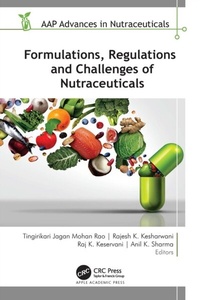
Formulations, Regulations, and Challenges of Nutraceuticals
1st Edition
Published on 23. August 2024
356 pages
978-1-000-91088-9 (ISBN)
Description

Formulations, Regulations, and Challenges of Nutraceuticals focuses on various novel micro- and nanocarriers being employed in the formulation and delivery of nutraceutical ingredients to increase their efficacy, bioavailability, safety, and stability. It also highlights the current challenges and future strategies for the development of novel nutraceuticals and functional foods with enhanced health benefits. The focus is on the formulations and regulations.
As compared to traditional drugs, there are no minimal regulations on nutraceutical products, which make them more market friendly. Since nutraceutical ingredients have no defined regulations at global level, they are not considered as medicine or therapeutic agents. Some countries have devised their own guidelines for regulating the usage of nutraceuticals, either as pharmaceutical ingredients or as food supplements. This volume addresses the need for common regulatory guidelines with important research on the production of stable and efficient nutraceutical formulations. The numerous regulatory frameworks being employed in Asia and European regulatory agencies in commercialization of nutraceutical products produced by manufacturing companies are discussed.
Chapters examine the factors affecting the stability of nutraceuticals in food and gut environments by stressing the results generated from in vitro and in vivo studies and suggests good manufacturing practices to be followed for the development of nutraceuticals.
Formulations, Regulations, and Challenges of Nutraceuticals will be valuable for upper-level students, faculty, nutraceutical researchers and practitioners, regulatory agencies, and those involved in the production and development of nutraceutical products.
As compared to traditional drugs, there are no minimal regulations on nutraceutical products, which make them more market friendly. Since nutraceutical ingredients have no defined regulations at global level, they are not considered as medicine or therapeutic agents. Some countries have devised their own guidelines for regulating the usage of nutraceuticals, either as pharmaceutical ingredients or as food supplements. This volume addresses the need for common regulatory guidelines with important research on the production of stable and efficient nutraceutical formulations. The numerous regulatory frameworks being employed in Asia and European regulatory agencies in commercialization of nutraceutical products produced by manufacturing companies are discussed.
Chapters examine the factors affecting the stability of nutraceuticals in food and gut environments by stressing the results generated from in vitro and in vivo studies and suggests good manufacturing practices to be followed for the development of nutraceuticals.
Formulations, Regulations, and Challenges of Nutraceuticals will be valuable for upper-level students, faculty, nutraceutical researchers and practitioners, regulatory agencies, and those involved in the production and development of nutraceutical products.
More details
Series
Edition
1. Auflage
Language
English
Place of publication
London
United Kingdom
Publishing group
Taylor & Francis Ltd
Target group
College/higher education
Professional and scholarly
Illustrations
23 Tables, black and white; 12 Line drawings, color; 19 Line drawings, black and white; 12 Illustrations, color; 19 Illustrations, black and white
ISBN-13
978-1-000-91088-9 (9781000910889)
Copyright in bibliographic data and cover images is held by Nielsen Book Services Limited or by the publishers or by their respective licensors: all rights reserved.
Schweitzer Classification
Other editions
Additional editions
Tingirikari Jagan Mohan Rao | Rajesh K. Kesharwani | Raj K. Keservani
Formulations, Regulations, and Challenges of Nutraceuticals
Book
08/2024
1st Edition
Apple Academic Press Inc.
€231.10
Shipment within 3-4 weeks
Persons
Tingirikari Jagan Mohan Rao, PhD, is an Assistant Professor in the Department of Biotechnology, National Institute of Technology, Andhra Pradesh, India. He has extensive research experience in synthesis and production of poly- and oligosaccharides. His significant contribution to scientific research is reflected from his publications (17 papers and six books, which have been cited more than 250 times; h-index of 10).
Rajesh K. Kesharwani, PhD, MTech, is Associate Professor of Computer Application at Nehru Gram Bharati (Deemed to be University), Prayagraj, India. He has more than 10 years of research and eight years of teaching experience at various institutes of India, imparting bioinformatics and biotechnology education. He has supervised PhD, postgraduate, and undergraduate students and has authored over 40 peer-reviewed articles, 20 book chapters, and 11 edited books with international publishers.
Raj K. Keservani, MPharm, is Associate Professor of Pharmacy at the CSM Group of Institutions, Prayagraj, India. He has more than 12 years of academic experience in pharmaceutical education and has supervised more that 25 undergraduate students for their research work. He has published over 30 peer-reviewed papers in the field of pharmaceutical sciences in national and international journals, over 70 book chapters, three co-authored books, and over 40 edited books. He is also active as a reviewer for several international scientific journals.
Anil K. Sharma, PhD, MPharm, is an expert in the area of pharmaceutics with a background in drug delivery. He has taught these subjects for nearly 13 years at universities such as the Delhi Institute of Pharmaceutical Sciences and Research, University of Delhi, and School of Medical and Allied Sciences, G D Goenka University, India. Prior to taking up his current role in 2022, Dr. Sharma served in academic positions such as Lecturer (Pharmaceutics), Delhi Institute of Pharmaceutical Sciences and Research, University of Delhi, India. He has published over 28 peer-reviewed papers in the field of pharmaceutical sciences in both national and international journals as well many book chapters and several edited books. He holds a PhD (Pharmaceutical Sciences) from the University of Delhi; MPharmacy (Pharmaceutics) from the Rajiv Gandhi Proudyogiki Vishwavidyalaya; and BPharmacy from the University of Rajasthan.
Rajesh K. Kesharwani, PhD, MTech, is Associate Professor of Computer Application at Nehru Gram Bharati (Deemed to be University), Prayagraj, India. He has more than 10 years of research and eight years of teaching experience at various institutes of India, imparting bioinformatics and biotechnology education. He has supervised PhD, postgraduate, and undergraduate students and has authored over 40 peer-reviewed articles, 20 book chapters, and 11 edited books with international publishers.
Raj K. Keservani, MPharm, is Associate Professor of Pharmacy at the CSM Group of Institutions, Prayagraj, India. He has more than 12 years of academic experience in pharmaceutical education and has supervised more that 25 undergraduate students for their research work. He has published over 30 peer-reviewed papers in the field of pharmaceutical sciences in national and international journals, over 70 book chapters, three co-authored books, and over 40 edited books. He is also active as a reviewer for several international scientific journals.
Anil K. Sharma, PhD, MPharm, is an expert in the area of pharmaceutics with a background in drug delivery. He has taught these subjects for nearly 13 years at universities such as the Delhi Institute of Pharmaceutical Sciences and Research, University of Delhi, and School of Medical and Allied Sciences, G D Goenka University, India. Prior to taking up his current role in 2022, Dr. Sharma served in academic positions such as Lecturer (Pharmaceutics), Delhi Institute of Pharmaceutical Sciences and Research, University of Delhi, India. He has published over 28 peer-reviewed papers in the field of pharmaceutical sciences in both national and international journals as well many book chapters and several edited books. He holds a PhD (Pharmaceutical Sciences) from the University of Delhi; MPharmacy (Pharmaceutics) from the Rajiv Gandhi Proudyogiki Vishwavidyalaya; and BPharmacy from the University of Rajasthan.
Content
1. Overview on Formulation, Challenges, and Regulation for the Development of Nutraceuticals 2. Formulation and Challenges Involved in Developing Plant/Phytochemical-Based Nutraceuticals 3. Recent Developments in the Formulation of Nutraceuticals 4. Future Trends in the Formulation of Nutraceuticals 5. Major Factors Contributing to the Regulations of Nutraceuticals 6. Nutraceutical Regulation in Asian Countries 7. Nutraceutical Regulation in European Countries 8. Regulatory Guidelines for the Development of Plant/Phytochemical-Based Nutraceuticals 9. In Vitro and In Vivo Studies on Nutraceuticals 10. Regulatory Framework for the Development of Nutraceuticals 11. Opportunities and Challenges in the Development of Functional Foods and Nutraceuticals 12. Nutraceuticals Manufacturing Challenges in the Fast-Growing Food Segment in India 13. Challenges for Incorporation of Nutraceuticals in Food
