

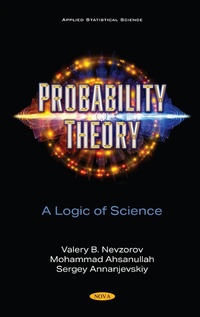
Probability Theory: A Logic of Science
Published on 21. April 2021
249 pages
978-1-5361-9220-9 (ISBN)
Description

This book is written for people who are interested to know the basics of probability theory. The basic knowledge of high school math will be enough to know the probability theory covered in the book. It covers basic theories of probability, statistical distributions, order statistics and record values, The use of characterization methods are described to identify various probability distributions. The book will be useful for undergraduate, graduate students and applied statisticians.
More details
Other editions
Additional editions
Book
04/2021
Nova Science Publishers Inc
€256.99
Shipment within 15-20 days
Content
- Intro
- Contents
- Preface
- Introduction
- Chapter 1
- Combinatorics
- Chapter 2
- Random Variables
- 2.1. The Simplest Probabilistic Models
- 2.2. Discrete Generalizations of the Classical Scheme
- 2.3. The General Construction of the Probability Space
- 2.4. Random Variables and Distribution Functions
- 2.5. Examples of Random Variables
- Chapter 3
- Generating and Characteristic Functions
- 3.1. Generating Functions and Their Properties
- 3.2. Characteristic Functions and Their Properties
- 3.2.1. Characteristic Functions and Polya Criterion
- 3.2.2. Polya Criterion
- Chapter 4
- Some Univariate Continuous Probability Distributions
- 4.1. Arcsine Distribution
- 4.2. Beta Distribution
- 4.3. Cauchy Distribution
- 4.4. Chi-Square Distribution
- 4.5. Exponential Distribution
- 4.6. Gamma Distribution
- 4.7. Inverse Gaussian Distribution
- 4.8. Laplace Distribution
- 4.9. Levy Distribution
- 4.10. Loglogistic Distribution
- 4.11. Logistic Distribution
- 4.12. Normal Distribution
- 4.13. Pareto Distribution
- 4.14. Power Function Distribution
- 4.15. Rayleigh Distribution
- 4.16. Stable Distribution
- 4.17. Student T-Distribution
- 4.18. Uniform Distribution
- 4.19. Weibull Distribution
- Chapter 5
- Order Statistics: From Minimum to Maximum
- 5.1. Definitions and Examples
- 5.2. Distributions of Order Statistics
- 5.3. Representations for Uniform and Exponential Order Statistics
- 5.4. Extreme Order Statistics
- Chapter 6
- Record Values and Probability Theory of Records
- 6.1. Definitions
- 6.2. Record Times and Record Values in the Case of Continuous Distributions
- 6.3. Records in the Sequences of Discrete Random Variables
- Chapter 7
- Characterizations of Continuous Distributions by Independent Copies
- Introduction
- 7.1. Arcsin Distribution
- 7.2. Beta Distribution
- 7.3. Chi-Square Distribution
- 7.4. Levy Distribution
- 7.5. Lindley Distribution
- 7.6. Loglogistic Distribution
- 7.7. Normal Distribution
- 7.8. Pearson's Random Walk
- 7.9. Power Function Distribution
- 7.10. Skew Distribution
- 7.11. Uniform Distribution
- 7.12. Von Mises distribution
- 7.13. Weibull Distribution
- 7.14. Wald Distribution
- Chapter 8
- Characterizations of Distributions by Order Statistics
- 8.1. Introduction
- 8.2. Characterizations of Distributions by Conditional Expectations
- 8.3. Characterizations by Identical Distribution
- 8.4. Characterizations by Independence Property
- Chapter 9
- Characterizations of Distributions by Record Values
- 9.1. Characterizations Using Conditional Expectations
- 9.2. Characterization by Independence Property
- 9.3. Characterizations by Identical Distribution
- Chapter 10
- Extreme Value Distributions
- Introduction
- 10.1. The PDF of Extreme Value Distributions
- 10.1.1 The Probability Density Function of Type 1 Extreme Value Distribution (T10) Is Given in Figure 10.1.1
- 10.1.2. The PDF of Type 2 Extreme Value Distributions for Xn,n
- 10.1.3. The PDF of Type 3 Distribution of Xn,n
- 10.2. Domain of Attraction
- 10.2.1. Domain of Attraction of Type I Extreme Value Distribution for Xn.n
- 10.2.2. Domain of Attraction of Type 2 Extreme Value Distribution for Xn,n
- 10.2.3. Domain of Attraction of Type 3 Extreme Value Distribution for Xn,n
- 10.3. Extreme Value Distributions for X1,n
- 10.3. Pdfs of the Extreme Value Distribution for X1,n
- 10.3.1. Type 1 Extreme Value Distribution for X1,n
- 10.3.2. Type 2 Extreme Value Distribution for X1,n
- 10.3.2. Type 3 Extreme Value Distribution for X1,n
- 10.3. Domain of Attraction of Extreme Value Distribution for X1,n
- 10.3.1. Domain of Attraction for Type 1 Extreme Value Distribution for X1,n
- 10.3.2. Domain of Attraction of Type 2 Distribution for X1,n
- 10.3.2. Domain of Attraction of Type 3 Distribution for X1,n
- 10.4. Asymptotic Distribution of the K-TH Largest Order Statistics
- Chapter 11
- Random Filling of a Segment with Unit Intervals
- 11.1. Random Filling. Continuous Case
- 11.2. Discrete Version of the Parking Problem
- Appendix
- A.1. Cauchy's Functional Equations
- A.2. Lemmas
- References
- About the Authors
- Index
- Blank Page
