

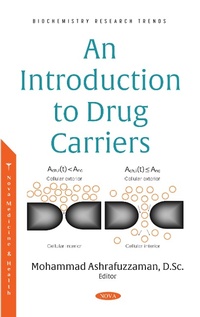
Introduction to Drug Carriers
Published on 13. September 2021
213 pages
978-1-68507-157-8 (ISBN)
Description

The book An Introduction to Drug Carriers provides a broad overview of drug carriers. Drug carriers play medically important roles in delivering drugs to pinpointed regions in biological systems. The cell hosts most of the disorders related to diseases. Therefore, the cell is also considered the main target region for most drugs. Some of the cellular compartments, especially cell-based membranes, which are geometrically constructed with both hydrophobic and hydrophilic layers/boundaries, often appear as barriers against vital candidate drugs' journey to the target regions. Besides, there are off-target structures that need to be avoided for drugs to get adsorbed. Otherwise, drugs may cause unbearable off-target binding originated toxicity, which would reduce the efficacy of the drugs. Appropriate choice of drug carriers may help specific drugs to get conjugated and be delivered to their optimal target structures. Biophysical and biochemical characterization of drug carriers concerning their role as vehicles to carry certain drugs may be obtained using engineering techniques. Manipulation in the cellular sites that cause disturbances in drug delivery is another biomedical option utilized to ensure smooth drug delivery. Various theoretical and experimental techniques are utilized to address all these issues related to drug carriers. The collected chapters written by experts in the field will help the subject matter be understood thoroughly.
More details
Other editions
Additional editions
Mohammad Ashrafuzzaman
An Introduction to Drug Carriers
Book
10/2021
Nova Science Publishers Inc
€211.28
Shipment within 15-20 days
Content
- Intro
- Contents
- Preface
- Acknowledgments
- Chapter 1
- Cell Systems as Biological Drug Carriers
- Abstract
- 1. Introduction
- 2. Red Blood Cells as Drug Carriers
- 3. Stem Cells as Drug Carriers
- 4. Vesicles as Biological Drug Carriers
- References
- Chapter 2
- Vesicles as Drug Carriers
- Abstract
- 1. Introduction
- 1.1. Definitions and Subtypes Extracellular Vesicles
- 1.2. EV Structure and Composition
- 1.2.1. Lipid Content and Membrane Features
- 1.2.2. RNA
- 1.2.3. DNA
- 1.2.4. Protein
- 1.3. EV Function
- 2. Engineering Extracellular Vesicles as Nanotherapeutics
- 3. Applications of Vesicles in Cancer Treatment
- 3.1. Vesicles in Gene Therapy
- Conclusion
- References
- Chapter 3
- A Significant Role of Various Polymers Conjugated with Folic Acid into Micelles as a Drug Carrier in Receptor-Targeted Drug Delivery for Breast Cancer
- Abstract
- 1. Introduction
- 1.1. Nanoparticles
- 1.2. Polymers in Drug Delivery
- 1.3. Natural and Synthetic Polymers
- 1.4. Significance of Polymers
- 2. Materials and Methods
- 2.1. Polymer Selection and Construction
- 2.2. Simulation of Monomer
- 2.3. Packing of Drug with Polymers
- 2.4. Folic Acid Conjugation with Polymer
- 2.5. Polymer-Receptor Docking
- 3. Results and Discussion
- 3.1. Equilibration of Polymers
- 3.2. Critical Micelle Packing
- 3.3. Energy Minimization of the Complex
- 3.4. Electrostatic Stability
- 3.5. Temperature Profile
- 3.6. Folic Acid and Polymer Encapsulated Drug
- 3.7. Long scale Dynamics of PLA System
- 3.8. Radius of Gyration
- 3.9. Biological Significance of the Study
- 3.10. Polymer and Folic Acid Receptor Docked Complex
- Conclusion
- References
- Chapter 4
- Emerging Applications of Drug Delivery Systems in Odontogenic Infections - An Overview
- Abstract
- 1. Introduction
- 2. Anatomy of Teeth
- 3. Dental Caries
- 4. Stages of Dental Caries
- 4.1. Stage I - Formation of White Spots
- 4.2. Stage II - Enamel Decay
- 4.3. Stage III - Dentin Decay
- 4.4. Stage IV - Involvement of the Pulp
- 4.5. Stage V - Abscess Formation
- 5. Classification of Dental Caries Dye, B. (2010)
- 6. Strategies for Treatment
- 6.1. Mouth Wash
- 6.2. Varnish
- 6.3. Toothpaste
- 6.4. Dental Sealants
- 6.5. Biomimetic Approaches
- 6.6. Periodontitis
- 7. Classification of Periodontitis
- 8. Strategies for Treatment
- 8.1. Films
- 8.2. Fibers
- 8.3. Dendrimers
- 8.4. Liposomes
- 8.5. Hydrogels
- Conclusion
- References
- Chapter 5
- Nanotechnology of Cell Membrane and Drug Delivery
- Abstract
- 1. Nanoparticles as Drug Carriers
- 2. Membrane's Selective Transport and General Barrier Properties
- 3. Membrane Transports Nanoparticles. Perspective of Nanoparticle-Membrane Interactions
- 4. Certain Nanoparticles Disrupt Membranes
- 4.1. Effects of Nanoparticle Size and Structure on Membrane Disruption
- 4.2. Disruption of Membrane Depends on the Lipid Phase Properties
- 5. Nanoparticles May Avoid Interactions with Membranes
- 6. Membrane Transport of Nanoparticles through Ion Pores/Channels
- 6.1. Membrane Delivery of Nanoparticles through Lipid-Lined Ion Pores
- 6.2. Membrane Delivery of Nanoparticles through Non-Lipid-Lined Ion Pores
- 6.3. Theoretical Understanding of the Nanoparticle Diffusion through Ion Pores/Channels in Membranes
- 7. Nanotechnology of Lipid-Based Drug Delivery
- 7.1. Lipid Carriers to Improve Tuberculosis Treatment
- 7.2. Pharmaceutical Formulation for Effective Therapy Using Lipid Nanoparticles
- References
- Chapter 6
- Current Trends in Applications of Nanosponges: A Multifaceted Drug Carrier System
- Abstract
- 1. Introduction
- 2. Materials Used in Nanosponges Development
- 2.1. Polymers
- 2.2. Metals
- 2.3. Biomaterials
- 2.4. Crosslinkers
- 2.5. Solvents
- 3. Merits and Demerits of Nanosponges
- 3.1. Merits [9, 28, 29]
- 3.2. Demerits [29, 30]
- 4. Drug Release Mechanism from Nanosponges
- 5. Drug Loading Mechanism into Nanosponges
- 6. Biomedical Applications of Nanosponges
- 6.1. Photothermal Therapy
- 6.2. Theranostic Application
- 6.3. Targeted Drug Delivery
- 6.4. Large Molecules Delivery
- 6.5. Topical Drug Delivery
- 6.6. Ocular Drug Delivery
- 6.7. Oral Drug Delivery
- 6.8. Therapeutic Stability
- 6.9. Bio-Responsive Drug Delivery
- 6.10. Solubility Enhancement
- Conclusion
- References
- About the Editor
- Index
- Blank Page
