

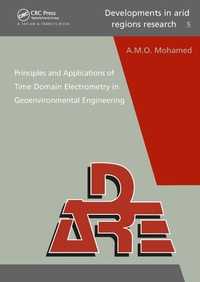
Principles and Applications of Time Domain Electrometry in Geoenvironmental Engineering
Published on 2. February 2026
622 pages
978-1-040-89863-5 (ISBN)
Description

Time domain electrometry (TDE) is a general term which includes time domain reflectrometry and time domain transmissiometry. It is a commercially-viable technique for leak detection, contaminant monitoring, and moisture content determination in contaminant transport modelling. Under demographic pressure, contaminated sites are increasingly being re-developed for domestic and industrial use; and this presents an urgent need for reliable, non-intrusive and integrated methods of subsurface characterization, detection and monitoring of organic and inorganic pollutants, soil moisture content and salinity. This book provides an overview of the potential application of TDE in geoenvironmental engineering and describes the geophysical methods used.
More details
Language
English
Place of publication
London
United Kingdom
Publishing group
Taylor & Francis Ltd
Target group
College/higher education
Professional and scholarly
File size
52,74 MB
ISBN-13
978-1-040-89863-5 (9781040898635)
Copyright in bibliographic data and cover images is held by Nielsen Book Services Limited or by the publishers or by their respective licensors: all rights reserved.
Schweitzer Classification
Other editions
Additional editions
A.M.O. Mohamed
Principles and Applications of Time Domain Electrometry in Geoenvironmental Engineering
Book
07/2006
1st Edition
CRC Press
€468.73
Shipment within 15-20 days
Person
Content
Developments in arid regions research series
About the author
Preface
Chapter 1: Use of time domain electrometry in geoenvironmental engineering
Chapter 2: Surface monitoring techniques
Chapter 3: Subsurface monitoring techniques
Chapter 4: Fundamentals of electromagnetics
Chapter 5: Time-varying fields and maxwell's equations
Chapter 6: Electromagnetic wave propagation
Chapter 7: Transmission lines
Chapter 8: Design of time domain electrometry (TDE) systems
Chapter 9: Signal and system analysis
Chapter 10: Electrical properties of subsurface materials
Chapter 11: Soil magnetic properties
Chapter 12: Soil dielectric permittivity
Chapter 13: Soil moisture content
Chapter 14: Detection and monitoring of solute transport in soils
Chapter 15: Detection and monitoring of nonaqueous phase liquids in soils
Appendix A: Vector analysis
Appendix B: Vector calculus
Appendix C: Complex numbers
Appendix D: Phasors
Appendix E: Debye equation
Appendix F: Dielectric mixture rules
References
Index
About the author
Preface
Chapter 1: Use of time domain electrometry in geoenvironmental engineering
Chapter 2: Surface monitoring techniques
Chapter 3: Subsurface monitoring techniques
Chapter 4: Fundamentals of electromagnetics
Chapter 5: Time-varying fields and maxwell's equations
Chapter 6: Electromagnetic wave propagation
Chapter 7: Transmission lines
Chapter 8: Design of time domain electrometry (TDE) systems
Chapter 9: Signal and system analysis
Chapter 10: Electrical properties of subsurface materials
Chapter 11: Soil magnetic properties
Chapter 12: Soil dielectric permittivity
Chapter 13: Soil moisture content
Chapter 14: Detection and monitoring of solute transport in soils
Chapter 15: Detection and monitoring of nonaqueous phase liquids in soils
Appendix A: Vector analysis
Appendix B: Vector calculus
Appendix C: Complex numbers
Appendix D: Phasors
Appendix E: Debye equation
Appendix F: Dielectric mixture rules
References
Index
