

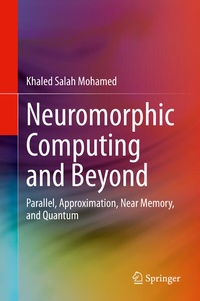
Neuromorphic Computing and Beyond
Description

This book discusses and compares several new trends that can be used to overcome Moore's law limitations, including Neuromorphic, Approximate, Parallel, In Memory, and Quantum Computing. The author shows how these paradigms are used to enhance computing capability as developers face the practical and physical limitations of scaling, while the demand for computing power keeps increasing. The discussion includes a state-of-the-art overview and the essential details of each of these paradigms.
More details
Other editions
Additional editions
Person
Khaled Salah Mohamed attended the school of engineering, Department of Electronics and Communications at Ain-Shams University from 1998 to 2003, where he received his B.Sc. degree in Electronics and Communications Engineering with distinction and honors. He received his Masters degree in Electronics from Cairo University, Egypt in 2008. He received his PhD degree in 2012. Dr. Khaled Salah is currently a Technical Lead at the Emulation division at Mentor Graphic, Egypt. Dr. Khaled Salah has published a large number of papers in in the top refereed journals and conferences. His research interests are in 3D integration, IP Modeling, and SoC design.
Content
An Introduction: New Trends in Computing.- Numerical Computing.- Parallel Computing: OpenMP, MPI, and CUDA.- Deep Learning and Cognitive computing: Pillars and Ladders.- Approximate Computing: Towards Ultra Low Power Systems Design.- Near-Memory/In-Memory Computing: Pillars and Ladders.- Quantum Computing and DNA Computing: Beyond Conventional Approaches.- Cloud, Fog and Edge Computing.- Reconfigurable and Heterogeneous Computing.- Conclusion.- Index.
