

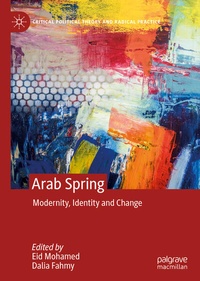
Arab Spring
Modernity, Identity and Change
1st Edition
Published on 8. October 2019
XVII, 282 pages
978-3-030-24758-4 (ISBN)
Description

This book provides systematic, integrated analyses of emergent social and cultural dynamics in the wake of the so-called Arab Spring, and looks closely at the narratives and experiences of a people as they confront crisis during a critical moment of transition. Providing an interdisciplinary approach to interconnections across regional and communal boundaries, this volume situates itself at the intersection of political science, cultural studies, media and film studies, and Middle Eastern studies, while offering some key critical revisions to dominant approaches in social and political theory. Through the unique contributions of each of its authors, this book will offer a much-needed addition to the study of Middle East politics and the Arab Spring. Moreover, although its specific focus is on the Arab context, its analysis will be of issues of significant relevance to a changing world order.
Reviews / Votes
"If the Arab Spring largely lacked any systematic intellectual anchor, its very happening has implied and spurred a new intellectual formation, notably on religion and politics. Setting out to address the crucial question of what the Arab spring can tell us about Arab thought, this book begins to open up a valuable discussion about the meaning of what swept across the Arab societies in the 2010s." (Asef Bayat, Bastian Professor of Global and Transnational Studies, University of Illinois, Urbana-Champaign, USA)"While the world at large may think that the spectacular crescendo of Arab Spring is over, understanding what has exactly happened to the Arab world has just begun. Two seminal scholars of the Arab world, Eid Mohamed and Dalia Fahmy, have gathered in this compendium of critical thinking-Arab Spring:Modernity, Identity and Change-the largely uncharted vicissitude of statecraft and governance as the locus classicus of our understanding of the Arab world-before and after these revolutions. What they have produced will teach us far beyond the surface of the historical unfolding of a world-historic event. They intend changing the very angle of our visions. No serious scholar of these revolutions can afford ignoring this book." (Hamid Dabashi, Hagop Kevorkian Professor of Iranian Studies and Comparative Literature, Columbia University, USA) "The rise and fall of the 2011 Arab revolts occasioned a crisis within political Islam in a number of ways. Of course there was the brutal, violent counter-revolution of the 2013 Egyptian coup and the subsequent persecution of all opposition movements. But within political Islam itself, the brief opening of the 2011 period (still partly alive in Tunisia), followed by the anti-political backlash in much of the region has caused something of a rupture in the historical trajectory of political Islam. Is it still possible to orient one's thinking in terms of an 'Islamic state' or an 'Islamization of modernity'? Or does the encounter with constituent politics in pluralist conditions, the authoritarian-nationalist trajectory of the AKP in Turkey, and the resurgence of anti-democratic neo-Traditionalism require a more radical shift of political and ideological framing on the part of Islamists themselves and scholars who study Islamist movements? This volume, with contributions from many leading scholars of political Islam and Arab politics (including many working and writing within the Middle East) is a crucial resource for answering those questions." (Andrew F. March, Associate Professor of Political Science, University ofMassachusetts, Amherst, USA)More details
Series
Language
English
Place of publication
Cham
Switzerland
Publishing group
Springer International Publishing
Target group
Professional and scholarly
Product notice
Reflowable
Illustrations
XVII, 282 p. 9 illus. in color.
File size
5,82 MB
ISBN-13
978-3-030-24758-4 (9783030247584)
DOI
10.1007/978-3-030-24758-4
Schweitzer Classification
Other editions
Additional editions
Book
10/2019
Palgrave Macmillan
€128.39
Shipment within 7-9 days
Persons
Eid Mohamed is Assistant Professor of Comparative Literature and US-Arab Cultural Politics at Doha Institute for Graduate Studies and the University of Guelph, Canada.
Dalia Fahmy is Associate Professor of Political Science at Long Island University, USA.Content
1. Arab Spring: Modernity, Identity and Change. 2. Whither Post-Islamism: Revisiting the Discourse/Movement After the Arab Spring.- 3. Islamists and Politics Today in Tunisia: The Foundation of a Democratic Islamic Party Possible?.- 4. The 'Arab Spring' and the End of Turkish Democracy.- 5. Re-examining Hasan al-Banna's Model of Da'wah in the Post Arab Spring Era.- 6. Democracy Promotion 2.0: Barack Obama and the 'Arab Spring' Conundrum.- 7. The Struggle for Revolutionary Memory: Historiography and documentation of the January 25 Revolution.- 8. Affective Encounters: Women, Hope, and Activism in Egypt.- 9. On Samir Murqus, the Narrative of Crisis and the Triumph of Tahrir.- 10. Seeking New Metaphors: Gender Identities in Tunisia and Lebanon.- 11. Constructing Civic Space: Civil Resistance, Sustainable Citizen Empowerment, and Transitional Justice as Pathways of Change in Contemporary Arab Politics.- 12. Unity - Consensus - Reconciliation: The Substance of Tunisia's Elite Compromise" An Analysis of Post-revolutionary Metaphors.- 13. Conclusion.
