

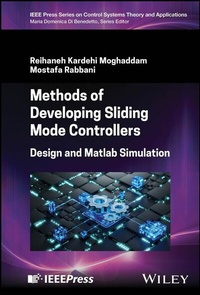
Methods of Developing Sliding Mode Controllers
Description

Comprehensive, fast-access guide to different types of sliding mode controllers and their programming and simulation in MATLAB and Simulink
Methods of Developing Sliding Mode Controllers delivers a practical review of sliding mode controllers (SMCs) and their challenges with coverage of related theorems, stability analysis, and how to program and simulate SMCs in MATLAB and Simulink. The book details the latest methods of their development and their applications in the automotive, aerospace, and robotics industries.
Initial chapters detail a range of different types of controllers. A combination of sliding and backstepping control is introduced and simulated and the phenomenon of chattering and effective solutions to reduce it are provided, along with suitable examples and analytical tables of the results. The final two chapters are related to fixed-time and event-triggered SMCs. Extensive Matlab/Simulink supported examples and simulation program code/block diagrams are included throughout.
Methods of Developing Sliding Mode Controllers: Design and Matlab Simulation explores sample topics including:
- Classic SMCs, covering variable structures, including relays and feedback control with switching gains, as well as controller design and theoretical foundations
- Terminal SMCs, covering nonsingular and fast variations, dynamic SMCs, and fuzzy SMCs, covering fuzzy approximation and equivalent control as well as indirect design
- Super twisting SMCs, adaptive SMCs, and backstepping SMCs, covering the backstepping method and chaotic duffing oscillator equations
- Sign, Epsilon-sign, saturation, hyperbolic tangent, and generalized hyperbolic tangent functions for chatter reduction
Methods of Developing Sliding Mode Controllers: Design and Matlab Simulation is a concise yet comprehensive and highly practical reference on the subject for graduate/postgraduate students in electrical engineering, mechanical engineering, and biomedical engineering along with academics and professionals in fields related to SMCs.
More details
Other editions
Additional editions
Persons
Reihaneh Kardehi Moghaddam, Department of Electrical Engineering, Mashhad Branch, Islamic Azad University, Mashhad, Iran, and School of Computing, Macquarie University, Sydney, Australia. Dr. Kardehi Moghaddam's main fields of research are optimization of extracted power from renewable energy sources, nonlinear fractional order sliding mode controllers, intelligent optimization methods and deep neural networks. She has supervised four doctoral dissertations and 45+ Master's dissertations.
Mostafa Rabbani, PhD researcher, Department of Electrical Engineering, Azad University of Mashhad, Mashhad, Iran. His main field of research is nonlinear control of uncertain nonlinear systems.
Content
About the Authors xiii
Acknowledgments xv
Introduction xvii
1 An Introduction to Sliding Mode Controllers 1
1.1 Introduction 1
1.2 Advantages and Limitations of Sliding Mode Controllers 2
1.3 An Overview of Book Contents 3
References 4
2 Classic Sliding-Mode Controller 5
2.1 Introduction 5
2.2 Variable-Structure Controllers 5
2.2.1 Industrial Variable-Structure Controllers 7
2.2.1.1 Relays 7
2.2.1.2 Feedback Control with Switching Gains 7
2.2.1.3 Sliding Mode Controlers 7
2.3 Classic Sliding Mode Controllers 8
2.4 Controller Design 9
2.5 Sliding Mode Controller Design 10
2.5.1 Reaching Phase 10
2.5.2 Sliding Phase 11
2.6 Theoretical Foundations of Sliding Mode Control 11
2.7 Designing Sliding Mode Controller for Second Order Uncertain Systems 12
2.7.1 System Dynamical Model 12
2.7.2 Sliding Surface Determination 13
2.7.3 Designing Nominal Controller 13
2.7.4 Designing the Variable Structure 13
2.8 Classical Sliding Mode Controller Design in MATLAB 15
References 24
3 Terminal Sliding Mode Controller 27
3.1 Introduction 27
3.2 Terminal Sliding Mode Controller Design 27
3.3 Nonsingular Terminal Sliding Mode Controller 30
3.4 Fast Terminal Sliding-Mode Controller 32
3.5 Nonsingular Fast Terminal Sliding-Mode Control 34
3.6 Integral Terminal Sliding-Mode Control 36
3.7 Extended INTSMC for n-Order Nonlinear Systems 38
3.8 MATLAB Simulation 39
3.8.1 Simulation using MATLAB mfiles 40
3.8.2 Designing Improved Sliding Mode Controllers for Inverted Pendulum in SIMULINK 47
3.9 Conclusion 55
References 57
4 Dynamic Sliding Mode Control 59
4.1 Introduction 59
4.2 Designing the Dynamic Sliding Mode Controller 59
4.2.1 Statement of the Problem 59
4.2.2 Controller Design and Stability Analysis 60
4.3 DSMC MATLAB Programming 61
4.3.1 Programming in Simulink Environment 65
References 68
5 Fuzzy Sliding Mode Controllers 69
5.1 Introduction 69
5.2 Designing Adaptive FSMC 69
5.2.1 Designing Sliding-Mode Controller Based on Fuzzy Approximator 70
5.2.2 Fuzzy Approximation 71
5.3 Designing an Indirect Adaptive Fuzzy Sliding-Mode Controller 72
5.3.1 Fuzzy Adaptive SMC Simulation Results 73
5.4 Designing Sliding-Mode Controller Based on Fuzzy Equivalent Control 84
5.4.1 Fuzzy Equivalent SMC Simulation Results for Inverted Pendulum 84
5.4.2 Fuzzy Equivalent SMC Simulation Results for Duffing System 95
References 102
6 Adaptive Sliding-Mode Control 103
6.1 Introduction 103
6.2 Adaptive Sliding Mode Control Design 103
6.3 Designing Adaptive SMC for Inverted Pendulum 104
References 110
7 Super Twisting SMC 111
7.1 Introduction 111
7.2 SMC Review 112
7.2.1 SMC Design 112
7.2.2 Inverted Pendulum Design 113
7.3 Super Twisting SMC 115
7.4 Super-Twisting SMC Controller Design in MATLAB 117
7.4.1 MATLAB Programming 117
References 122
8 Back-Stepping Sliding-Mode Control 123
8.1 Introduction 123
8.2 Back-Stepping Controller Design 124
8.2.1 Back-Stepping Method 124
8.2.2 Chaotic Duffing Oscillator Equations 126
8.3 Back-Stepping Control of Chaotic Duffing Oscillator 128
8.3.1 Stability Analysis 129
8.4 MATLAB Programming of Back-Stepping Controller 131
8.4.1 Back-Stepping Controller Design in MATLAB 132
8.4.2 Controller Design Based on Back-Stepping Super-Twisting SMC 132
8.5 Back-Stepping Super-Twisting Sliding-Mode Controller Design 140
8.5.1 Proof of Stability 141
8.5.2 MATLAB Programming 142
8.5.3 Back-Stepping Super-Twisting SMC Controller Design in MATLAB 143
References 149
9 Chattering Reduction Methods 151
9.1 Introduction 151
9.2 Methodology 152
9.2.1 Methods to Reduce Chattering Phenomenon 152
9.2.2 Sign Function 153
9.2.3 Epsilon-Sign Function 154
9.2.4 Saturation Function 155
9.2.5 Hyperbolic Tangent Function 156
9.2.6 Generalized Hyperbolic Tangent Function 157
9.2.7 Generalized Hyperbolic Tangent Function 158
9.2.8 Super Twisting 159
References 166
10 Feedback Linearization and Sliding Mode Controllers 169
10.1 Introduction 169
10.2 Feedback Linearization 170
10.2.1 Feedback Linearization of Systems with Canonical Form 170
10.2.2 Input-State Linearization 171
10.2.3 Input-Output Linearization 172
10.3 Inverted Pendulum System Equations 173
10.4 Controller Design Based on Feedback Linearization 173
10.5 Proof of Stability 176
10.5.1 MATLAB Programming 176
10.6 Sliding-Mode Control Based on Feedback Linearization Method 180
10.6.1 MATLAB Programming 181
References 185
11 Fixed-Time Terminal Sliding-Mode Controller 187
11.1 Introduction 187
11.2 Finite-Time Terminal Sliding Mode Controller 188
11.2.1 Finite-Time Convergence 188
11.2.2 Mathematical Preliminaries 188
11.2.3 Finite-Time Terminal Sliding-Mode Controller Design 190
11.2.4 MATLAB Programming 191
11.3 Fixed-Time Terminal Sliding-Mode Controller 195
11.3.1 Fixed-Time Convergence 195
11.3.2 Mathematical Preliminaries 195
11.3.3 Design and Stability Analysis 196
11.3.4 MATLAB Programming 198
11.3.5 Nonsingular Fixed-Time Terminal Sliding-Mode Controller 202
11.3.5.1 Design of Nonsingular Fixed-Time Terminal Sliding-Mode Controller 204
11.3.5.2 MATLAB Programming 209
References 211
12 Event-Triggering Sliding-Mode Controllers 213
12.1 Introduction 213
12.2 Designing Event-Triggering Sliding-Mode Controller for Linear Systems 213
12.2.1 Definitions and Mathematical Preliminaries 214
12.2.2 Controller Design 215
12.3 MATLAB Programming and Simulation Results: Event-Triggering Sliding-Mode Controller for Linear Systems 217
12.4 Design of Event-Triggering SMC for Nonlinear Systems 219
12.5 MATLAB Programming and Simulation Results 224
References 229
Index 231
1
An Introduction to Sliding Mode Controllers
1.1 Introduction
In the world of control systems, sliding-mode controller (SMC) is a nonlinear control strategy that uses a control signal with a variable structure to change the dynamics of a nonlinear system that forces the system to "slide" along a predetermined path. It is called the sliding surface, and the curved movement of the system path on this surface will guarantee the stability of the system in the presence of parametric and structural uncertainties with a limited bound. The state feedback control law in sliding mode controllers is not a continuous function in terms of time, and, in other words, the position of the system path curve in the state space is dependent. Hence, sliding mode control is a variable structure control method. This variable structure controller is designed in such a way that the system trajectories always converge toward the sliding surface, and by sliding on this path, the tracking error of the desired behavior in the control system tends to zero. The movement of the system during sliding along the neighborhood of the sliding surface is called sliding mode. In the framework of modern control theory, the SMC variable structure system is considered as a subset of hybrid dynamic control systems, because the path curve of the system moves continuously through different and discrete control laws.
Sliding-mode control has two main advantages. The first advantage is that by choosing the appropriate sliding function, the desired dynamic behavior of the system can be achieved. And secondly, the closed-loop response of the system has no sensitivity to uncertainties (model parameters, disturbances, and non-linearity). As a result, from a practical point of view, nonlinear processes are controlled by using sliding-mode control in the presence of model disturbances and uncertainties. Unique features such as accuracy, consistency, and easy setup and implementation have made sliding controllers very popular.
Sliding-mode control is especially useful for systems that are highly nonlinear and have uncertain dynamics. It can also be used for systems with external disturbances that need to be rejected. This technique is widely used in aerospace, automotive, and robotics applications.
1.2 Advantages and Limitations of Sliding Mode Controllers
Sliding-mode control is a variable structure controller that was first introduced by Vadim Utkin [1]. Sliding-mode control is a robust control method that is widely used to control and stabilize nonlinear systems. Its most important features are simple design and resistance to uncertainty in the model, i.e. parametric uncertainties and unmodeled dynamics, as well as rejection of external disturbances. Uncertainties have destructive effects on nonlinear systems and strongly affect the design of closed-loop control system [2]. The SMC design is based on the definition of an arbitrary linear slip surface in order to guarantee the optimal performance of the closed-loop control system and asymptotic stability based on the concept of the Lyapunov stability theorem. As SMC does not result in the convergence of system states to zero in finite time, it is developed to Terminal Sliding-Mode Control (TSMC) in order to achieve the finite time convergence. In this method, a non-linear sliding surface is used instead of the linear one applied in conventional SMC methods. Nonlinear sliding surfaces in TSMC have improved the transient-mode performance and, compared to conventional SMC, TSMC provides features such as fast convergence, finite time stability, increased accuracy of steady-state response, and in addition enhanced robustness [3]. However, the conventional TSMC faces two major problems that need to be solved: the singularity problem and the chattering phenomenon. To solve the first problem in [4], a switching method between non-linear sliding surface in TSMC and linear sliding surface in SMC is proposed. Also, in [5], the method of transferring the system path to a specific area inorder to singularity avoidance, is used. However, in these methods, the singularity problem is solved indirectly. Therefore, a Non-singular Terminal Sliding-mode Control method (NTSMC) has been introduced in [6], which directly solves the singularity problem by proposing a non-singular non-linear sliding surface.
Regarding the second problem, in techniques based on sliding mode control, when the system states are close to the sliding level, the existence of the discontinuous term in the control law causes chattering phenomenon. Chattering is an undesirable phenomenon as the vibration of the control signal causes energy loss, and, on the other hand, due to its high frequency, it may stimulate the high-frequency modes of the system which could potentially lead to instability. Also, chattering can cause wear in mechanical parts and electromechanical systems, and possible damage to various system components. To overcome this problem, various techniques are used in different articles such as high-order sliding-mode control [7, 8], fuzzy sliding mode control [9-11], and using neural networks [12, 13].
Although, as stated, the supplementary topics of the sliding controllers, which are provided to solve the limitations of this controller, are very extensive, in this book, an attempt has been made to the basic part of these supplementary topics, i.e. chattering removal methods, terminal, fuzzy, adaptive, and super-twisting SMC. It is also combined with feedback linearization and back stepping and at the end of each chapter a MATLAB programming is presented on the inverted pendulum to investigate the results.
1.3 An Overview of Book Contents
This book contains 12 chapters. In the first chapter, sliding mode controllers and their challenges are introduced in general. In the second chapter, the basic issues and definitions of classic sliding mode controllers and how to program and simulate these controllers in MATLAB have been discussed. The third chapter deals with the terminal sliding controllers that use the non-linear sliding surface to increase the convergence speed. In addition, its complementary topics, including fast and non-singular sliding-mode controllers, have been introduced and simulated. The fourth chapter deals with the dynamic sliding controllers, and the fifth chapter introduces the fuzzy sliding controllers for the uncertain dynamic estimation of the system with fuzzy structure and its sliding control. In the sixth chapter, adaptive sliding controllers with indeterminate parameters in system dynamics are presented along with parameter adaptation rules and MATLAB programming. The seventh chapter, includes super-twisting sliding-mode controllers. In chapter eight, the combination of sliding and backstepping control, which is of great interest due to its advantages such as the ability to design subsystems step by step, has been introduced and simulated. In the ninth chapter, the phenomenon of chattering and the effective solutions to reduce drawbacks have been reviewed along with providing suitable examples and analytical tables of the results. Chapter 10 indicates the supplementary topics of using sliding controllers with feedback linearization. In chapter 11, the design and stability analysis of fixed-time sliding mode controllers is discussed and finally the last chapter is related to design and MATLAB programming of event triggered sliding mode controllers.
The purpose of the authors of this book is to introduce basic techniques of SMC improvement to students and researchers who are interested in design and simulation of sliding-mode controllers and control of nonlinear systems, quickly and easily. We hope that this book can be an effective guide for researchers in this field.
References
- 1 Utkin, V. (1977). Variable structure systems with sliding modes. IEEE Transactions on Automatic Control 22 (2): 212-222.
- 2 Slotine, J.J.E. and Li, W. (1991). Applied Nonlinear Control. Englewood Cliffs, NJ: Prentice Hall.
- 3 Zhihong, M., Paplinski, A.P., and Wu, H.R. (1994). A robust MIMO terminal sliding mode control scheme for rigid robotic manipulators. IEEE Transactions on Automatic Control 39 (12): 2464-2469.
- 4 Zhihong, M. and Yu, X.H. (1997). Terminal sliding mode control of MIMO linear systems. IEEE Transactions on Circuits and Systems I: Fundamental Theory and Applications 44 (11): 1065-1070.
- 5 Wu, Y., Yu, X., and Man, Z. (1998). Terminal sliding mode control design for uncertain dynamic systems. Systems & Control Letters 34 (5): 281-287.
- 6 Feng, Y., Yu, X., and Man, Z. (2002). Non-singular terminal sliding mode control of rigid manipulators. Automatica 38 (12): 2159-2167.
- 7 Bartolini, G., Ferrara, A., and Usai, E. (1998). Chattering avoidance by second-order sliding mode control. IEEE Transactions on Automatic Control 43 (2): 241-246.
- 8 Levant, A. (2005). Homogeneity approach to high-order sliding mode design. Automatica 41 (5): 823-830.
- 9 Nekoukar, V. and Erfanian, A. (2011). Adaptive fuzzy terminal sliding mode control for a class of MIMO uncertain nonlinear systems. Fuzzy Sets and Systems 179 (1): 34-49.
- 10 Cerman, O. and Husek, P. (2012). Adaptive fuzzy...
