

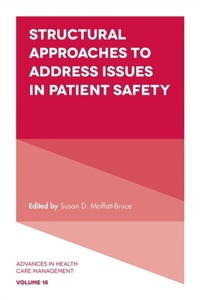
Structural Approaches to Address Issues in Patient Safety
1st Edition
Published on 24. October 2019
296 pages
978-1-83867-084-9 (ISBN)
Description

This volume explores the ways in which structural changes in health care environments impact patient safety. It delves into the potential that design thinking can have when applied to organizational systems and structures, as well as the physical environment, to mitigate risks, reduce medical errors and ultimately improve the quality of care, provider well-being, and the overall patient experience.
Much of health management empirical research has focused on the process and outcomes and then attempted to reverse engineer the structure that may reasonably explain that. This volume presents studies from the United States and Europe to demonstrate the benefits of a structure led approach. The chapters employ a variety of methods including needs assessment, consensus building, systems modelling, survey research, secondary analysis of EMR data, and qualitative methodologies. Together they provide meaningful conclusions to the question of how structural approaches in learning health care environments can be improved to create a positive impact on patient safety.
Much of health management empirical research has focused on the process and outcomes and then attempted to reverse engineer the structure that may reasonably explain that. This volume presents studies from the United States and Europe to demonstrate the benefits of a structure led approach. The chapters employ a variety of methods including needs assessment, consensus building, systems modelling, survey research, secondary analysis of EMR data, and qualitative methodologies. Together they provide meaningful conclusions to the question of how structural approaches in learning health care environments can be improved to create a positive impact on patient safety.
Reviews / Votes
This volume consists of 12 essays on structural approaches to issues of patient safety. Medical, management, and other specialists from the US and Europe address systems-based improvements that target hospital design; guiding change in the healthcare environment using a flexible process model; using a systems modeling approach to reduce the risk of healthcare-associated infections; the role of geographic information systems for infection control in hospitals; the use of human factor approaches to develop and conduct an evaluation of the design of a neonatal intensive care unit; the role of burnout in the relationship between a perceived patient-safe, friendly working environment and unsafe performance in an obstetric unit; failure-to-rescue event mitigation system assessment; continuous cardiac monitoring policy implementation; sterile processing of instruments and the preparation of case carts; cultivating a culture of continuous learning and improvement; a systems approach to the design and implementation of patient assessment tools in the inpatient setting; and optimizing the patient experience. -- Copyright 2019 * Portland, OR *More details
Series
Language
English
Place of publication
Bingley
United Kingdom
Target group
Professional and scholarly
File size
8,32 MB
ISBN-13
978-1-83867-084-9 (9781838670849)
Copyright in bibliographic data and cover images is held by Nielsen Book Services Limited or by the publishers or by their respective licensors: all rights reserved.
Schweitzer Classification
Other editions
Additional editions
Susan D. Moffatt-Bruce
Structural Approaches to Address Issues in Patient Safety
Book
10/2019
Emerald Publishing Limited
€127.30
Shipment within 3-4 weeks
Person
Susan D. Moffatt-Bruce is the Executive Director of University Hospital at The Ohio State University Wexner Medical Center. She is a Professor of Surgery and Biomedical Informatics as well as a practicing Cardiothoracic Surgeon.
Content
Chapter 1. Case Study: More Patient Safety by Design - System-Based Approaches for Hospitals; Irene Kobler, Alfred Angerer, and David Schwappach Chapter 2. PROcess for the Design of User Centered Environments (PRODUCE): Guiding Change in the Healthcare Environment; Jessica M. Ray, Rebecca Berg and Stephanie N. Sudikoff
Chapter 3. Systems Modeling Approach for Reducing the Risk of Healthcare-Associated Infections; Shreyas S. Limaye and Christina M. Mastrangelo
Chapter 4. Repurposing Geographic Information Systems for Routine Hospital Infection Control; Courtney Hebert and Elisabeth Dowling Root
Chapter 5. Application of Human Factors in Neonatal Intensive Care Unit Redesign; Anna Grome, Elizabeth Lerner Papautsky, Beth Crandall, James Greenberg
Chapter 6. The Mediating Role of Burnout in the Relationship Between Perceived Patient-safe, Friendly Working Environment and Perceived Unsafe Performance in an Obstetric Unit; Sandra C. Buttigieg, Emanuela-Anna Azzopardi, and Vincent Cassar
Chapter 7. Failure to Rescue Event Mitigation System Assessment: A Mixed-methods Approach to Analysis of Complex Adaptive Systems; Susan P. McGrath, Emily E. Wells, Krystal M. McGovern, Irina Perreard, Kathleen O. Stewart, Dennis McGrath, and George Blike
Chapter 8. Continuous Cardiac Monitoring Policy Implementation: Three-year Sustained Decrease of Hospital Resource Utilization; Chelsea R Horwood, Susan D. Moffatt-Bruce, and Michael F. Rayo
Chapter 9. A Work Systems Analysis of Sterile Processing: Sterilization and Case Cart Preparation; Myrtede Alfred, Ken Catchpole, Emily Huffer, Kevin Taafe, and Larry Fredendall
Chapter 10. A Model for Cultivating a Culture of Continuous Learning and Improvement: An Ethnographic Report; Catherine C. Quatman-Yates, Mark V. Paterno, Mariann Strenk, Michelle Kiger, Tory Hogan, Brian Cunningham, Rebecca Reder
Chapter 11. A Systems Approach to Design and Implementation of Patient Assessment Tools in the Inpatient Setting; Susan P. McGrath, Irina Perreard, Joshua Ramos, Krystal M. McGovern, Todd MacKenzie, George Blike
Chapter 12. Beyond Patient Satisfaction: Optimizing the Patient Experience; Jennifer L. Hefner, Ann Scheck McAlearney, Nicole Spatafora, and Susan D. Moffatt-Bruce
Chapter 3. Systems Modeling Approach for Reducing the Risk of Healthcare-Associated Infections; Shreyas S. Limaye and Christina M. Mastrangelo
Chapter 4. Repurposing Geographic Information Systems for Routine Hospital Infection Control; Courtney Hebert and Elisabeth Dowling Root
Chapter 5. Application of Human Factors in Neonatal Intensive Care Unit Redesign; Anna Grome, Elizabeth Lerner Papautsky, Beth Crandall, James Greenberg
Chapter 6. The Mediating Role of Burnout in the Relationship Between Perceived Patient-safe, Friendly Working Environment and Perceived Unsafe Performance in an Obstetric Unit; Sandra C. Buttigieg, Emanuela-Anna Azzopardi, and Vincent Cassar
Chapter 7. Failure to Rescue Event Mitigation System Assessment: A Mixed-methods Approach to Analysis of Complex Adaptive Systems; Susan P. McGrath, Emily E. Wells, Krystal M. McGovern, Irina Perreard, Kathleen O. Stewart, Dennis McGrath, and George Blike
Chapter 8. Continuous Cardiac Monitoring Policy Implementation: Three-year Sustained Decrease of Hospital Resource Utilization; Chelsea R Horwood, Susan D. Moffatt-Bruce, and Michael F. Rayo
Chapter 9. A Work Systems Analysis of Sterile Processing: Sterilization and Case Cart Preparation; Myrtede Alfred, Ken Catchpole, Emily Huffer, Kevin Taafe, and Larry Fredendall
Chapter 10. A Model for Cultivating a Culture of Continuous Learning and Improvement: An Ethnographic Report; Catherine C. Quatman-Yates, Mark V. Paterno, Mariann Strenk, Michelle Kiger, Tory Hogan, Brian Cunningham, Rebecca Reder
Chapter 11. A Systems Approach to Design and Implementation of Patient Assessment Tools in the Inpatient Setting; Susan P. McGrath, Irina Perreard, Joshua Ramos, Krystal M. McGovern, Todd MacKenzie, George Blike
Chapter 12. Beyond Patient Satisfaction: Optimizing the Patient Experience; Jennifer L. Hefner, Ann Scheck McAlearney, Nicole Spatafora, and Susan D. Moffatt-Bruce
