

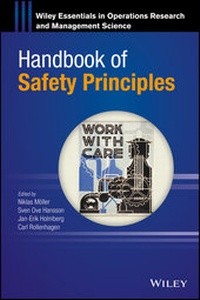
Handbook of Safety Principles
Description

Presents recent breakthroughs in the theory, methods, and applications of safety and risk analysis for safety engineers, risk analysts, and policy makers
Safety principles are paramount to addressing structured handling of safety concerns in all technological systems. This handbook captures and discusses the multitude of safety principles in a practical and applicable manner. It is organized by five overarching categories of safety principles: Safety Reserves; Information and Control; Demonstrability; Optimization; and Organizational Principles and Practices. With a focus on the structured treatment of a large number of safety principles relevant to all related fields, each chapter defines the principle in question and discusses its application as well as how it relates to other principles and terms. This treatment includes the history, the underlying theory, and the limitations and criticism of the principle. Several chapters also problematize and critically discuss the very concept of a safety principle. The book treats issues such as: What are safety principles and what roles do they have? What kinds of safety principles are there? When, if ever, should rules and principles be disobeyed? How do safety principles relate to the law; what is the status of principles in different domains? The book also features:
. Insights from leading international experts on safety and reliability
. Real-world applications and case studies including systems usability, verification and validation, human reliability, and safety barriers
. Different taxonomies for how safety principles are categorized
. Breakthroughs in safety and risk science that can significantly change, improve, and inform important practical decisions
. A structured treatment of safety principles relevant to numerous disciplines and application areas in industry and other sectors of society
. Comprehensive and practical coverage of the multitude of safety principles including maintenance optimization, substitution, safety automation, risk communication, precautionary approaches, non-quantitative safety analysis, safety culture, and many others
The Handbook of Safety Principles is an ideal reference and resource for professionals engaged in risk and safety analysis and research. This book is also appropriate as a graduate and PhD-level textbook for courses in risk and safety analysis, reliability, safety engineering, and risk management offered within mathematics, operations research, and engineering departments.
NIKLAS MÖLLER, PhD, is Associate Professor at the Royal Institute of Technology in Sweden. The author of approximately 20 international journal articles, Dr. Möller's research interests include the philosophy of risk, metaethics, philosophy of science, and epistemology.
SVEN OVE HANSSON, PhD, is Professor of Philosophy at the Royal Institute of Technology. He has authored over 300 articles in international journals and is a member of the Royal Swedish Academy of Engineering Sciences. Dr. Hansson is also a Topical Editor for the Wiley Encyclopedia of Operations Research and Management Science.
JAN-ERIK HOLMBERG, PhD, is Senior Consultant at Risk Pilot AB and Adjunct Professor of Probabilistic Riskand Safety Analysis at the Royal Institute of Technology. Dr. Holmberg received his PhD in Applied Mathematics from Helsinki University of Technology in 1997.
CARL ROLLENHAGEN, PhD, is Adjunct Professor of Risk and Safety at the Royal Institute of Technology. Dr. Rollenhagen has performed extensive research in the field of human factors and MTO (Man, Technology, and Organization) with a specific emphasis on safety culture and climate, event investigation methods, and organizational safety assessment.
More details
Other editions
Additional editions
Persons
NIKLAS MÖLLER, PhD, is Associate Professor at the Royal Institute of Technology in Sweden. The author of approximately 20 international journal articles, Dr. Möller's research interests include the philosophy of risk, metaethics, philosophy of science, and epistemology.
SVEN OVE HANSSON, PhD, is Professor of Philosophy at the Royal Institute of Technology. He has authored over 300 articles in international journals and is a member of the Royal Swedish Academy of Engineering Sciences. Dr. Hansson is also a Topical Editor for the Wiley Encyclopedia of Operations Research and Management Science.
JAN-ERIK HOLMBERG, PhD, is Senior Consultant at Risk Pilot AB and Adjunct Professor of Probabilistic Risk and Safety Analysis at the Royal Institute of Technology. Dr. Holmberg received his PhD in Applied Mathematics from Helsinki University of Technology in 1997.
CARL ROLLENHAGEN, PhD, is Adjunct Professor of Risk and Safety at the Royal Institute of Technology. Dr. Rollenhagen has performed extensive research in the field of human factors and MTO (Man, Technology, and Organization) with a specific emphasis on safety culture and climate, event investigation methods, and organizational safety assessment.
Content
Preface xxv
List of Contributors xxvii
1 Introduction 1
Niklas Möller, Sven Ove Hansson, Jan-Erik Holmberg, and Carl Rollenhagen
1.1 Competition, Overlap, and Conflicts 1
1.2 A New Level in the Study of Safety Principles 2
1.3 Metaprinciples of Safety 3
1.4 Other Ways to Characterize Safety Principles 5
1.5 Conflicts Between Safety Principles 7
1.6 When Can Safety Principles Be Broken? 8
1.7 Safety in Context 9
References 10
2 Preview 11
Niklas Möller, Sven Ove Hansson, Jan-Erik Holmberg, and Carl Rollenhagen
2.1 Part I: Safety Reserves 12
2.2 Part II: Information and Control 13
2.3 Part III: Demonstrability 16
2.4 Part IV: Optimization 17
2.5 Part V: Organizational Principles and Practices 20
Part I Safety Reserves 23
3 Resilience Engineering and the Future of Safety Management 25
Erik Hollnagel
3.1 On the Origins of Resilience 25
3.2 The Resilience Engineering Understanding of "Resilience" 27
3.3 The Four Potentials for Resilience Performance 29
3.4 Safety Management Systems 31
3.5 Developing Definitions of Resilience 33
3.6 Managing the Potentials for Resilient Performance 34
3.7 Resilience Management: LP-HI OR HP-LI? 37
References 39
4 Defense-In-Depth 42
Jan-Erik Holmberg
4.1 Introduction 42
4.2 Underlying Theory and Theoretical Assumptions 43
4.3 Redundancy, Diversity, and Separation Principles 44
4.4 Use and Implementation 53
4.5 Empirical Research on use and Efficiency 57
4.6 Weaknesses, Limitations, and Criticism 57
4.7 Relations to Other Safety Principles 59
References 60
Further Reading 61
5 Safety Barriers 63
Lars Harms-Ringdahl and Carl Rollenhagen
5.1 Introduction 63
5.2 Origin and Theoretical Background 65
5.3 Definitions and Terminology 67
5.4 Classification of Barriers 71
5.5 Methods for Analysis of Safety Barriers 75
5.6 Quality and Efficiency of Barriers 79
5.7 Discussion and Conclusions 82
References 84
6 Factors and Margins of Safety 87
Neelke Doorn and Sven Ove Hansson
6.1 Introduction 87
6.2 Origin and History 91
6.3 Definitions and Terminology 92
6.4 Underlying Theory and Theoretical Assumptions 94
6.5 Use and Implementation 98
6.6 Empirical Research on Use and Efficiency 101
6.7 Weaknesses, Limitations, and Criticism 103
6.8 Relations to Other Safety Principles 105
Acknowledgment 108
References 108
Further Reading 114
Part II Information and Control 115
7 Experience Feedback 117
Urban Kjellén
7.1 Introduction 117
7.2 Origin and History 118
7.3 Definitions 121
7.4 Underlying Theories and Assumptions 122
7.5 Use and Implementation 127
7.6 Empirical Research on Use and Efficiency 135
7.7 Relations to Other Safety Principles 137
References 138
Further Reading 141
8 Risk and Safety Indicators 142
Drew Rae
8.1 Introduction 142
8.2 Origin and History 143
8.3 Definitions and Terminology 145
8.4 Underlying Theory and Theoretical Assumptions 146
8.5 Use and Implementation 152
8.6 Empirical Research on Use and Efficacy 154
8.7 Weaknesses, Limitations, and Criticism 155
8.8 Relations to Other Safety Principles 158
References 159
9 Principles of Human Factors Engineering 164
Leena Norros and Paula Savioja
9.1 Introduction 164
9.2 Principle 1: HFE is Design Thinking 167
9.3 Principle 2: HFE Studies Human as a Manifold Entity 172
9.4 Principle 3: HFE Focuses on Technology in Use 177
9.5 Principle 4: Safety is Achieved Through Continuous HFE 182
9.6 Relation to Other Safety Principles 187
9.7 Limitations 188
9.8 Conclusions 189
References 190
Further Reading 195
10 Safety Automation 196
Björn Wahlström
10.1 Introduction 196
10.2 Origin and History 201
10.3 Definitions and Terminology 205
10.4 Underlying Theories and Assumptions 211
10.5 Use and Implementation 215
10.6 Research on Use and Efficiency 220
10.7 Weaknesses, Limitations, and Criticism 222
10.8 Relations to Other Safety Principles 225
10.9 Summary and Conclusions 228
References 229
11 Risk Communication 235
Jan M. Gutteling
11.1 Introduction 235
11.2 The Origin and History of Risk Communication as Academic Field 238
11.3 Underlying Assumptions, Concepts and Empirical Data on Risk Communication Models 241
11.4 Weaknesses, Limitations, and Criticism 250
11.5 Final Word 252
References 252
Further Reading 257
12 The Precautionary Principle 258
Sven Ove Hansson
12.1 Introduction 258
12.2 History and Current Use 259
12.3 Definitions 263
12.4 Underlying Theory 267
12.5 Research on Use and Efficiency 271
12.6 Weaknesses, Limitations, and Criticism 271
12.7 Relation to Expected Utility and Probabilistic Risk Assessment 273
12.8 Relations to Other Safety Principles 276
Acknowledgment 279
References 279
Further Reading 283
13 Operating Procedure 284
Jinkyun Park
13.1 Introduction 284
13.2 Manual, Guideline, and Procedure 286
13.3 Existing Principles for Developing a Good Procedure 288
13.4 Additional Principle to Develop a Good Procedure 292
13.5 Concluding Remarks 299
References 301
Further Reading 304
14 Human-Machine System 305
Anna-Lisa Osvalder and Håkan Alm
14.1 Human-Machine System 306
14.2 Complex Systems 307
14.3 To Control a Complex System 307
14.4 Operator Demands 308
14.5 Performance-Shaping Factors 313
14.6 User Interface Design 315
14.7 Demands on the Environment 322
14.8 Handling Complexity 327
References 329
Part III Demonstrability 331
15 Quality Principles and Their Applications To Safety 333
Bo Bergman
15.1 Introduction 333
15.2 Improvement Knowledge and its Application to Safety 338
15.3 Health-Care Improvement and Patient Safety 349
15.4 Weaknesses, Limitations, and Criticism 351
15.5 Some Personal Experiences 352
15.6 Relations to Other Safety Principles 353
References 355
Further Reading 360
16 Safety Cases 361
Tim Kelly
16.1 Introduction 361
16.2 Origins and History 361
16.3 Definitions and Terminology 364
16.4 Underlying Theory 367
16.5 Empirical Research on Use and Efficiency 377
16.6 Weaknesses, Limitations, and Criticisms 377
16.7 Relationship to Other Principles 382
References 383
Further Reading 385
17 Inherently Safe Design 386
Rajagopalan Srinivasan and Mohd Umair Iqbal
17.1 Introduction 386
17.2 Origin and History of the Principle 387
17.3 Definitions and Terminology 388
17.4 Use and Implementation 389
17.5 Empirical Research on Use and Efficiency 392
17.6 Weaknesses, Limitation, and Criticism 393
17.7 Relation to Other Principles 394
References 394
18 Maintenance, Maintainability, and Inspectability 397
Torbjörn Ylipää, Anders Skoogh, and Jon Bokrantz
18.1 Introduction 397
18.2 Origin and History 399
18.3 Underlying Theory, Theoretical Assumptions, Definition, and Terminology 400
18.4 Use and Implementation 405
18.5 Empirical Research on Use and Efficiency 408
18.6 Weaknesses, Limitations, and Criticism 409
18.7 Relations to Other Safety Principles 410
References 410
Further Reading 413
Part IV Optimization 415
19 On the Risk-Informed Regulation for the Safety Against External Hazards 417
Pieter van Gelder
19.1 Introduction 417
19.2 Risk-Regulation in Safety Against Environmental Risks 421
19.3 Dealing with Uncertainties in Risk-Informed Regulation 422
19.4 Limitations of the Current Risk Measures 424
19.5 Spatial Risk 426
19.6 Temporal Risk 429
19.7 Conclusions and Recommendations 431
Acknowledgment 432
References 432
20 Quantitative Risk Analysis 434
Jan-Erik Holmberg
20.1 Introduction 434
20.2 Origin and History 435
20.3 Underlying Theory and Theoretical Assumptions 438
20.4 Use and Implementation 449
20.5 Empirical Research on Use and Efficiency 456
20.6 Weaknesses, Limitations, and Criticism 456
20.7 Relations to Other Safety Principles 458
References 458
Further Reading 460
21 Qualitative Risk Analysis 463
Risto Tiusanen
21.1 Introduction 463
21.2 Origin and History of the Principle 464
21.3 Definitions 465
21.4 Underlying Theory and Theoretical Assumptions 466
21.5 Use and Implementation 471
21.6 Strengths, Weaknesses, Limitations and Criticism 480
21.7 Experiences of Preliminary Hazard Identification Methods 482
21.8 Experiences of Hazop Studies 482
21.9 Experiences of Risk Estimation Methods 483
21.10 Summary of Strengths and Limitations 484
21.11 Experiences from Complex Machinery Applications 484
21.12 Relations to Other Safety Principles 491
References 491
22 Principles and Limitations of Cost-Benefit Analysis for Safety Investments 493
Genserik Reniers and Luca Talarico
22.1 Introduction 493
22.2 Principles of Cost-Benefit Analysis 495
22.3 CBA Methodologies 497
22.4 Conclusions 511
References 512
23 Rams Optimization Principles 514
Yan-Fu Li and Enrico Zio
List of Acronyms 514
23.1 Introduction to Reliability, Availability, Maintainability, and Safety (RAMS) Optimization 515
23.2 Multi-Objective Optimization 516
23.3 Solution Methods 519
23.4 Performance Measures 523
23.5 Selection of Preferred Solutions 524
23.6 Guidelines for Implementation and Use 525
23.7 Numerical Case Study 527
23.8 Discussion 536
23.9 Relations to Other Principles 536
References 537
Further Reading 539
24 Maintenance Optimization and Its Relation to Safety 540
Roger Flage
24.1 Introduction 540
24.2 Related Principles and Terms 541
24.3 Maintenance Optimization 547
24.4 Discussion and Conclusions 556
Further Reading 559
References 561
25 Human Reliability Analysis 565
Luca Podofillini
25.1 Introduction with Examples 565
25.2 Origin and History of the Principle 569
25.3 Underlying Theory and Theoretical Assumptions 572
25.4 Use and Implementation 576
25.5 Empirical Research on Use and Efficiency 578
25.6 Weaknesses, Limitations, and Criticism 583
25.7 Relationship with Other Principles 585
References 586
26 Alara, Bat, and the Substitution Principle 593
Sven Ove Hansson
26.1 Introduction 593
26.2 Alara 594
26.3 Best Available Technology 601
26.4 The Substitution Principle 606
26.5 Comparative Discussion 615
Acknowledgment 618
References 618
Further Reading 624
Part V Organizational Principles and Practices 625
27 Safety Management Principles 627
Gudela Grote
27.1 Introduction 627
27.2 Origin and History of the Principle 629
27.3 Definitions 629
27.4 Underlying Theory and Theoretical Assumptions 630
27.5 Use and Implementation 633
27.6 Empirical Research on Use and Efficiency 634
27.7 Weaknesses, Limitations, and Criticism 640
27.8 Relations to Other Safety Principles 642
References 642
Further Reading 646
28 Safety Culture 647
Teemu Reiman and Carl Rollenhagen
28.1 Introduction 647
28.2 Origin and History 652
28.3 Definitions and Terminology 656
28.4 Underlying Theory and Theoretical Assumptions 658
28.5 Empirical Research 662
28.6 Use and Implementation 663
28.7 Weaknesses and Critique 667
28.8 Main Messages and What the Concept Tells About Safety 670
References 671
29 Principles of Behavior-Based Safety 677
Steve Roberts and E. Scott Geller
29.1 Introduction 677
29.2 Origin and History of BBS 678
29.3 Leadership 680
29.4 Physical Environment/Conditions 683
29.5 Systems 683
29.6 Behaviors 689
29.7 Employee Involvement and Ownership 695
29.8 Person States 699
29.9 The Benefits of Behavior-Based Safety 701
29.10 Weaknesses, Limitations, and Criticisms 703
29.11 Relationship with Other Principles 705
References 707
Further Reading 710
30 Principles of Emergency Plans and Crisis Management 711
Ann Enander
30.1 Introduction 711
30.2 Origin and History 716
30.3 Definitions and Terminology 717
30.4 Underlying Theory and Theoretical Assumptions 720
30.5 Use and Implementation 721
30.6 Empirical Research on Use and Efficiency 722
30.7 Weaknesses, Limitations, and Criticism 723
30.8 Relations to Other Safety Principles 725
References 726
Further Reading 731
31 Safety Standards: Chronic Challenges and Emerging Principles 732
Ibrahim Habli
31.1 Introduction 732
31.2 Definitions and Terminology 734
31.3 Organization of Safety Standards 734
31.4 Domain Specific Principles 736
31.5 Development of Standards 742
31.6 Rationale in Standards 743
31.7 Chapter Summary 744
References 744
Further Reading 746
32 Managing the Unexpected 747
Jean-Christophe Le Coze
32.1 Introduction 747
32.2 Defining the Unexpected 750
32.3 Thirty Years of Research on the Unexpected 754
32.4 Managing the Unexpected 766
32.5 Relation to Other Principles: Further Reading 771
32.6 Conclusion 772
References 772
Index 777
List of Contributors
- Håkan Alm is professor emeritus in engineering psychology at Luleå University of Technology in Luleå, Sweden, where he was a professor from 2002 until 2016. His research interests cover many areas such as cognitive psychology, traffic psychology, new technology and safety, human work conditions, risk perception, and safety in complex systems. He has publications in international journals, book chapters, and technical reports. He has been a supervisor for 10 PhD students. His teaching activities cover a broad spectrum in psychology and engineering psychology.
- Bo Bergman is professor emeritus at Chalmers University of Technology, Gothenburg, Sweden and retired in 2015 from a chair in Quality Sciences. From 2012 to 2015, he was a guest professor at Meiji University, Tokyo, Japan. His career started with 15 years in the aerospace industry, during which time he also became a PhD in mathematical statistics from Lund University, Lund, Sweden in 1978, and was a part-time professor in reliability at the Royal Institute of Technology, Stockholm, Sweden, (1981-1983). In 1983, he became a professor of quality technology at Linköping University, Linköping, Sweden, and in 1999, he was appointed the SKF professor in quality management at Chalmers University of Technology. Bergman was a co-founder of the Centre for Healthcare Improvement (CHI) at Chalmers and its first director (2004-2009). As a professor, he has supervised a large number of PhD students, many of whom are now professors themselves. Professor Bergman is a member of the International Statistical Institute (ISI) and an academician of the International Academy for Quality (IAQ).
- Jon Bokrantz is a PhD student in the area of production service systems and maintenance at the Industrial and Materials Science, Chalmers University of Technology. He has a background in production engineering, and his research focuses on maintenance in digital manufacturing.
- Neelke Doorn is a full professor Ethics of Water Engineering at the Technical University Delft, the Netherlands, with a background in civil engineering (MSc), philosophy (MA, PhD), and law (LLM). She is editor-in-chief of Techné: Research in Philosophy and Technology (official journal of the Society for Philosophy and Technology). Her current research concentrates on moral issues in risk governance, with a special focus on water-related risks. In 2013, she was awarded a personal Veni grant for outstanding researchers from the Netherlands Organization for Scientific Research (NWO). She was shortlisted for the Engineer of the Year Award 2014 from KIVI NIRIA, a Dutch professional engineering organization, for her work on the interface of ethics and engineering.
- Ann Enander is a licensed psychologist and professor of leadership psychology at the Leadership Center of the Swedish Defence University in Karlstad, Sweden. Her research has primarily been concerned with issues of risk perception and communication, emergency preparedness and crisis management at the local, regional, and national level. Her empirical work encompasses studies of a number of crises and critical events including the Chernobyl disaster, the Kobe earthquake, the 2009 A(H1N1) pandemic, and other technological and natural disasters. She has published more than 100 articles, book chapters, and books. She is a fellow of the Royal Swedish Academy of War Sciences, and currently government-appointed member of the Advisory Monitoring Board of the Swedish Chemicals Inspectorate and of the Swedish Defense Recruitment Agency. She is also a past president of the Society for Risk Analysis Europe.
- Roger Flage is an assistant professor of risk analysis at the University of Stavanger, Norway. He has a PhD in risk management and societal safety, a master's degree in offshore technology with specialization in offshore safety, and a bachelor's degree in health, safety, and environmental engineering. He has also worked as a consultant in the field of risk assessment and risk management. His research focuses on risk and uncertainty assessment, integrated risk management and risk-informed decision-making, and maintenance modeling and optimization. He is a member of the editorial board of the journal Risk Analysis.
- Pieter van Gelder is a professor of safety science at the Faculty of Technology, Policy, and Management of Delft University of Technology and director of the TU Delft Safety and Security Institute. He is also the chairman of the ESRA Technical Committee on Safety from Natural Hazards. Van Gelder has been involved in research and education on safety and reliability since 1991. His research interests are in risk analysis and optimization of systems, processes, and structures. He teaches 4th and 5th year courses at TU Delft and conducts research on new methods and techniques in risk analysis. Van Gelder has authored and co-authored over 300 papers and several books in the field of risk and safety and has supervised over 50 MSc students and 15 PhD students.
- E. Scott Geller, PhD, is an Alumni Distinguished Professor in the Department of Psychology at Virginia Tech, and senior partner at Safety Performance Solutions, Inc. He authored, edited, or co-authored 41 books, 82 book chapters, 39 training programs, 259 magazine articles, and more than 300 research articles addressing the development and evaluation of behavior-change interventions to improve quality of life on a large scale. His most recent 700-page book Applied Psychology: Actively Caring for People, published by Cambridge University Press, reflects the mission of his teaching, research, and scholarship throughout his 49-year career. He was awarded the statewide Virginia Outstanding Faculty Award by the State Council of Higher Education, and he has received lifetime achievement awards from the International Organizational Behavior Management Network (in 2008) and the American Psychological Foundation (in 2009). The College of Wooster awarded E. Scott Geller the honorary degree Doctor of Humane Letters.
- Gudela Grote is a professor of work and organizational psychology at the Department of Management, Technology, and Economics at the ETH Zürich, Switzerland. She received her PhD in industrial/organizational psychology from the Georgia Institute of Technology, Atlanta, GA, USA. A special interest in her research is the increasing flexibility and virtuality of work and its consequences for the individual and organizational management of uncertainty. She has published widely on topics in organizational behavior, human factors, human resource management, and safety management. Professor Grote is associate editor of the journal Safety Science and the president of the European Association of Work and Organizational Psychology.
- Jan M. Gutteling is an associate professor of crisis and risk communication at the University of Twente (UT). He received his training as a clinical psychologist with an extended minor in social psychology from Utrecht University, and his PhD from the UT. His research focus is on the understanding of risk perception and the application of this understanding in crisis and risk communication. His studies are primarily quantitative and empirical, and aim (i) to develop social psychological models of risk, or (ii) to establish experimentally how and under which circumstances communication and information influence risk perception and risk-related behavior. His recent research themes are environmental risks and physical safety issues, modern biotechnology and genomics, water safety management (flood risks), and new communication tools in disaster management. His teaching focuses on risk management (perception/communication) in the broader societal context, as well as in occupational safety and health, at the Master and PhD levels. He has published approximately 100 papers in reviewed journals, books, book chapters, and scientific reports, including Exploring Risk Communication, the first European book on risk communication (in 1996).
- Ibrahim Habli is a Lecturer in Safety-Critical Systems at the University of York, England. His expertise lies in expertise lies in the design and assurance of safety-critical systems, primarily within the aviation, automotive, and healthcare domains. He currently holds an Industrial Fellowship Award from the Royal Academy of Engineering, funding a collaborative project with the English National Health Service on understanding the relationship between Health IT and patient safety. He teaches on York's postgraduate programs in safety-critical systems engineering. He is currently a member of the DS/1 Dependability Committee at BSI, the committee on safety case development within the Motor Industry Software Reliability Association (MISRA) and the Goal Structuring Notation (GSN) Standardization group. He was a member of the Joint EUROCAE/RTCA committee responsible for developing the international aerospace guidance DO-178C.
- Sven Ove Hansson is a professor in philosophy at the Royal Institute of Technology, Stockholm. He is editor-in-chief of Theoria and of the book series Outstanding Contributions to Logic. He is also member of the editorial boards of several journals, including Philosophy and Technology, Techné, and Synthese. His research on risk and safety focuses on ethical and epistemological aspects. His other philosophical research includes contributions to the philosophy of science and...
