

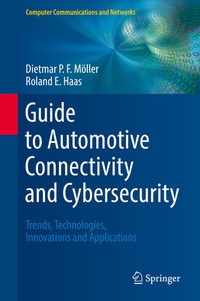
Guide to Automotive Connectivity and Cybersecurity
Description

This comprehensive text/reference presents an in-depth review of the state of the art of automotive connectivity and cybersecurity with regard to trends, technologies, innovations, and applications. The text describes the challenges of the global automotive market, clearly showing where the multitude of innovative activities fit within the overall effort of cutting-edge automotive innovations, and provides an ideal framework for understanding the complexity of automotive connectivity and cybersecurity.
Topics and features: discusses the automotive market, automotive research and development, and automotive electrical/electronic and software technology; examines connected cars and autonomous vehicles, and methodological approaches to cybersecurity to avoid cyber-attacks against vehicles; provides an overview on the automotive industry that introduces the trends driving the automotive industry towards smart mobility and autonomous driving; reviews automotive research and development, offering background on the complexity involved in developing new vehicle models; describes the technologies essential for the evolution of connected cars, such as cyber-physical systems and the Internet of Things; presents case studies on Car2Go and car sharing, car hailing and ridesharing, connected parking, and advanced driver assistance systems; includes review questions and exercises at the end of each chapter.The insights offered by this practical guide will be of great value to graduate students, academic researchers and professionals in industry seeking to learn about the advanced methodologies in automotive connectivity and cybersecurity.
Reviews / Votes
"The authors do a good job of explaining the rapid growth of IC T in the automotive industry. Importantly, the cybersecurity risks associated with this uptake are discussed--issues which the automotive industry, unlike the IT industry, would most likely not have previously encountered. This is a timely red flag to the industry that may help ensure cybersecurity risks are considered and addressed during vehicle systems design." (David B. Henderson, Computing Reviews, October 9, 2020)
More details
Other editions
Additional editions
Persons
Roland E. Haas is the Founder and CEO of QSO-Technologies in Bangalore, India. He has more than 20 years of professional experience in senior techno-managerial, business innovation and business development assignments in Germany, USA, India and Japan with broad experience in automotive R&D, aerospace R&D, engineering & IT services, consulting and strategy. As an entrepreneur, he serves as a mentor for startups, a researcher and a book author. He is an honorary professor at the International Institute of Information Technology (IIIT-B) and an adjunct faculty member of the Indian Institute of Science (IISc). His teaching is in mechatronics, automotive electronics, car IT, automotive software technologies, information management and virtual product creation.
Content
Introduction.- The Automotive Industry.- Automotive Research and Development.- Automotive E/E and Automotive Software Technology.- The Connected Car.- Automotive Cybersecurity.- Mobile Apps for the Connected Car.- Case Study A - Car2Go, Carsharing by Daimler.- Case Study B - Car Hailing and Ridesharing.- Case Study C - Connected Parking and Automated Value Parking.- Case Study D - ADAS and Autonomous Driving.- Summary, Outlook and Final Remarks.
