

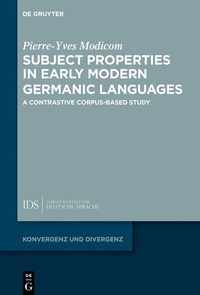
Subject Properties in Early Modern Germanic Languages
Description

This monograph is devoted to the cross-linguistic profile of subjects in Early Modern Germanic languages. The typologically complex question of subject criteria is addressed in a functional framework relying on recent developments in Construction Grammar. The set of data is extracted from a parallel corpus made up of the 1587 German chapbook about the life of Dr. Faustus and its English, Dutch and Danish translations, all of which had been published by 1592. At that time, the syntactic features of English subjects were still comparable to Continental languages like Danish, facilitating the inclusion of English in a cross-Germanic analysis.
The analysis makes use of two comparative concepts of subjecthood; argumental subjecthood, centred on the argument-structural characteristics of subjects, and informational subjecthood, which corresponds to the syntacticization of information-structural properties. Subjecthood is defined as a labile multi-level configuration of argumental and informational parameters. This approach sheds new light on notorious tricks of Germanic syntax such as oblique subjects, expletives, scrambling and subjectless passives.
More details
Other editions
Additional editions
Person
Content
- Intro
- Contents
- List of Abbreviations
- 1 Introduction: The trouble with subjects
- 2 Comparative concepts of subjecthood for Germanic languages
- 3 The pragmatics of clause syntax in Early Modern Germanic
- 4 Informational subjecthood between discourse structure and sentence structure: Ellipsis, anaphora and topicalization
- 5 Dissociation at the interface of informational and argumental structure
- 6 Oblique subjects and argumental subjecthood
- 7 Conclusion
- 8 References of the corpus
- 9 Bibliography
