

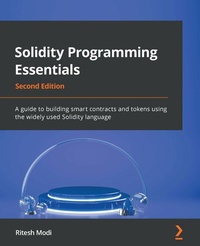
Solidity Programming Essentials
A guide to building smart contracts and tokens using the widely used Solidity language
2nd Edition
Published on 23. September 2024
412 pages
978-1-80323-479-3 (ISBN)
Description

A comprehensive guide sprinkled with lots of hands-on code samples to get you up and running with Solidity and writing your smart contracts on Blockchain and Ethereum
Key Features
Learn proven smart contract implementation challenges and solve them using Solidity
Go deeper into Solidity to write effective upgradable and maintainable smart contracts using best practices
Get to grips with the latest version of Solidity with updated codes and examples
Book DescriptionSolidity is a high-level language for writing smart contracts, and the syntax has large similarities with JavaScript, thereby making it easier for developers to learn, design, compile, and deploy smart contracts on large blockchain ecosystems including Ethereum and Polygon among others. This book guides you in understanding Solidity programming from scratch. The book starts with step-by-step instructions for the installation of multiple tools and private blockchain, along with foundational concepts such as variables, data types, and programming constructs. You'll then explore contracts based on an object-oriented paradigm, including the usage of constructors, interfaces, libraries, and abstract contracts. The following chapters help you get to grips with testing and debugging smart contracts. As you advance, you'll learn about advanced concepts like assembly programming, advanced interfaces, usage of recovery, and error handling using try-catch blocks. You'll also explore multiple design patterns for smart contracts alongside developing secure smart contracts, as well as gain a solid understanding of writing upgradable smart concepts and data modeling. Finally, you'll discover how to create your own ERC20 and NFT tokens from scratch. By the end of this book, you will be able to write, deploy, and test smart contracts in Ethereum.What you will learn
Write efficient, effective, and secure smart contracts
Code, compile, and test smart contracts in an object-oriented way
Implement assembly code in Solidity
Adopt upgradable and haltable ownership and security design patterns
Understand exception handling and debugging in Solidity
Create new ERC20 and NFT tokens from the ground up
Who this book is forThis Ethereum book is primarily aimed at beginners who want to get started with Solidity Programming for developing an Ethereum smart contract. No prior knowledge of EVM is required, but knowing the basics of any programming language will help you follow along.
Key Features
Learn proven smart contract implementation challenges and solve them using Solidity
Go deeper into Solidity to write effective upgradable and maintainable smart contracts using best practices
Get to grips with the latest version of Solidity with updated codes and examples
Book DescriptionSolidity is a high-level language for writing smart contracts, and the syntax has large similarities with JavaScript, thereby making it easier for developers to learn, design, compile, and deploy smart contracts on large blockchain ecosystems including Ethereum and Polygon among others. This book guides you in understanding Solidity programming from scratch. The book starts with step-by-step instructions for the installation of multiple tools and private blockchain, along with foundational concepts such as variables, data types, and programming constructs. You'll then explore contracts based on an object-oriented paradigm, including the usage of constructors, interfaces, libraries, and abstract contracts. The following chapters help you get to grips with testing and debugging smart contracts. As you advance, you'll learn about advanced concepts like assembly programming, advanced interfaces, usage of recovery, and error handling using try-catch blocks. You'll also explore multiple design patterns for smart contracts alongside developing secure smart contracts, as well as gain a solid understanding of writing upgradable smart concepts and data modeling. Finally, you'll discover how to create your own ERC20 and NFT tokens from scratch. By the end of this book, you will be able to write, deploy, and test smart contracts in Ethereum.What you will learn
Write efficient, effective, and secure smart contracts
Code, compile, and test smart contracts in an object-oriented way
Implement assembly code in Solidity
Adopt upgradable and haltable ownership and security design patterns
Understand exception handling and debugging in Solidity
Create new ERC20 and NFT tokens from the ground up
Who this book is forThis Ethereum book is primarily aimed at beginners who want to get started with Solidity Programming for developing an Ethereum smart contract. No prior knowledge of EVM is required, but knowing the basics of any programming language will help you follow along.
All prices
More details
Edition
2nd Revised edition
Language
English
Place of publication
Birmingham
United Kingdom
Target group
Professional and scholarly
US School Grade: College Graduate Student
Edition type
Revised edition
Product notice
Reflowable
File size
10,58 MB
ISBN-13
978-1-80323-479-3 (9781803234793)
Copyright in bibliographic data and cover images is held by Nielsen Book Services Limited or by the publishers or by their respective licensors: all rights reserved.
Schweitzer Classification
Other editions
Additional editions
Ritesh Modi
Solidity Programming Essentials
A guide to building smart contracts and tokens using the widely used Solidity language
Book
06/2022
2nd Edition
Packt Publishing
€49.90
Available immediately
Previous edition
Ritesh Modi
Solidity Programming Essentials
A beginner's guide to build smart contracts for Ethereum and blockchain
E-Book
09/2024
Packt Publishing
€24.99
Available for download
Person
Modi Ritesh :
Ritesh Modi is a technologist with more than 18 years of experience. He holds a master's degree in science in AI/ML from LJMU. He has been recognized as a Microsoft Regional Director for his contributions to building tech communities, products, and services. He has published more than 10 tech books in the past and is a cloud architect, speaker, and leader who is popular for his contributions to data centers, Azure, Kubernetes, blockchain, cognitive services, DevOps, AI, and automation.
Ritesh Modi is a technologist with more than 18 years of experience. He holds a master's degree in science in AI/ML from LJMU. He has been recognized as a Microsoft Regional Director for his contributions to building tech communities, products, and services. He has published more than 10 tech books in the past and is a cloud architect, speaker, and leader who is popular for his contributions to data centers, Azure, Kubernetes, blockchain, cognitive services, DevOps, AI, and automation.
Content
Table of Contents
Introduction to Blockchain, Ethereum, and Smart Contracts
Installing Ethereum and Solidity
Introducing Solidity
Global variables and functions
Expressions and control structure
Writing Smart Contracts
Functions, Modifiers, and Fallbacks
Exceptions, Events and Logging
Basics of Truffle and Unit Testing
Debugging contracts
Assembly Programming
Upgradable Smart Contracts
Writing Secure Contracts
Writing Token Contracts
Solidity Design Patterns
Introduction to Blockchain, Ethereum, and Smart Contracts
Installing Ethereum and Solidity
Introducing Solidity
Global variables and functions
Expressions and control structure
Writing Smart Contracts
Functions, Modifiers, and Fallbacks
Exceptions, Events and Logging
Basics of Truffle and Unit Testing
Debugging contracts
Assembly Programming
Upgradable Smart Contracts
Writing Secure Contracts
Writing Token Contracts
Solidity Design Patterns
