

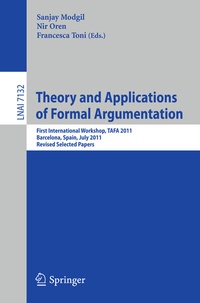
Theory and Applications of Formal Argumentation
First International Workshop, TAFA 2011. Barcelona, Spain, July 16-17, 2011, Revised Selected Papers
Published on 26. March 2012
X, 281 pages
978-3-642-29184-5 (ISBN)
Description

This book constitutes the thoroughly refereed proceedings of the First International Workshop on the Theory and Applications of Formal Argumentation, TAFA 2011, held in Barcelona, Spain, in Juli 2011, as a workshop at IJCAI 2011, the 22nd International Joint Conference on Artificial Intelligence. The 9 revised full papers presented together with 8 revised poster papers were carefully selected during two rounds of reviewing and improvement from 32 initial submissions. The workshop promotes and fosters uptake of argumentation as a viable AI paradigm with wide ranging application, and provides a forum for further development of ideas and the initiation of new and innovative collaborations. The papers cover the following topics: properties of formal models of argumentation; instantiations of abstract argumentation frameworks; relationships among different argumentation frameworks; practical applications of formal models of argumentation; argumentation and other artificial intelligence techniques; evaluation of formal models of argumentation; validation and evaluation of applications of argumentation.
More details
Other editions
Additional editions
Sanjay Modgil | Nir Oren | Francesca Toni
Theory and Applications of Formal Argumentation
First International Workshop, TAFA 2011. Barcelona, Spain, July 16-17, 2011, Revised Selected Papers
Book
03/2012
Springer
€53.49
Shipment within 7-9 days
Content
- Title
- Preface
- Organization
- Table of Contents
- Theory and Applications of Formal Argumentation
- Probabilistic Argumentation Frameworks
- Introduction
- Probabilistic Argumentation Frameworks
- Formalising Probabilistic Argumentation Frameworks
- Probabilistic Justification
- Approximate Solutions in Probabilistic Argumentation Frameworks
- Evaluation
- Applying PrAFs to Coalition Formation
- Discussion and Future Work
- Conclusions
- References
- Splitting Argumentation Frameworks: An Empirical Evaluation
- Introduction
- Background
- Argumentation Frameworks
- Labelling-Based Semantics
- Splitting Results
- Splittings and Strongly Connected Components (SCC)
- Algorithms
- Labelling Algorithms
- Computation of Splitting
- Experimental Results
- Conclusions
- References
- On the Complexity of Computing the Justification Status of an Argument
- Introduction
- Preliminaries
- Justification Status of Arguments
- Complexity Analysis
- General Complexity
- The Complexity of Weak Acceptance
- Conclusion
- References
- Arguments over Co-operative Plans
- Introduction
- Action Representation and Proposal
- Action Representation
- Action Combinations
- Action-Based Alternating Transition Systems
- Proposals for Action
- Plan Proposal and Critical Questions
- Critical Questions for Plan Proposals
- Example
- Related Work
- Conclusion
- References
- An Implemented Dialogue System for Inquiry and Persuasion
- Introduction
- Background
- Extending the Formalisation of Critical Questions
- The State Comparison Definition
- The Additional Critical Questions
- Extending the pAct Protocol
- Defining the Inquiry Protocol
- pAct Strategy
- Implementation
- Implementation Example
- Discussion and Concluding Remarks
- References
- An Argumentation Framework for Qualitative Multi-criteria Preferences
- Introduction
- Qualitative Preference Systems
- Argumentation Framework
- Abstract Argumentation Framework
- Arguments
- Defeat
- Language
- Inference Rules
- Correspondence between QPS and AF
- Reasoning with Background Knowledge
- Language
- Inferences
- Conclusion
- References
- Modeling and Solving AFs with a Constraint-Based Tool: ConArg
- Introduction
- Dung Argumentation
- Constraint Programming
- Mapping AFs to CSPs in ConArg
- Testing ConArg
- Hard Problems Solved with ConArg
- Related Work
- Conclusions and Future Work
- References
- Resource Boundedness and Argumentation
- Introduction
- Resource Boundedness and Traditional Conflicts
- The Resource-Bounded Argumentation Framework
- An Approach for RB-Compliant Extensions: Partitioning
- An Approach for RB-compliant Extensions: Modifying the RAF
- TheFITS Project: An Application for the RAF
- Discussion and Future Work
- Conclusions
- References
- An Empirical Study of a Deliberation Dialogue System
- Introduction
- Model
- Argumentation Model
- Dialogue System
- Consensus Forming
- Measuring Quality of Outcome
- Experimental Set Up
- Results
- Dialogue Is Significantly More Likely to Be Successful Than Consensus Forming
- Successful Dialogues Are More Likely with Higher Numbers of Actions and Values
- Quality of Dialogue Outcome Is Very Rarely Worse Than Quality of Consensus Outcome
- Successful Dialogue Outcomes Are More Likely to Be Globally Agreeable to Both Agents Than Successful Consensus Outcomes
- Average Dialogue Outcome Quality Score Is Higher Than Average Consensus Outcome Quality Score
- Dialogue Length Grows Exponentially with Increasing Arguments
- Discussion
- References
- Selective Revision by Deductive Argumentation
- Introduction
- Preliminaries
- Selective Multiple Base Revision
- Deductive Argumentation
- Selective Revision by Deductive Argumentation
- Related Work
- Conclusion
- References
- A Three-Layer Argumentation Framework
- Introduction
- Abstract Argumentation Frameworks
- Three-Layer Argumentation Framework
- Informal Overview
- Formal Definition
- A Walk-through Example
- A TLAF Model
- Instantiating a TLAF Model
- Deriving Arguments Relationships
- Deriving Support Relationships
- Deriving Attack Relationships
- Exploiting the Derivation Process
- Related Work
- Conclusions and Future Work
- References
- Stable Extensions in Timed Argumentation Frameworks
- Introduction
- Classic Abstract Argumentation
- Time Representation
- Timed Argumentation Framework
- Semantics for Timed Argumentation
- Conclusions and Future Work
- References
- Computing with Infinite Argumentation Frameworks: The Case of AFRAs
- Introduction
- Preliminary Background
- An Example: Moral Dilemmas
- Representing R in afras
- The dfa+ Representation of afras
- Computing the Grounded Extension with the dfa+ Representation
- Conclusions
- References
- Multi-sorted Argumentation
- Introduction
- Preliminaries
- Multi-sorted Argumentation
- Properties
- The Modal Fibring Approach
- Related Work
- Conclusion and Future Work
- References
- Conditional Labelling for Abstract Argumentation
- Introduction
- Background
- Conditional Labels
- Creating Conditional Labels
- Related Work
- Summary
- References
- Bottom-Up Argumentation
- Introduction
- Motivation
- Annotations
- Assumption-Based Argumentation
- An ABA Mapping for Bottom-Up Argumentation
- Conclusions
- References
- A First Step towards Argumentation Dialogues for Discovery
- Introduction
- Background
- Motivating Example
- Goals and Discovery Dialogues
- Debate Trees
- Formal Results
- Related Work
- Conclusion
- References
- Author Index
