

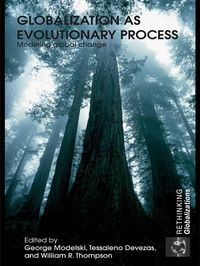
Globalization as Evolutionary Process
Modeling Global Change
Published on 20. December 2007
464 pages
978-1-135-97763-4 (ISBN)
Description

The term globalization has gained widespread popularity; yet most treatments are either descriptive and/or focused on changes in economic interconnectivity. In this volume the concept is seen in broader terms as leading international experts from a range of disciplines develop a long-term analysis to address the problems of globalization.
The editors and contributors develop a framework for understanding the origins and trajectory of contemporary world trends, constructing testable and verifiable models of globalization. They demonstrate how the evolutionary approach allows us to view globalization as an enterprise of the human species as a whole focusing on the analytical problem of global change and the rules governing those changes. The emphasis is not on broad-based accounts of the course of world affairs but, selectively, on processes that reshape the social of the human species, the making of world opinion and the innovations that animate these developments.
Chapters are clustered into four foci. One emphasizes the interpretation of globalization as an explicitly evolutionary process. A second looks at historical sequences of such phenomena as population growth or imperial rise and decline as processes that can be modeled and not purely described. The third cluster examines ongoing changes in economic processes, especially information technology. A final cluster takes on some of the challenges associated with forecasting and simulating the complexities of globalization processes.
This innovative and important volume will be of interest to students and scholars across the social sciences concerned with the phenomenon of globalization.
The editors and contributors develop a framework for understanding the origins and trajectory of contemporary world trends, constructing testable and verifiable models of globalization. They demonstrate how the evolutionary approach allows us to view globalization as an enterprise of the human species as a whole focusing on the analytical problem of global change and the rules governing those changes. The emphasis is not on broad-based accounts of the course of world affairs but, selectively, on processes that reshape the social of the human species, the making of world opinion and the innovations that animate these developments.
Chapters are clustered into four foci. One emphasizes the interpretation of globalization as an explicitly evolutionary process. A second looks at historical sequences of such phenomena as population growth or imperial rise and decline as processes that can be modeled and not purely described. The third cluster examines ongoing changes in economic processes, especially information technology. A final cluster takes on some of the challenges associated with forecasting and simulating the complexities of globalization processes.
This innovative and important volume will be of interest to students and scholars across the social sciences concerned with the phenomenon of globalization.
Reviews / Votes
'The editors of this volume should be highly and widely commended for recruiting so many distinguished natural and social scientists as well as historians to their noble endeavour to bring heuristic perspectives, innovative approaches and theoretical rigour to the study of globalization as an evolutionary process. No scholar who shares their view that historical understanding will help to promote a sense of global citizenship could fail to learn from this unusual but impressive collaborative venture to construct new paradigms for historical research into the origins of the accelerated globalization of our times.'Patrick O'Brien, FBA, Centennial Professor and Convenor of the Network in Global Economic History, London School of Economics, UK
'This single volume codifies the position of the evolutionary perspective as a powerful school of thought in international relations. Setting its analytical sights on explaining globalization, 19 fascinating chapters take the reader from the key theoretical components of an evolutionary orientation through advances in modeling, the impact of information age phenomena, forecasting and simulation. This volume delivers much more than is promised, and concludes with a thoughtful assessment of what has been accomplished and the challenges that remain.'
Robert A. Denemark, University of Delaware, USA
'This book makes a significant contribution to the scientific study of globalization. Multidimensional rather than narrowly economistic, social-scientific rather than speculative-polemical, the book collects a diverse set of pieces on the large-scale and long-term in world politics and economy, while yet asserting a definite and distinctive position in the globalization controversy.'
David Wilkinson, Professor of Political Science, University of California, Los Angeles, USA
'This book presents a great many thought provoking multi-disciplinary insights into the long-term process of globalization. It offers an excellent contribution to the discussion of how globalization has been proceeding during the past five centuries.'
Fred Spier, University of Amsterdam, the Netherlands
More details
Series
Language
English
Place of publication
London
United Kingdom
Publishing group
Taylor & Francis Ltd
Target group
College/higher education
Product notice
Reflowable
Illustrations
91 s/w Abbildungen, 26 s/w Tabellen, 91 s/w Zeichnungen
26 Tables, black and white; 91 Line drawings, black and white; 91 Illustrations, black and white
File size
3,11 MB
ISBN-13
978-1-135-97763-4 (9781135977634)
Copyright in bibliographic data and cover images is held by Nielsen Book Services Limited or by the publishers or by their respective licensors: all rights reserved.
Schweitzer Classification
Other editions
Additional editions
George Modelski | Tessaleno Devezas | William R. Thompson
Globalization as Evolutionary Process
Modeling Global Change
Book
12/2007
1st Edition
Routledge
€263.60
Shipment within 15-20 days
George Modelski | Tessaleno Devezas | William R. Thompson
Globalization as Evolutionary Process
Modeling Global Change
Book
12/2007
1st Edition
Routledge
€87.60
Shipment within 15-20 days
Persons
George Modelski is Emeritus Professor at the Department of Political Science, University of Washington, USA.
Tessaleno Devezas is Associate Professor at the Department of Electromechanics of the University of Beira Interior, Covilha, Portugal.
William R. Thompson is Donald A. Rogers Professor of Political Science at Indiana University, Bloomington, USA.
Tessaleno Devezas is Associate Professor at the Department of Electromechanics of the University of Beira Interior, Covilha, Portugal.
William R. Thompson is Donald A. Rogers Professor of Political Science at Indiana University, Bloomington, USA.
Content
Preface Joao Caraca. Foreword Nebojsa Nakicenovic 1. Introduction: A New Approach to Globalization George Modelski, Tessaleno Devezas and William R. Thompson Part 1: Evolutionary Models 2. Globalization as Evolutionary Process George Modelski 3. The Portuguese as System Builders: Technological Innovation in Early Globalization Tessalino Devezas and George Modelski 4. Modeling Long-term Processes of Political Globalization William R. Thompson 5. Is Globalization Self-Organizing? Joachim Karl Rennstich 6. Theories of Long-Term Change and the Future of World Political Institutions Fulvio Attina Part 2: Models of Long-Term Change 7. Compact Mathematical Models of World System Development, and How they can Help us to Clarify our Understanding of Globalization Processes Andrey Korotayev 8. Modeling Periodic Waves of Integration in the Afroeurasian World System Peter Turchin 9. Discovering Oscillatory Dynamics of City-Size Distributions in World Historical Systems Douglas R. White, Natasa Kejzar and Laurent Tambayong 10. Nature, Disease and Globalization: An Evolutionary Perspective Dennis Pirages 11. Globalization in History and the History of Globalization: The Application of a Globalization Model to Historical Research Catia Antunes Part 3: Global Change and the Information Age 12. Three Globalizing Phases of the World System and Modernity Shumpei Kumon and Yasuhide Yamanouchi 13. Accelerating Socio-Technological Evolution: From Ephemeralization and Stigmergy to the Global Brain Francis Heylighen 14. Growth of the Internet, Long Waves and Global Change Tessaleno C. Devezas, Harold A. Linstone and Humberto J.S. Santos 15. The Value to Globalizing Informatics Research of an Evolutionary View: One Anthropologist's Perspective David Hakken Part 4: Forecasting and Simulating Globalization 16. Forecasting Globalization: The Use of International Futures (Ifs) Barry Hughes 17. Forecasting Globalization Using World Models Rafael Reuveny 18. Evolution, Modernization and Globalization: Computer-Based Analysis of Social Complexity Jurgen Kluver and Christina Kluver Part 5: Assessment 19. Assessment: What Has Been Learnt? George Modelski, Tessaleno Devezas and William R. Thompson
