

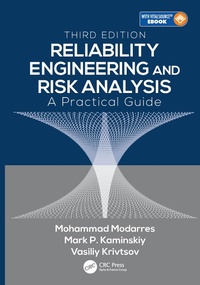
Reliability Engineering and Risk Analysis
A Practical Guide, Third Edition
3rd Edition
Published on 25. November 2016
522 pages
978-1-4987-4588-8 (ISBN)
Description

This undergraduate and graduate textbook provides a practical and comprehensive overview of reliability and risk analysis techniques. Written for engineering students and practicing engineers, the book is multi-disciplinary in scope. The new edition has new topics in classical confidence interval estimation; Bayesian uncertainty analysis; models for physics-of-failure approach to life estimation; extended discussions on the generalized renewal process and optimal maintenance; and further modifications, updates, and discussions. The book includes examples to clarify technical subjects and many end of chapter exercises. PowerPoint slides and a Solutions Manual are also available.
Reviews / Votes
"This book is comprehensive in coverage and insightful in presentation. It would be very useful to practitioners (for both training and reference purposes) because of the inclusion of realistic examples and case studies. The treatment of data analysis techniques is at the right level - not too mathematical for non-theoreticians yet not without the necessary rigor."-T.N. Goh, National University of Singapore
More details
Edition
3rd edition
Language
English
Place of publication
London
United Kingdom
Publishing group
Taylor & Francis Ltd
Target group
College/higher education
Illustrations
85 Tables, black and white; 238 Illustrations, black and white
File size
10,10 MB
ISBN-13
978-1-4987-4588-8 (9781498745888)
Copyright in bibliographic data and cover images is held by Nielsen Book Services Limited or by the publishers or by their respective licensors: all rights reserved.
Schweitzer Classification
Other editions
Additional editions
Mohammad Modarres | Mark P. Kaminskiy | Vasiliy Krivtsov
Reliability Engineering and Risk Analysis
A Practical Guide, Third Edition
Book
12/2016
3rd Edition
CRC Press
€141.50
Shipment within 15-20 days
Persons
Mohammad Modarres has a well-established and extensive history of academic research, teaching, and administrative services at the A.J. Clark School of Engineering, University of Maryland. Early in his career, he proposed and established the Reliability Engineering Graduate Program. Subsequently, this program grew and now is a leading academic curriculum in reliability engineering and risk analysis in the world. During his academic career, he has served in a number of leadership roles, including director of the Center for Risk and Reliability, director of Nuclear Engineering Program, and leader of the Division of Design and Reliability of Systems at the Department of Mechanical Engineering. He is an expert in probabilistic risk assessment and management, uncertainty analysis, probabilistic physics of failure, and degradation and damage modeling of systems, structures, and components. His research areas include fatigue- and corrosion- based degradation assessment of airframes, nuclear reactor vessels, support structures, and piping of advanced nuclear plants using probabilistic physics of failure, including characterization of all uncertainties. His interests in reliability, integrity, prognosis, and health management of structures include theoretical as well as experimental and model development for condition monitoring and assessment of remaining useful life. He is an expert in probabilistic model development and updating using Bayesian inference methods, data fusion, and sensor-based big data analyses.
Dr. Modarres is a University of Maryland Distinguished Scholar-Teacher, a fellow of the American Nuclear Society, and a recipient of multiple awards. He earned his engineer's degree, MS, and PhD in nuclear engineering from MIT, and MS in mechanical engineering also from MIT. For detailed publications and information about his research activities, visit http://www.modarres.umd.edu/.
Mark P. Kaminskiy is currently a principal reliability engineer at the NASA Goddard Space Flight Center (via ARES Corporation). He has conducted numerous research and consulting projects funded by the government for the Department of Transportation, Coast Guards, Army Corps of Engineers, Navy, Nuclear Regulatory Commission, and American Society of Mechanical Engineers, and by corporations for Ford Motor, Qualcomm Inc., and some other engineering companies. He has taught several graduate courses on reliability engineering at the University of Maryland. Dr. Kaminskiy is the author and coauthor of more than 60 professional publications, including two books on reliability and risk analysis, and chapters in many books on statistical reliability and risk analysis. He earned his MS in nuclear physics from the Polytechnic University of St. Petersburg, Russia and PhD in electrical engineering from the Electrotechnical University of St. Petersburg, Russia.
Vasiliy Krivtsov is a practitioner and consultant in reliability engineering, risk analysis, and applied statistics, employed by Ford Motor Company as a senior staff technical specialist. He also holds the position of adjunct associate professor of reliability engineering at the University of Maryland, where he teaches a graduate course on reliability data analysis.
Dr. Krivtsov earned his PhD in electrical engineering from Kharkov Polytechnic Institute, Ukraine and PhD in reliability engineering from the University of Maryland, USA. He is the author and coauthor of more than 60 professional publications, including two books on reliability engineering and risk analysis, nine patented inventions, and six trade secret inventions on statistical algorithms for Ford. He is a member of the editorial board of Elsevier's international journal Reliability Engineering & System Safety, vice chair of the International Reliability K26963_Book.indb 17 27-08-2016 12:57:19 xviii Authors Symposium (RAMS (R)) Tutorials Committee, and a senior member of IEEE. Prior to Ford, Dr. Krivtsov held the position of associate professor of electrical engineering, Kharkov Institute of Electric Power & Computer Technology, Ukraine, and that of graduate research assistant at the University of Maryland Center for Reliability Engineering. Further information on his professional activity is available at http://www.krivtsov.net/.
Dr. Modarres is a University of Maryland Distinguished Scholar-Teacher, a fellow of the American Nuclear Society, and a recipient of multiple awards. He earned his engineer's degree, MS, and PhD in nuclear engineering from MIT, and MS in mechanical engineering also from MIT. For detailed publications and information about his research activities, visit http://www.modarres.umd.edu/.
Mark P. Kaminskiy is currently a principal reliability engineer at the NASA Goddard Space Flight Center (via ARES Corporation). He has conducted numerous research and consulting projects funded by the government for the Department of Transportation, Coast Guards, Army Corps of Engineers, Navy, Nuclear Regulatory Commission, and American Society of Mechanical Engineers, and by corporations for Ford Motor, Qualcomm Inc., and some other engineering companies. He has taught several graduate courses on reliability engineering at the University of Maryland. Dr. Kaminskiy is the author and coauthor of more than 60 professional publications, including two books on reliability and risk analysis, and chapters in many books on statistical reliability and risk analysis. He earned his MS in nuclear physics from the Polytechnic University of St. Petersburg, Russia and PhD in electrical engineering from the Electrotechnical University of St. Petersburg, Russia.
Vasiliy Krivtsov is a practitioner and consultant in reliability engineering, risk analysis, and applied statistics, employed by Ford Motor Company as a senior staff technical specialist. He also holds the position of adjunct associate professor of reliability engineering at the University of Maryland, where he teaches a graduate course on reliability data analysis.
Dr. Krivtsov earned his PhD in electrical engineering from Kharkov Polytechnic Institute, Ukraine and PhD in reliability engineering from the University of Maryland, USA. He is the author and coauthor of more than 60 professional publications, including two books on reliability engineering and risk analysis, nine patented inventions, and six trade secret inventions on statistical algorithms for Ford. He is a member of the editorial board of Elsevier's international journal Reliability Engineering & System Safety, vice chair of the International Reliability K26963_Book.indb 17 27-08-2016 12:57:19 xviii Authors Symposium (RAMS (R)) Tutorials Committee, and a senior member of IEEE. Prior to Ford, Dr. Krivtsov held the position of associate professor of electrical engineering, Kharkov Institute of Electric Power & Computer Technology, Ukraine, and that of graduate research assistant at the University of Maryland Center for Reliability Engineering. Further information on his professional activity is available at http://www.krivtsov.net/.
Content
Reliability Engineering in Perspective. Basic Reliability Mathematics: Review of Probability and Statistics.Component Analysis. System Reliability Analysis. Reliability and Availability of Repairable Components and Systems. Selected Topics in Reliability Modeling. Selected Topics in Reliability Data Analysis. Risk Analysis
