

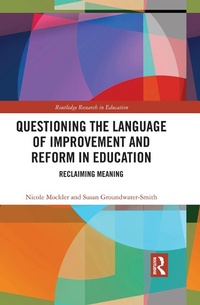
Questioning the Language of Improvement and Reform in Education
Reclaiming Meaning
1st Edition
Published on 11. May 2018
166 pages
978-1-315-51956-2 (ISBN)
Description

Questioning the Language of Improvement and Reform in Education challenges the language used in education by linking the language of both the public and professional domains with the changing intentions of the governance of education. Exploring various issues, which embody the many manifestations of the manner in which strident, conservative language has captured the public view of education, the book covers topics such as the importance of language in the context of educational practice, the media's portrayal of teachers globally, the role of students in the face of curriculum reform and the language used in educational policy worldwide.
The book addresses the ways in which the words 'improvement' and 'reform' have been appropriated and hollowed-out by policymakers in order to justify globalised education policies. Using international case studies and reports, the authors argue that the employment of specific words masks the reality that new educational policies are regressive and require re-examination, while perpetuating the illusion that progressive educational practice is being brought to the fore.
Questioning the Language of Improvement and Reform in Education is a fascinating and original take on this topic, which will be of great interest to educational practitioners, policymakers and linguists.
The book addresses the ways in which the words 'improvement' and 'reform' have been appropriated and hollowed-out by policymakers in order to justify globalised education policies. Using international case studies and reports, the authors argue that the employment of specific words masks the reality that new educational policies are regressive and require re-examination, while perpetuating the illusion that progressive educational practice is being brought to the fore.
Questioning the Language of Improvement and Reform in Education is a fascinating and original take on this topic, which will be of great interest to educational practitioners, policymakers and linguists.
Reviews / Votes
"This generous, articulate book reveals how the economic discourse of neoliberalism misconstrues the field and the work of education. It shows what neoliberal discourse does not see, and cannot construe: what education means, for individual persons and for societies. Against the hollow utilitarianism of much contemporary education policy, the authors make a clear and compelling case for renewing, for the 21st century, the aspirations of progressive education to secure 'a world worth living in' - in which people practise practical wisdom, and the virtues of 'respectfulness, steadfastness, grace, courage, generosity, gratitude, and a concern for social justice'."Professor Emeritus Stephen Kemmis, Charles Sturt University.
"Mockler and Groundwater-Smith have done all of us in the education community a huge service in this timely and important book. By unpicking the pervasive and pernicious international language of 'reform and improvement' that now pervades policy discourse across the world, they show carefully and systematically how it undermines the very process of highly quality teaching and learning itself. Based firmly on evidence from three major English speaking jurisdictions (Australia, England and the USA) the book lays bare the hollow nature of so much contemporary educational policy. Instead it argues for a vision of education based on moral values - respectfulness, steadfastness, grace, courage, generosity, gratitude and a concern for social justice. It is a book not to be missed; essential reading for everyone with a passion for genuine education."
John Furlong, Emeritus Professor of Education, University of Oxford.
"This is an important book which engages in a searing, effective critique of the current education policy conditions in the name of 'decent schooling conditions' characterised by a sense of humanity, dignity and wide purpose or meaning. The trap of being driven by nostalgia, something so favoured by populists, is also an important warning. I urge you to read it."
Professor Colleen McLaughlin, Director of Educational Reform, University of Cambridge Faculty of Education, UK.
More details
Series
Edition
1. Auflage
Language
English
Place of publication
London
United Kingdom
Publishing group
Taylor & Francis Ltd
Target group
College/higher education
Professional and scholarly
Illustrations
13 Tables, black and white; 3 Line drawings, black and white
ISBN-13
978-1-315-51956-2 (9781315519562)
Copyright in bibliographic data and cover images is held by Nielsen Book Services Limited or by the publishers or by their respective licensors: all rights reserved.
Schweitzer Classification
Other editions
Additional editions
Nicole Mockler | Susan Groundwater-Smith
Questioning the Language of Improvement and Reform in Education
Reclaiming Meaning
Book
02/2020
1st Edition
Routledge
€65.40
Shipment within 15-20 days
Nicole Mockler | Susan Groundwater-Smith
Questioning the Language of Improvement and Reform in Education
Reclaiming Meaning
Book
05/2018
1st Edition
Routledge
€215.41
Shipment within 10-20 days
Persons
Nicole Mockler is Associate Professor in the Sydney School of Education and Social Work at the University of Sydney, Australia, and a University of Sydney SOAR Fellow 2018-2019.
Susan Groundwater-Smith is Honorary Professor of Education at the University of Sydney, Australia, and Chair of the Teacher Education Advisory Board.
Susan Groundwater-Smith is Honorary Professor of Education at the University of Sydney, Australia, and Chair of the Teacher Education Advisory Board.
Content
Chapter 1. Language matters Chapter 2. The Language of Reform in Education Policy Chapter 3. The Seduction of Effectiveness Chapter 4. Compliance, Voice and Power Chapter 5. The Language of Reform and Teachers' Work Chapter 6. The work of learners in the face of curriculum reform Chapter 7. Toward Practical Wisdom Chapter 8. The 'Mediation' of Educational Reform and Improvement Chapter 9. Beyond Nostalgia
