

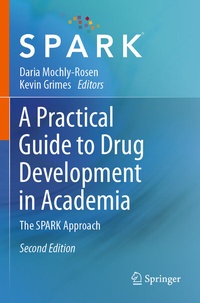
A Practical Guide to Drug Development in Academia
Description

"A lot of hard-won knowledge is laid out here in a brief but informative way. Every topic is well referenced, with citations from both the primary literature and relevant resources from the internet." Review of first edition from Nature Chemical Biology
Written by the founders of the SPARK program at Stanford University, this book is a practical guide designed for professors, students and clinicians at academic research institutions who are interested in learning more about the drug development process and how to start transforming their basic research discoveries into novel drugs. Often many potentially transformative basic science discoveries are not pursued because they are deemed 'too early' to attract industry interest. This comprehensive book lays out simple, relatively cost-effective things that academic researchers can do to advance their findings to the point that they can be tested in the clinic or attract more industry interest.Each chapter broadly discusses an important topic in drug development, from discovery, optimization and preclinical studies through clinical trial design, regulatory issues and marketing assessments. After the practical overview provided here, the reader is encouraged to consult more detailed texts on specific topics of interest.
The SPARK model has been adopted in over 60 institutions on six continents, and the program has been honored with multiple awards including the 2020 Xconomy Award for Ecosystem Development, the 2020 Cures Within Reach Award for Patient Impact Research, and the 2022 California Life Sciences Pantheon Award for Academia, Non-Profits, & Research.The new edition updates every chapter with the latest developments since the 2014 publication of the first edition.
More details
Other editions
Additional editions
Previous edition
Persons
Kevin Grimes, M.D., M.B.A., is a Professor of Chemical and Systems Biology at Stanford University School of Medicine and Co-director of SPARK at Stanford. He received his M.D. from Brown University and after his internship and residency at Stanford, he joined the Stanford faculty as Clinical Assistant Professor of Medicine. Dr. Grimes then received his M.B.A from Stanford University and served as a White House Fellow. He later worked in the medical device and biotechnology sectors before returning to academia. He currently teaches drug discovery and development and teaches and practices internal medicine at Stanford.
