

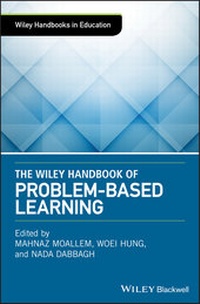
The Wiley Handbook of Problem-Based Learning
Description

The Wiley Handbook of Problem-Based Learning is the first book of its kind to present a collection of original essays that integrate the research and practice of problem-based learning in one comprehensive volume. With contributions from an international panel of leading scholars, researchers, practitioners and educational and training communities, the handbook is an authoritative, definitive, and contemporary volume that clearly demonstrates the impact and scope of research-based practice in problem-based learning (PBL).
After many years of its successful implementation in medical education curricula, problem-based learning is now being emphasized and practiced more widely in K-12, higher education, and other professional fields. The handbook provides timely and stimulating advice and reflection on the theory, research, and practice of PBL. Throughout the book the contributors address the skills needed to implement PBL in the classroom and the need for creating learning environments that are active, collaborative, experiential, motivating and engaging. This important resource:
* Addresses the need for a comprehensive resource to problem-based learning research and implementation
* Contains contributions from an international panel of experts on the topic
* Offers a rich collection of scholarly writings that challenge readers to refresh their knowledge and rethink their assumptions
* Takes an inclusive approach that addresses the theory, design, and practice of problem-based learning
* Includes guidelines for instructional designers, and implementation and assessment strategies for practitioners
Written for academics, students, and practitioners in education, The Wiley Handbook of Problem-Based Learning offers a key resource to the most recent information on the research and practice of problem-based learning.
More details
Other editions
Additional editions
Content
Notes on Contributors
Mark A. Albanese is an Emeritus Professor of Educational Psychology and Population Health at the Schools of Education and Medicine and Public Health at the University of Wisconsin-Madison and Director of Testing and Research for the National Conference of Bar Examiners. Among other awards, he received the 1998 John P. Hubbard Award from the National Board of Medical Examiners for "significant contributions to the pursuit of excellence in the field of evaluation in medicine." Albanese has authored over 125 articles in peer-reviewed publications.
Ulisses F. Araújo is a Professor at the School of Arts, Sciences and Humanities of the University of São Paulo, and President of the PAN-PBL: an Association of Problem-Based Learning and Active Learning Methodologies. He is the Scientific Director of the Research Center on New Pedagogical Architectures at the University of São Paulo. From 2014 to 2017 he was the pedagogical Course Director of the Virtual University of Sao Paulo, in charge of designing and implementing a blended perspective that articulates face-to-face sessions with the use of different digital languages, tools, and other active methodologies for collaborative projects. His main research and study goals are the development of programs, courses, and methods that articulate emerging technologies with active learning methodologies, as the main tool to rethink time, space, and relations in education.
Denis Bédard is a Full Professor in the Department of Pedagogy at the Université de Sherbrooke, Canada. Professor Bédard received a PhD from McGill University in educational psychology in 1993. He has been active as a researcher in the field of higher education teaching and learning, initially interested by the role of context on knowledge acquisition, he has, for the past 15 years, oriented his research on the innovation process both at the pedagogical and curricular levels. For his early work, he earned the Glen L. Martin Best Paper Award from the American Society for Engineering Education in 1997. In 2009, he co-edited a book published at the Presses Universitaires de France: Innover en enseignement supérieur. He is currently Vice-President of the European Network for Research on Innovation in Higher Education and of the association Questions de pédagogie en enseignement supérieur ().
Brian R. Belland is an Associate Professor of Instructional Technology and Learning Sciences at Utah State University. His research centers on the use of technology to support students argumentation and problem-solving abilities while engaged in ill-structured problem solving.
Dr. Roy Bhakta is a Research Fellow and joined the University of Worcester in 2015 having previously worked at Coventry University. His interests are focused on the use of technology to improve learning, psychology of achievement, and engagement within higher education with a focus on STEM. In addition to research, he is involved in research student supervision, and teaching research methods and statistics. In the past, Roy has worked as a programmer and also taught students in the schools, colleges, and higher education sectors.
Pia Bøgelund is an Associate Professor in Facilitation of problem-based learning () at the Aalborg Centre for Problem Based Learning in Engineering Science and Sustainability under the auspices of the United Nations Educational, Scientific and Cultural Organization () (UCPBL) at Aalborg University. Her current areas of research are facilitation of group work and group dynamics, motivation, and conflict management within engineering education. Retention and drop-out among 1 year engineering students is another important research area as well as PhD supervision, with a special emphasis on the facilitation of international PhD students.
Phyllis Blumberg is an Assistant Provost for Faculty and Assessment Development, the Director of the Teaching and Learning Center and Professor of Social Sciences and Education at the University of the Sciences. Blumberg is the author of more than 60 articles on active learning, learner-centered teaching, PBL, and program assessment. Her books include a guide on how to implement learner-centered teaching, Developing Learner-Centered Teaching: A Practical Guide for Faculty (2009, Jossey-Bass) and a book that describes a new way to self-assess and improve teaching, Assessing and Improving Your Teaching: Strategies and Rubrics for Faculty Growth and Student Learning (2014, Jossey-Bass). Blumberg earned her doctorate in educational and developmental psychology from the University of Pittsburgh, Learning Research and Development Center in 1976.
Dr. Susan M. Bridges is Assistant Dean (Curriculum Innovation) with the Faculty of Education and the Centre for the Enhancement of Teaching and Learning, Honorary Associate Professor with Bau Institute of Medical and Health Sciences Education () at the Li Ka Shing Faculty of Medicine at the University of Hong Kong () and Adjunct Professor at the Australian Catholic University (). She is an award-winning teacher and researcher, and leads curriculum re-design and staff development projects in higher education. Her locally and internationally funded research explores the "how" of effective pedagogy and communication in the health sciences through interactional and ethnographic approaches. She is interested in integrated curriculum designs and inquiry-based learning and how educational technologies can support and enhance these. She has recently joined the Editorial Board for the Interdisciplinary Journal of Problem-Based Learning.
Dr. Bee Leng Chua is a Senior Lecturer in the Psychological Studies Academic Group at National Institute of Education, Nanyang Technological University, Singapore. Dr. Chua has conducted research in the areas of PBL, mediated learning, motivation, cognition, and use of technology in teaching and learning. She serves on the Editorial Board of the Interdisciplinary Journal of Problem-Based Learning and Educational Research for Policy and Practice. She is currently the Vice-President of Educational Research Association of Singapore () and Vice-President (Asia-Pacific) for the International Association for Cognitive Education and Psychology.
Nada Dabbagh is Professor and Director of the Division of Learning Technologies in the College of Education and Human Development at George Mason University in Fairfax, Virginia. Dr. Dabbagh teaches graduate courses in instructional design, e-Learning pedagogy, and cognition and technology in the Instructional Design and Technology () Master's program and the Learning Technologies Design Research () PhD program of the Division of Learning Technologies. Her research explores the pedagogical ecology of technology mediated learning environments with the goal of understanding the social and cognitive consequences of learning systems design. Specific research areas include personal learning environments (), case problem generation and representation in PBL, and supporting student self-regulation in online and blended learning. Dr. Dabbagh has an extensive publication record including three authored books and over 100 research papers and book chapters. For more information about Dr. Dabbagh, visit http://cehd.gmu.edu/people/faculty/ndabbagh
Diana H. J. M. Dolmans is a Professor in the field of innovative learning arrangements and a staff member of the School of Health Professions Education () at Maastricht University, The Netherlands. Her research focuses on key success factors of innovative curricula within higher education. She holds an MSc in educational sciences (1989) and a PhD (1994). Her PhD dealt with PBL and was obtained at Maastricht University. She is mainly interested in how to optimize the learning environment. Her topics of interest are PBL, faculty development, and quality assurance. Her line of research within PBL is internationally well acknowledged. She is the Educational Director of the Interuniversity Centre for Educational Research (), a research school in which 15 Dutch and Flemish universities collaborate in offering a training program for their PhD candidates in educational sciences. Finally, she is Associate Editor of Advances in Health Sciences Education, Editorial Board member of several international journals and has over 100 papers in refereed international journals.
Mary English is Associate Director in the Center for Advancing Teaching and Learning at Northeastern University. She has a background in educational psychology and instructional systems design and technology. Her research interests focus on student motivation and self-regulated learning, and the design of PBL, service-learning, and other experiential learning environments.
Peggy A. Ertmer is Professor Emerita of Learning Design and Technology at Purdue University. Her research interests relate to technology integration, teacher beliefs, and helping students become expert instructional designers, specifically through the use of case-based and PBL methods. She is the Founding Editor of the...
