

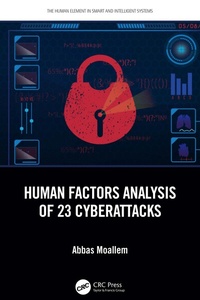
Human Factors Analysis of 23 Cyberattacks
1st Edition
Published on 31. March 2025
198 pages
978-1-040-32843-9 (ISBN)
Description

As cyber threat actors have become more sophisticated, data breaches, phishing attacks, and ransomware are increasing, and the global cybercrime damage in 2021 was $16.4 billion a day. While technical issue analyses are fundamental in understanding how to improve system security, analyzing the roles of human agents is crucial. Human Factors Analysis of 23 Cyberattacks addresses, through examples, the human factors behind cybersecurity attacks.
Focusing on human factors in individual attack cases, this book aims to understand the primary behaviors that might result in the success of attacks. Each chapter looks at a series of cases describing the nature of the attack through the reports and reviews of the experts, followed by the role and human factors analysis. It investigates where a human agent's intervention was a factor in starting, discovering, monitoring, or suffering from the attacks. Written in an easy-to-understand way and free from technical jargon, the reader will develop a thorough understanding of why cyberattacks occur and how they can be mitigated by comparison to the practical examples provided.
This title will appeal to students and practitioners in the fields of ergonomics, human factors, cybersecurity, computer engineering, industrial engineering, and computer science.
Focusing on human factors in individual attack cases, this book aims to understand the primary behaviors that might result in the success of attacks. Each chapter looks at a series of cases describing the nature of the attack through the reports and reviews of the experts, followed by the role and human factors analysis. It investigates where a human agent's intervention was a factor in starting, discovering, monitoring, or suffering from the attacks. Written in an easy-to-understand way and free from technical jargon, the reader will develop a thorough understanding of why cyberattacks occur and how they can be mitigated by comparison to the practical examples provided.
This title will appeal to students and practitioners in the fields of ergonomics, human factors, cybersecurity, computer engineering, industrial engineering, and computer science.
More details
Series
Edition
1. Auflage
Language
English
Place of publication
London
United Kingdom
Publishing group
Taylor & Francis Ltd
Target group
College/higher education
Professional and scholarly
Illustrations
1 Tables, black and white; 5 Line drawings, black and white; 5 Illustrations, black and white
File size
2,99 MB
ISBN-13
978-1-040-32843-9 (9781040328439)
Copyright in bibliographic data and cover images is held by Nielsen Book Services Limited or by the publishers or by their respective licensors: all rights reserved.
Schweitzer Classification
Other editions
Additional editions
Abbas Moallem
Human Factors Analysis of 23 Cyberattacks
Book
approx. 06/2026
1st Edition
CRC Press
€69.00
Not yet published

Abbas Moallem
Human Factors Analysis of 23 Cyberattacks
Book
04/2025
CRC Press
Unfortunately, price unknown
Available (delivery time upon request)
Abbas Moallem
Human Factors Analysis of 23 Cyberattacks
Book
03/2025
1st Edition
CRC Press
€121.00
Shipment within 10-20 days
Person
Abbas Moallem, Ph.D., is a consultant and adjunct professor at San Jose State University, California, where he teaches human-computer interaction, cybersecurity, information visualization, and human factors. He is also the program chair of HCI-CPT, the International Conference on HCI for Cybersecurity, Privacy, and Trust, and the track chair of the International Conference on Human Factors in Cybersecurity.
Dr. Moallem is the editor of Human-Computer Interaction and Cybersecurity Handbook, Smart and Intelligent Systems, The Human Elements in Artificial Intelligence, Robotics, and Cybersecurity, Cybersecurity Awareness Among Students and Faculty, Understanding Cybersecurity Technologies, A Guide to Selecting the Right Cybersecurity Tools. He is also the editor of a book series from CRC Press titled The Human Element in Smart and Intelligent Systems.
Dr. Moallem is the editor of Human-Computer Interaction and Cybersecurity Handbook, Smart and Intelligent Systems, The Human Elements in Artificial Intelligence, Robotics, and Cybersecurity, Cybersecurity Awareness Among Students and Faculty, Understanding Cybersecurity Technologies, A Guide to Selecting the Right Cybersecurity Tools. He is also the editor of a book series from CRC Press titled The Human Element in Smart and Intelligent Systems.
Content
Contents
Acknowledgments
About the author
Introduction
Part 1: Human and Motivation
Chapter 1: Human Agents
Chapter 2: Cyberattackers versus Hackers
Chapter 3: Cyberattackers' Motivations
Part 2: Cyberwar and Cyberespionage
Chapter 4: SolarWinds
Chapter 5: Pegasus Spyware
Chapter 6: Google Chrome Extension Spyware
Chapter 7: Marriott International
Part 3: Sabotage
Chapter 8: Stuxnet
Chapter 9: Colonial Pipelines
Chapter 10: Ukrainian Power Grid Hack
Part 4: Fake News Shaping People's Opinions
Chapter 11: Facebook-Cambridge Analytica
Chapter 12: Instagram
Part 5: Data Privacy
Chapter 13: Baidu Android Apps
Chapter 14: Zoom
Chapter 15: LinkedIn
Chapter 16: Spotify
Part 6: Trust
Chapter 17: Uber Technologies
Chapter 18: Equifax
Chapter 19: Office of Personnel Management Data
Part 7: Financial Cybercrimes
Chapter 20: Emulators-Mobile Banking Frauds
Chapter 21: Google Store
Chapter 22: British Airways
Chapter 23: Target Data Breach
Chapter 24: TJ Maxx's Data Breach
Part 8: Black Mail-Hacktivism
Chapter 25: Ashley Madison
Chapter 26: Dark Web Hosting Provider Hack
Part 9: Conclusion
Chapter 27: Factors Shaping Vulnerable Behaviors
Index
Acknowledgments
About the author
Introduction
Part 1: Human and Motivation
Chapter 1: Human Agents
Chapter 2: Cyberattackers versus Hackers
Chapter 3: Cyberattackers' Motivations
Part 2: Cyberwar and Cyberespionage
Chapter 4: SolarWinds
Chapter 5: Pegasus Spyware
Chapter 6: Google Chrome Extension Spyware
Chapter 7: Marriott International
Part 3: Sabotage
Chapter 8: Stuxnet
Chapter 9: Colonial Pipelines
Chapter 10: Ukrainian Power Grid Hack
Part 4: Fake News Shaping People's Opinions
Chapter 11: Facebook-Cambridge Analytica
Chapter 12: Instagram
Part 5: Data Privacy
Chapter 13: Baidu Android Apps
Chapter 14: Zoom
Chapter 15: LinkedIn
Chapter 16: Spotify
Part 6: Trust
Chapter 17: Uber Technologies
Chapter 18: Equifax
Chapter 19: Office of Personnel Management Data
Part 7: Financial Cybercrimes
Chapter 20: Emulators-Mobile Banking Frauds
Chapter 21: Google Store
Chapter 22: British Airways
Chapter 23: Target Data Breach
Chapter 24: TJ Maxx's Data Breach
Part 8: Black Mail-Hacktivism
Chapter 25: Ashley Madison
Chapter 26: Dark Web Hosting Provider Hack
Part 9: Conclusion
Chapter 27: Factors Shaping Vulnerable Behaviors
Index
