

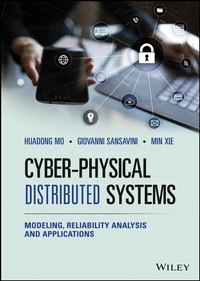
Cyber-Physical Distributed Systems
Description

Gather detailed knowledge and insights into cyber-physical systems behaviors from a cutting-edge reference written by leading voices in the field
In Cyber-Physical Distributed Systems: Modeling, Reliability Analysis and Applications, distinguished researchers and authors Drs. Huadong Mo, Giovanni Sansavini, and Min Xie deliver a detailed exploration of the modeling and reliability analysis of cyber physical systems through applications in infrastructure and energy and power systems. The book focuses on the integrated modeling of systems that bring together physical and cyber elements and analyzing their stochastic behaviors and reliability with a view to controlling and managing them.
The book offers a comprehensive treatment on the aging process and corresponding online maintenance, network degradation, and cyber-attacks occurring in cyber-physical systems. The authors include many illustrative examples and case studies based on real-world systems and offer readers a rich set of references for further research and study.
Cyber-Physical Distributed Systems covers recent advances in combinatorial models and algorithms for cyber-physical systems modeling and analysis. The book also includes:
* A general introduction to traditional physical/cyber systems, and the challenges, research trends, and opportunities for real cyber-physical systems applications that general readers will find interesting and useful
* Discussions of general modeling, assessment, verification, and optimization of industrial cyber-physical systems
* Explorations of stability analysis and enhancement of cyber-physical systems, including the integration of physical systems and open communication networks
* A detailed treatment of a system-of-systems framework for the reliability analysis and optimal maintenance of distributed systems with aging components
Perfect for undergraduate and graduate students in computer science, electrical engineering, cyber security, industrial and system engineering departments, Cyber-Physical Distributed Systems will also earn a place on the bookshelves of students taking courses related to reliability, risk and control engineering from a system perspective. Reliability, safety and industrial control professionals will also benefit greatly from this book.
More details
Other editions
Additional editions
Persons
Huadong Mo, PhD, is Senior Lecturer in the School of Engineering and Information Technology at the University of New South Wales. He received his doctorate from the City University of Hong Kong in the area of cyber-physical system reliability engineering.
Giovanni Sansavini, PhD, is Associate Professor at the Reliability and Risk Engineering Laboratory, Institute of Energy and Process Engineering, ETH Zurich, Switzerland. He is also the director of Reliability and Risk Engineering Laboratory, in the Institute of Energy and Process Engineering, Department of Mechanical and Process Engineering. He received his doctorate in nuclear engineering in 2010 from Politecnico di Milano, Italy, and a doctorate in engineering mechanics from Virginia Tech in Blacksburg in 2010.
Min Xie, PhD, is Chair Professor of Industrial Engineering in the Department of Advanced Design and Systems Engineering, at City University of Hong Kong. He received his doctorate in Quality Technology in 1987 from Linkoping University in Sweden and was elected as a Fellow of the IEEE in 2006.
Content
Preface v
List of Acronyms and Abbreviations ix
Introduction 1
Challenges of Traditional Physical and Cyber Systems 1
Research Trends in Cyber-Physical Systems (CPSs) 3
Stability of CPSs 3
Reliability of CPSs 6
Opportunities for CPS Applications 7
Managing Reliability and Feasibility of CPSs 7
Ensuring Cybersecurity of CPSs 9
Fundamentals of CPSs 13
Models for Exploring CPSs 14
Control-Block-Diagram of CPSs 14
Control Signal in CPSs 14
Degraded Actuator and Sensor 14
Time-Varying Model of CPSs 15
Implementation in TrueTime Simulator 16
Introduction of TrueTime Simulator 16
Architecture of CPSs in TrueTime 17
Evaluation and Verification of CPSs 18
CPS Performance Evaluation 18
CPS Performance Index 18
Reliability Evaluation of CPSs 19
CPS Model Verification 20
CPS Performance Improvement 21
PSO-Based Reliability Enhancement 22
Optimal PID-Automatic Generation Control (AGC) 23
Stability Enhancement of CPSs 29
Integration of Physical and Cyber Models 30
Basics of Wide-Area Power Systems (WAPS) 30
Physical Layer 30
Cyber Layer 31
WAPS Realized in TrueTime 32
An Illustrative WAPS 33
Illustrative Physical Layer 33
Illustrative Cyber Layer 34
Illustrative Integrated System 36
Settings of Stability Analysis 36
Settings of Delay Predictions 37
Settings of Illustrative WAPS 37
Cases for Illustrative WAPS 38
Hidden Markov Model (HMM)-Based Stability Improvement 38
Online Smith Predictor 38
Initialization of Discrete HMM (DHMM) 39
Parameter Estimation of DHMM 41
Delay Prediction via DHMM 43
Smith Predictor Structure 44
Delay Predictions 44
Settings of DHMM 45
Prediction Comparison 46
Performance of Smith Predictor 47
Settings of Smith Predictor 47
Analysis of Case 1 47
Analysis of Case 2 48
Stability Enhancement of Illustrative WAPS 49
Eigenvalue Analysis and Delay Impact 49
Sensitivity Analysis of Network Parameters 49
Optimal AGC 50
Optimal Controller Performance 50
Scenario 1 Analysis 51
Scenario 2 Analysis 51
Scenario 3 Analysis 52
Scenario 4 Analysis 52
Robustness of Optimal AGC 52
Reliability Analysis of CPSs 65
Conceptual Distributed Generation Systems (DGSs) 65
Mathematical Model of Degraded Network 65
Model of Transmission Delay 66
Model of Packet Dropout 67
Scenarios of Degraded Network 68
Modeling and Simulation of DGSs 69
DGS Model 69
Preliminary Model 69
Power Source Model 70
Data Interpolation 71
Reliability Estimation Via Optimal Power Flow (OPF) 71
Data Prediction 71
Monte Carlo Simulation (MCS) of DGSs 73
OPF of DGSs 74
Actual Cost and Reliability Analysis 75
OPF of DGSs Against Unreliable Network 76
Settings of Networked DGSs 76
OPF Under Different Demand Levels 78
OPF Under Entire Period 79
Maintenance of Aging CPSs 87
Data-driven Degradation Model for CPSs 88
Degraded Control System 88
Parameter Estimation via EM Algorithm 89
Load Frequency Control (LFC) Performance Criteria 90
Maintenance Model and Cost Model 91
Performance Based Maintenance (PBM) Model 91
Cost Model 93
Applications to DGSs 94
Output of Aging Generators 94
Impact of Aging on DGSs 94
Settings of Aging DGSs 94
Validations of Generator Performance Indexes 95
Quantitative Aging Impact 96
Applications to Gas Turbine Plant 98
Settings of Networked DGS Sensitivity Analysis of PBM 98
Impact of Degradation on LFC 98
Numerical Sensitivity Analysis 98
Pictorial Sensitivity Analysis 99
Optimal Maintenance Strategy 100
Maintenance Models Comparison 100
Game Theory Based CPS Protection Plan 109
Vulnerability Model for CPSs 110
Multi-state Attack-Defence Game 111
Backgrounds of Game Model for CPSs 111
Mathematical Game Model 112
Attack Consequence and Optimal Defence 113
Damage Cost Model 113
Attack Uncertainty 114
Optimal Defence Plan 115
Applications to DGSs with Uncertain Cyber-Attacks 116
Settings of Game Model 116
Optimal Protection with Constant Resource Allocation 116
Impact Under Constant Case 116
Optimal Constant Resource Allocation Fraction 117
Optimal Protection with Dynamic Resource Allocation 118
Vulnerability Model Under Dynamic Case 119
Optimal Dynamic Resource Allocation Fraction 120
Optimization Results Justification 121
Bayesian Based Cyberteam Deployment 125
Poisson Distribution based Cyber-attacks 125
Impacts of DoS Attack 125
Poisson Arrival Model Verification 126
Average Arrival Attacks 127
Cost of Multi-node Bandit Model 128
Regret Function of Worst Case 128
Upper Bound on Cost 129
Thompson-Hedge Algorithm 130
Hedge Algorithm 130
Details of Thompson-Hedge Algorithm 131
Separation of Target Regret 132
Upper Bound of ¿_1 133
Upper Bound of ¿_2 133
Upper Bound of Regret R^TH 134
Applications to Smart Grids 135
Operation Cost of Smart Grid 135
Numerical Analysis of Cost Sequences 137
Performance of Thompson-Hedge Algorithm 137
Comparison Study Against R.EXP3 137
Sensitivity to the Variation 140
Recent Advances in CPS Modeling, Stability and Reliability 145
Modeling Techniques for CPS Components 145
Inverse Gaussian Process 145
Hitting Time to a Curved Boundary 146
Estimator Error 147
Theoretical Stability Analysis 148
Impacts of Uncertainties 148
Small Gain Theorem based Stability Criteria 149
Robust Stability Criteria 150
Game Model for CPSs 151
References 153
Index 177
Preface
A cyber-physical system (CPS) consists of a collection of computing devices communicating with one another and interacting with the physical world via sensors and actuators in a feedback loop. Increasingly, such systems are everywhere, from smart buildings to medical devices to automobiles. The emergence of CPSs as a novel paradigm has revolutionized the relationship between humans, computers, and the physical environment. CPSs are still in their infancy, and most recent studies are application-specific and lack systematic design methodology. As a result, it is challenging to investigate and explore the core system science perspective needed to design and build complex CPSs, which are of great importance in many applications.
Using the underlying theories of systems science, such as probability theory, decision theory, game theory, control theory, data analysis, organizational sociology, behavioral economics, and cognitive psychology, this book addresses foundational issues central across CPS applications, including: (I) System Verification - How to develop effective metrics and methods to verify and certify large and complex CPSs; (II) System Design - How to design CPSs to be safe, secure, and resilient in rapidly evolving environments; (III) Real-Time Control and Adaptation - How to achieve real-time dynamic control and behavior adaptation in diverse environments, such as distribution and in network-challenged spaces; (IV) System of Systems - How to harness communication, computation, and control for developing new integrated systems, reducing concepts to realizable designs, and producing integrated software-hardware systems at a pace far exceeding today's timeline.
In general, this book has four essential topics. Chapters 1 and 2 provide readers who do not have a sufficient background on CPSs with a general introduction, research gaps, and representative CPS applications, including CPS modeling, statistical analysis of CPS performance, probability prediction of CPS state, robust CPS control techniques, and management and optimization of CPS reliability and risk. Chapters 3 and 4 mainly concern the robust control of CPSs by designing optimal control strategies, or resource management to enhance robust performance and improve the reliability index against time delays and packet dropouts, which are the inherent properties of open communication networks. Chapter 5 addresses the data-driven degradation modeling of aging physical (actuators) and cyber (sensors) components of CPSs, and corresponding optimal maintenance plans to improve the reliability of CPSs. Chapters 6 and 7 investigate the cyber security of CPSs, introduce the general concept of cyberattacks, design vulnerability models, and risk assessment procedures, and develop game-theoretic mitigation techniques and Bayesian-based cyberteam deployment strategies.
More specifically, Chapter 1 summarizes the evolution from the traditional physical system to the CPS and provides an overview of dynamic and dependent behaviors to be addressed in the subsequent chapters of the book. The introduction discusses some important and recent challenges in improving traditional physical systems in terms of CPSs, popular research trends in evaluating the impacts of CPSs on society, and opportunities for enhancing the performance of realistic applications, which are primarily network control systems. The detailed properties, requirements, and vulnerabilities of utility systems are also introduced. The reasons why the proposed modeling techniques work is important in a field that would be difficult to deal with if the cyber and physical domains were treated separately.
In Chapter 2, readers acquire the basic knowledge to be used in data-driven statistical modeling, the estimation of the probabilistic CPS state, and a comprehensive framework for conducting reliability analysis of CPSs. In addition, this chapter introduces how to use to historical data to validate the performance of the proposed CPS model, and how to use performance indexes to facilitate the resilient design of CPSs. Moreover, it also demonstrates a real-time test platform for various industrial applications and the standard procedures for improving real-time criteria.
Chapter 3 focuses on the stability of CPSs, where decision makers perform dynamic control and adaptation based on real-time data from sensors. It provides two examples of the design of the controller parameters for robust system performance. The first example illustrates the development of adaptive control for wide-area measurement power systems, where communication delays are predicted to provide delay compensation for additional frequency stability. In addition, the integration of control theory, power engineering, and statistical estimation is discussed. The second example is an extension of wide-area measurement power systems from a dedicated communication network to open communication networks, where occurrences of communication delays and packet dropouts result in the failure of the power management system from renewable energy resources. Explicit and implicit methods are then designed for system integration, analysis, and improvement.
Chapter 4 illustrates a system-of-systems framework for the reliability of distributed CPS accounting for the impact of degraded communication networks. This is quite different from the focus of Chapter 3, which mainly covers the stability of CPSs from a control perspective. Based on the collected dataset, the degradation path of open communication networks is described in terms of stochastic continuous time transmission delays and packet dropouts. A distributed generation system with open communication infrastructure is used as an example, which is a multi-area distributed system that is more complicated than the single-area power system presented in Chapter 3. An optimal power flow model is proposed to generate consecutive time-dependent optimal operation scenarios for a distributed CPS. Quantitative analysis is carried out to evaluate the effect of networked degradation on the reliability indexes of CPSs, e.g., energy not supplied and operation cost. A prediction method for reconstructing missing data is proposed to mitigate the influence of packet dropouts, which is universal and applicable to most current industrial applications.
Chapter 5 models the functional dependence between stochastic aging actuators and sensors within their operating environments. This dependence is considered in the time domain, causing a distinct degradation status in the actuators and sensors. Reliability modeling of the stochastic effects and effective maintenance activities are discussed for different types of CPSs, including the cooling system in a nuclear power plant, a one-area energy system with a single generation group, and a multi-area energy system with several different generation groups.
Chapter 6 explores the concepts, principles, practices, components, technologies, and tools behind risk management for cybersecurity of CPSs, providing practical experience through a realistic case study that focuses on the methodologies available to identify and assess such threats, evaluate their impact, and determine appropriate measures to prevent, mitigate, and recover from any threat or disruptive event so that the operations and profitability of the organizations are maintained and maximized.
Chapter 6 presents the framework of CPSs under cyberattacks from a game-theoretic perspective, which makes use of statistical data to model the behavior of cyberattacks and study the dynamic game between the network defender and attacker at the system level. For current utility CPSs, cyber threats from supervisory control and data acquisition (SCADA) systems, and spear-phishing attacks on the accounts of internal employees to gain access to dedicated communication networks are investigated in Chapters 6 and 7. In addition, these chapters focus on how to modify the basic modeling techniques presented in Chapter 2 to describe cyber vulnerabilities, such as seizing the SCADA system under control, disabling/destroying IT infrastructure components, and denial-of-service (DoS) attacks on the control center in smart grids. Based on historical data for IT security spending, the cost of launching distributed DoS attacks, and the occurrence probability of cyber event losses, the contest intensity between the attacker and defender can be accurately predicted for the next period to guide the design of an effective network protection plan, that is, a game-theoretic protection plan and a Bayesian-based cyberteam deployment.
Chapter 7 investigates sequential control problems (i.e., sequential cyberteam deployment) in modern CPSs by introducing an adversarial cost sequence with a variation constraint. Chapter 6 reviews the data-driven vulnerability model, and Chapter 7 deals with the dataset of the arrival time of cyberattacks, which uncovers the statistical pattern of attackers. To solve such problems, a fundamental idea is to first obtain sampled parameters for the arrival model of cyberattacks from the posterior distribution of realistic cyberattack arrival records. The reinforcement learning model for estimating parameters is formulated as a partly parameterized Bayesian model. As a result, the sampled parameters are used instead of the true parameters. The paradigm of this framework can also be applied to other classical models, although...
