

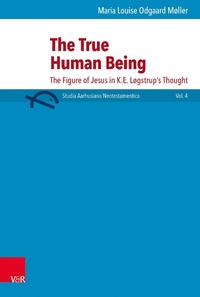
The True Human Being
The Figure of Jesus in K.E. Løgstrup's Thought
1st Edition
Published on 17. June 2019
285 pages
978-3-647-53617-0 (ISBN)
Description

The aim of Odgaard Møller's book is threefold: The first main section seeks to clarify how and why Jesus is presented in the pre-1968 writings of the Danish theologian and philosopher K.E. Løgstrup (1905-1981). Throughout his work, Løgstrup's main focus has been a rehabilitation of the insight that life is something definite, because it is created. Here, Jesus primarily plays a methodological/strategic role as the one confirming and giving witness to Løgstrup's interpretation of created life in a given time of his authorship. When faith in creation is formulated polemically against another interpretation of life, Jesus serves as Løgstrup's ally in this discussion. In the second main section, this examination is extrapolated to include a discussion with Bultmann and two of his students in order to clarify the character of his Christology, not least whether - or in what way - this can be characterised as 'implicit Christology'. Finally, in the light of Ricoeur's hermeneutic philosophy of religion, the third main section considers the systematic-theological validity of this picture of Jesus. The overall conclusion can be summed up in this way: The main line in Løgstrup's work goes from created life to the human being Jesus of Nazareth. Jesus incarnates created life; therefore he is the true human being. This close connection between (created) Life and (true) Human Being is the kernel in Løgstrup's thought. This makes his perception of Jesus and his Christology distinctive, original and specifically Løgstrupian.
PhD Maria Louise Odgaard Møller is Pastor in the Danish National Evangelical-Lutheran Church and a Postdoctoral fellow at Department of Theology, Aarhus University.
PhD Maria Louise Odgaard Møller is Pastor in the Danish National Evangelical-Lutheran Church and a Postdoctoral fellow at Department of Theology, Aarhus University.
More details
Other editions
Additional editions
Book
06/2019
1st Edition
Vandenhoeck & Ruprecht
€89.00
Shipment within 7-9 days
Person
PhD Maria Louise Odgaard Møller is Pastor in the Danish National Evangelical-Lutheran Church and a Postdoctoral fellow at Department of Theology, Aarhus University.
Content
- Intro
- Title Page
- Copyright
- Table of Contents
- Body
- Preface
- 1 Introduction
- 1.1 Defining the issues and presentating the hypotheses
- 1.2 The structure of the book and presentation of the material
- 1.3 Concluding remarks
- Main Part One: Løgstrup's understanding of Jesus
- 2 Prædikenen og dens tekst
- 2.1 Thesis I
- 2.2 Thesis II
- 2.2.1 Løgstrup's view on historical critique
- 2.2.2 The scripturalist veto against historical critique and its consequences
- 2.3 Thesis III
- 2.4 Thesis IV and the epilogue
- 2.5 Løgstrup's understanding of Jesus in Prædikenen og dens tekst
- 2.6 The debate with Paul Seidelin in Stud.Theol. 1941-42
- 2.7 Prenter's critique in Bibelen og vor Forkyndelse 1942
- 3 Løgstrup's dissertation
- 3.1 Løgstrup's analysis of the conflict between transcendental idealism and theology
- 3.1.1 Schumann's analysis
- 3.1.2 Løgstrup's critique of the transcendental analysis of the nature of cognition
- 3.2 View of life and the monological. Preconditions for the conflict of transcendental idealism and theology
- 3.2.1 The Judeo-Christian view of life
- 3.2.2 The conflict between the transcendentalist and Judea-Christian views of life
- 3.2.3 The conflict between the transcendentalist and the Judeo-Christian conceptions of cognition
- 3.3 Løgstrup's presentation and understanding of Jesus in the dissertation
- 4 Løgstrup's sermons and church publications 1936-1943
- 4.1 Human life - our life and the life of Jesus
- 4.2 Time and sin
- 4.3 Death on the Cross and Resurrection
- 4.4 The image of Jesus in the sermons and church publications
- 5 Bultmann's Jesus: one of the inspirational sources for Løgstrup?
- 5.1 Bultmann's Jesus
- 5.1.1 The Coming of the Rule of God
- 5.1.2 God's will
- 5.1.3 The distant and the near God
- 5.2 Bultmann's presentation of Jesus
- 5.3 Bultmann and Løgstrup: Differences and similarities
- 5.3.1 Bultmann and Løgstrup: Similarities
- 5.3.2 Bultmann and Løgstrup: Differences
- 6 Grønbech's Jesus, the Son of Man
- 6.1 Jesus, the Son of Man
- 6.1.1 "The Kingdom of God is near"
- 6.1.2 "Indignation" and "I am the Lord of the Sabbath".
- 6.1.3 "Two worlds"
- 6.1.4 "The Son of Man" and "The last days."
- 6.2 Grønbech's Jesus - and Løgstrup's
- 7 The Ethical Demand
- 7.1 "Humanism and Christianity"
- 7.2 The Ethical Demand
- 7.2.1 Løgstrup's concerns in The Ethical Demand
- 7.2.2 The fact and the demand
- 7.2.3 The gift understanding of life
- 7.2.4 Human guilt
- 7.2.5 God's forgiveness
- 7.2.6 Løgstrup's methodological premises and way of working
- 7.2.7 The Gospel is the answer to the problem of sin
- 7.3 The figure of Jesus in The Ethical Demand
- 7.3.1 The introductory chapter
- 7.3.2 Chapter 5
- 7.3.3 Chapter 12
- 7.3.4 The Parable of the Good Samaritan
- 7.4 The debate between Løgstrup and Prenter in Dansk Teologisk Tidsskrift 1962-63
- 7.4.1 Prenter's questions to Løgstrup
- 7.4.2 Løgstrup's reply to Prenter
- 7.5 Inspiration from Bultmann
- 8 Controverting Kierkegaard
- 8.1 Christianity without a belief in creation
- 8.2 Opgør med Kierkegaard
- 8.2.1 Part One: Christianity without the historical Jesus
- 8.2.2 Part Two: The Sacrifice
- 8.2.3 Part Three: The movement of infinity
- 8.3 The Figure of Jesus in Opgør med Kierkegaard
- 9 Conclusion for Main Part One: Løgstrup's understanding of Jesus
- 9.1 1930s and 1940s: The very earliest writings
- 9.2 1956: The Ethical Demand
- 9.3 1968: Opgør med Kierkegaard
- Main Part Two: Løgstrup's Christology
- 10 Løgstrup, Neue Frage and implicit Christology
- 10.1 The beginning of the search for the historical Jesus and the first quest
- 11 The discussion between Bultmann and his students. Neue Frage.
- 11.1 Bultmann's Theology of the New Testament
- 11.2 Käsemann's lecture in 1953. The beginning of the Neue Frage
- 11.2.1 What is history - and what does it mean for faith?
- 11.2.2 The criterion of difference and the question of the relationship to Judaism
- 11.3 Bornkamm's Jesus book
- 11.3.1 The immediacy and authority of Jesus
- 11.4 From the 1960s onwards: The fronts harden and the tone becomes rougher
- 11.4.1 Bultmann: "Das Verhältnis der urchristlichen Christusbotschaft zum historischen Jesus"
- 11.4.2 Käsemann: "Sackgassen im Streit um den historischen Jesus"
- 11.4.3 Bultmann: "Antwort an Ernst Käsemann"
- 11.4.4 Käsemann: "Die neue Jesus-Frage"
- 11.4.5 Bornkamm: "Wandlungen im alt- und neutestamentlichen Gesetzverständnis"
- 11.5 Conclusion: Implicit Christology in Bultmann, Käsemann and Bornkamm
- 12 Løgstrup's Christology
- 12.1 The Christology of the dissertation and Prædikenen og dens tekst
- 12.2 The Christology of The Ethical Demand
- 12.3 The Christology of Opgør med Kierkegaard
- 12.4 Christianity without the historical Jesus
- 12.5 Critical questions and conclusion
- 12.6 Differences and similarities between Løgstrup's implicit Christology and Bultmann's, Käsemann's and Bornkamm's, respectively
- Main Part Three: Criticism, evaluation and discussion
- 13 Criticism in light of Ricour's hermeneutic philosophy of religion
- 13.1 General considerations
- 13.2 Ricour's hermeneutic philosophy of religion
- 13.3 A Ricouristic image of Jesus
- 14 Evaluation of Løgstrup's image of Jesus
- 15 Conclusion
- References
- Index
