

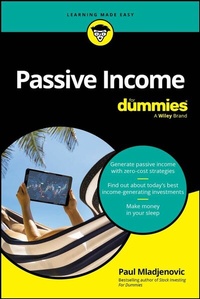
Passive Income For Dummies
Description

In Passive Income For Dummies, bestselling author, national speaker, popular investing and business educator, and the author of Stock Investing For Dummies, Paul Mladjenovic delivers an exciting and practical new guide to building consistent income streams that work for you. He introduces a broad collection of passive income strategies that fit into all sorts of lifestyles, including selling digital products and earning with affiliate links to investing in dividend-paying stocks and launching subscription-based services.
Mladjenovic draws on over four decades of personal and professional experience building online and offline income streams to show you exactly how you can set up and automate your own. You'll find step-by-step playbooks and proven examples that work in today's competitive economic realities. Most importantly, many of the techniques he offers don't require thousands and thousands of dollars to get off the ground. You can get started building a more prosperous future today even with small amounts!
Inside the book:
- Access to a free bonus online video mini-course, How to Get Growing, Passive Income from the Fortune 500, to help you add dividend investing to your passive income strategies
- Digital and offline tools and resources that will keep on track as you build more income and financial independence
- Easy-to-understand, jargon-free advice for combating inflation, navigating the gig economy, and joining the creator class
- Create multiple streams of income like the most successful investors!
- Hands-on info that helps you manage risk and avoid scams, dead-ends, and common mistakes
Perfect for everyone looking to supplement their income and build a more financially secure and flexible future, Passive Income For Dummies is an invaluable strategy guide for retirees, freelancers, part-time workers, content creators, investors, students, and entrepreneurs everywhere.
More details
Other editions
Additional editions
Person
Content
Part 1: Getting Started with Passive Income 5
CHAPTER 1: Passive Income 101 7
CHAPTER 2: Making Passive Income Part of Your Retirement 17
CHAPTER 3: Investing versus Business Strategies 27
Part 2: Regular Passive Investing 37
CHAPTER 4: Interest Income 39
CHAPTER 5: Dividend Income 53
CHAPTER 6: Advanced Dividend Strategies 65
CHAPTER 7: Dividend ETFs and Mutual Funds 79
CHAPTER 8: Annuities 93
Part 3: Passive Income Alternatives 101
CHAPTER 9: Real Estate Income 103
CHAPTER 10: Covered Call Options 117
CHAPTER 11: Put Options 131
CHAPTER 12: Closed-End and Enhanced Income Funds 141
Part 4: Business Strategies for Passive Income 151
CHAPTER 13: The A/B Strategy 153
CHAPTER 14: Publishing Income 161
CHAPTER 15: Online Education 171
CHAPTER 16: Affiliate Marketing Strategies 183
CHAPTER 17: Tackling Taxes on Your Passive Income 193
Part 5: The Part of Tens 209
CHAPTER 18: Ten (or So) Passive Income Investments 211
CHAPTER 19: Ten Passive Income Business Strategies 221
CHAPTER 20: (Almost) Ten AI Tactics for Passive Income 227
Part 6: Appendixes 235
APPENDIX A: Investing Resources 237
APPENDIX B: Business Resources 245
Index 253
Chapter 1
Passive Income 101
IN THIS CHAPTER
Understanding the basics of earning passive income
Breaking down passive income categories
Gathering some cash and making a tracking spreadsheet
Walking through the steps of your first passive investment
One of the hottest and fastest-growing financial topics in recent years has been passive income. When you think about it, you probably see passive income as part of the financial picture of the rich and affluent. Noted investor Warren Buffett famously said, "If you don't find a way to make money while you sleep, you will work until you die." Who wouldn't want income flowing in without needing to work hard to get it? The great thing for you is, what's growing just as fast (faster?) as the popularity of earning passive income are the choices and alternatives for earning it.
Many years ago, your choices for bringing in passive income were very limited: dividend stocks, interest-bearing accounts, annuities, and rental real estate. Perhaps I've missed an item or two here, but you get the picture. Fortunately, there's been an explosion of various methods, strategies, and investment vehicles for gaining true passive income. The traditional ways still exist, but many new and improved strategies and methods have appeared on the scene in recent years.
The great news is, you have this book as a handy guide to help you understand all the ways to navigate this popular income-earning scene. Just be active (not passive!) with the information. This chapter gets you started on your passive income journey.
Defining Passive Income
The purest form of passive income is a continuous stream of money that flows from a singular act or transaction requiring little or no maintenance on your part after the initial transaction. This book focuses on passive income from two different worlds: investing and business (see Chapter 3 for details on the differences between the two).
You won't find any totally cost-free ways to generate passive income. You can come close, but some type of cost will exist. The cost will either be financial, or it will come in nonfinancial investments such as sweat equity (the initial setup work), or the learning curve of doing things to achieve the pending passive income.
The bottom line is, the passive income strategies I cover in this book don't require a lot of money to get started. Investing strategies will require some money, of course, but most investment vehicles and strategies can begin with as little as $50 or $100. Business strategies can be executed with no money at all. I discuss ways to find or make some money later in this chapter, so lack of money isn't an obstacle in the beginning.
For example, suppose you save up $900; what can that cash produce for you via passive investing? Here are some possibilities:
- You may buy some local public utility stock that earns a dividend yield of 6 percent. That's $54 coming in per year. If you reinvest the dividend in the stock, you can grow your original $900 into $1,000, and then $2,000, and on and on. If the stock increases its dividend, and you reinvest your earnings, your investment can grow to $5,000, or $10,000, or more. By then, your annual dividend income can reach $540 or more per year.
- You may invest your cash in 100 shares of an optionable stock. You can then write a covered call option and easily earn a few hundred dollars (see Chapter 10). Say your investment earns $200 in income. In that case, your $900 has given you an effective dividend of 22 percent ($200 divided by $900). If you do that same covered call three times in a year, your $900 will earn you $600 in option income, which calculates to an effective dividend of 67 percent! And what if you reinvest that income? It can grow and grow .
- You may use the $900 to finance a business that gives you passive income from publishing, product sales, or affiliate marketing. Many businesses have generated a handsome income starting with much less. Eventually, you can sell the business, if it's generating income, for a large sum. Even if it generates income of only $5,000 per year, on a price-to-earnings ratio of 15 (discussed in Chapter 5), that means your business may have a market worth of $75,000!
These three scenarios aren't unreasonable. And I can go on and on. Rich people will be the first to tell you that small sums invested and reinvested over time become substantial wealth.
In my $50 wealth-builder course - a class I've offered every year since 1983 - I tell folks what I'm telling you now: Building wealth, including wealth that yields significant passive income, isn't one big thing that you do. It's the hundred little things you do, day in and day out, over months and years, that give you the life-changing wealth you seek.
So, take to heart all the passive income strategies I share with you in this book, get really good at a few of them, make them grow, and you'll do very well.
In this book I focus on passive income, of course, but some folks may be better off with passive gains. In other words, they'll make that initial singular transaction or effort but get their payoff in long-term appreciation (long-term capital gains) rather than income.
Checking Out Categories of Passive Income
You don't have to be an expert in every kind of passive income strategy. Your greatest chance of success is to focus on one category or strategy. Get good at that, and do it over and over.
What's that, you say? You've had some success with recording an audiobook or selling artwork? Great! Just do it over and over, get excellent at it, and dominate your market. The passive income will build up, and the gains will come easier over time.
Take a look at some of the different types of passive income categories:
- Investment: This is the simplest one. You make an investment and get regular, predictable income through either dividends or interest. Examples include stocks, bonds, and the world of funds (exchange-traded funds, mutual funds, and so on). Investing is covered in greater detail in Chapters 4, 5, 6, 7, and 12.
- Real estate: Although it can be lumped into the preceding category, real estate has enough variety and specialization to be its own category. Passive income opportunities range from hands-on real estate and limited partnerships, to real estate investment trusts and mortgages (covered in Chapter 9).
- Trading: You can earn passive income by utilizing call and put options that complement your regular investment portfolio. Find out about call options in Chapter 10 and put options in Chapter 11.
- Traditional: Social Security, pensions, and annuities are in this category. Annuities are covered in greater detail in Chapter 8.
- Business creative: This involves creating something of value and putting or posting it in a suitable marketplace. Your creation can be an e-book, a course, artwork, and the like. See Chapters 13, 14, and 15 for more on creating business income. Chapter 19 gives you 10 business ideas.
- Business marketing: This may include securing licenses and marketing arrangements to make money from what others create. Affiliate marketing, covered in Chapter 16, is an example of this.
Finding Your Own Investable Cash
You may not be at the point where you have an investable million bucks on hand for your juicy passive income strategies to become 100 percent financially free . yet. But everyone has a starting point in their own personal situation. In the following sections, I provide some guidance on getting a hold of cash to invest.
You can find more income sources and ideas at www.ravingcapitalist.com/PIFD.
Selling your stuff
A few years ago, I sold a large batch of my childhood comics to a comic book dealer and got $900. No, that's not a fortune, but it's always nice to free up a little money that can become productive and earn some passive income.
Perhaps you have some valuable items sitting around and gathering dust. Why not put those things to good use as you pursue passive income? Here are some examples of stuff you can convert into cash and where to go for more details on selling it:
- Clothes and more: Visit Poshmark (
www.poshmark.com), ThredUp (www.thredup.com), and Vinted (www.vinted.com). - Designer handbags: Check out Fashionphile (
www.fashionphile.com/pages/sell-with-us). - Furniture: Try AptDeco (
www.aptdeco.com).
Trying fun activities
By "fun activities," I mean income-producing activities that aren't work at all if you think about it. Everyone generally does something day in and day out without viewing it as work or an activity that can generate income. Which of the following things are you doing just for fun . or just because you have some time on your hands? Here are some suggestions for turning those activities into money you can invest:
- Do you like to shop?...
