

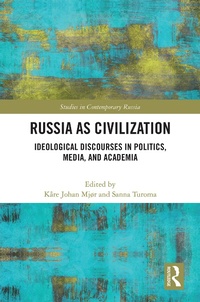
Russia as Civilization
Ideological Discourses in Politics, Media and Academia
1st Edition
Published on 18. May 2020
250 pages
978-1-000-07233-4 (ISBN)
Description

Analyzing the use of civilization in Russian-language political and media discourses, intellectual and academic production, and artistic practices, this book discusses the rise of civilizational rhetoric in Russia and global politics.
Why does the concept of civilization play such a prevalent role in current Russian geopolitical and creative imaginations? The contributors answer this question by exploring the extent to which discourse on civilization penetrates Russian identity formations in imperial and national configurations, and at state and civil levels of society. Although the chapters offer different interpretations and approaches, the book shows that Russian civilizationism is a form of ideological production responding to the challenges of globalization. The concept of "civilization," while increasingly popular as a conceptual tool in identity formation, is also widely contested in Russia today.
This examination of contemporary Russian identities and self-understanding will be of particular interest to students and scholars of Russian area studies and Slavic studies, intellectual and cultural history, nationalism and imperial histories, international relations, discourse analysis, cultural studies, media studies, religion studies, and gender studies.
Why does the concept of civilization play such a prevalent role in current Russian geopolitical and creative imaginations? The contributors answer this question by exploring the extent to which discourse on civilization penetrates Russian identity formations in imperial and national configurations, and at state and civil levels of society. Although the chapters offer different interpretations and approaches, the book shows that Russian civilizationism is a form of ideological production responding to the challenges of globalization. The concept of "civilization," while increasingly popular as a conceptual tool in identity formation, is also widely contested in Russia today.
This examination of contemporary Russian identities and self-understanding will be of particular interest to students and scholars of Russian area studies and Slavic studies, intellectual and cultural history, nationalism and imperial histories, international relations, discourse analysis, cultural studies, media studies, religion studies, and gender studies.
Reviews / Votes
"At the end of the Cold War, Samuel Huntington prophesized that national identities would increasingly involve a sense of belonging to larger cultural-historical entities he called civilizations. Russia as Civilization: Ideological Discourses in Politics, Media, and Academia takes Huntington one step further, to explore how the image of a single nation can be constructed and perceived as a civilization unto itself. Through detailed examinations of Russian intellectual and creative practices as well as political discourses, gender debates, media, the fine arts, and the production of academic scholarship, the chapters shed light on the extraordinary potential of the civilization concept as a locus for mobilizing powerful senses of shared national identity. This collection is essential reading for all those interested in the cultural politics of Russian identity, and in contemporary Russian culture and politics more generally." Mark Bassin, Baltic Sea Professor in the History of Ideas, Center for Baltic and East European Studies, Soedertoern University, Stockholm, Sweden"Using Russia as a case study, this book sheds new light on how and with what consequences the notion of civilizations has replaced that of nations as a conceptual foundation for constructing group identities worldwide. It makes a compelling case for understanding the proliferation of civilizational narratives in Russia as a transnational phenomenon and as a response to the challenges posed to the country by globalization." Vera Tolz, Sir William Mather Professor of Russian Studies, The University of Manchester, UK
More details
Series
Edition
1. Auflage
Language
English
Place of publication
London
United Kingdom
Publishing group
Taylor & Francis Ltd
Target group
College/higher education
Illustrations
1 Tables, black and white; 12 Line drawings, black and white; 12 Illustrations, black and white
File size
6,74 MB
ISBN-13
978-1-000-07233-4 (9781000072334)
Copyright in bibliographic data and cover images is held by Nielsen Book Services Limited or by the publishers or by their respective licensors: all rights reserved.
Schweitzer Classification
Other editions
Additional editions
Kare Johan Mjor | Sanna Turoma
Russia as Civilization
Ideological Discourses in Politics, Media and Academia
Book
04/2022
1st Edition
Routledge
€65.40
Shipment within 15-20 days
Kare Johan Mjor | Sanna Turoma
Russia as Civilization
Ideological Discourses in Politics, Media and Academia
Book
07/2020
1st Edition
Routledge
€206.40
Shipment within 15-20 days
Russia as Civilization
Ideological Discourses in Politics, Media and Academia
Book
06/2020
Routledge
Unfortunately, price unknown
Available (delivery time upon request)
Persons
Kare Johan Mjor is Associate Professor of Russian at the University of Bergen, Norway, and Senior Research Librarian at the Western Norway University of Applied Sciences.
Sanna Turoma is Professor of Russian Language and Cultural Studies at Tampere University, Finland.
Sanna Turoma is Professor of Russian Language and Cultural Studies at Tampere University, Finland.
Content
Introduction: Russian Civilizationism in a Global Perspective 1 "Nation" and "Civilization" as Templates for Russian Identity Construction: A Historical Overview 2 From Socio-Economic Formations to Civilizations: Seeking a Paradigm Change in Late Soviet Discussions 3 Russia between a Civilization and a Civic Nation: Secular and Religious Uses of Civilizational Discourse during Putin's Third Term 4 "Civilization" in the Russian Mediatized Public Sphere: Imperial and Regional Discourses 5 "Clash of Masculinities"? Gendering Russian-Western Relations in Popular Geopolitics. 6 Re-Imagining Antiquity: The Conservative Discourse of "Russia as the True Europe" and the Kremlin's New Cultural Policy 7 Civilizational Discourses in Doctoral Dissertations in Post-Soviet Russia 8 An Eternal Russia: Oleg Platonov, the Institute for Russian Civilization and the Nationalization of Russian Thought 9 Contemporary Civilizational Analysis and Russian Sociology
