

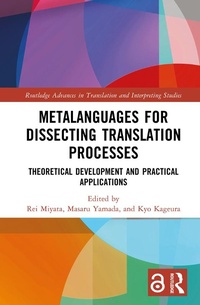
Metalanguages for Dissecting Translation Processes
Theoretical Development and Practical Applications
1st Edition
Published on 4. July 2022
264 pages
978-1-000-58347-2 (ISBN)
Description

This edited volume covers the development and application of metalanguages for concretely describing and communicating translation processes in practice.
In a modern setting of project-based translation, it is crucial to bridge the gaps between various actors involved in the translation process, especially among clients, translation service providers (TSPs), translators, and technology developers. However, we have been confronted with the lack of common understanding among them about the notion and detailed mechanisms of translation. Against this backdrop, we are developing systematic, fine-grained metalanguages that are designed to describe and analyse translation processes in concrete terms. Underpinned by the rich accumulation of theoretical findings in translation studies and established standards of practical translation services, such as ISO 17100, our metalanguages extensively cover the core processes in translation projects, namely project management, source document analysis, translation, and revision.
Gathering authors with diverse backgrounds and expertise, this book proffers the fruits of the contributors' collaborative endeavour; it not only provides practicable metalanguages, but also reports on wide-ranging case studies on the application of metalanguages in practical and pedagogical scenarios. This book supplies concrete guidance for those who are involved in the translation practices and translation training/education. In addition to being of practical use, the metalanguages reflect explication of the translation process. As such, this book provides essential insights for researchers and students in the field of translation studies.
The up-to-date versions of the metalanguages, related materials, and the corrigendum for the book content are available on our project website: https://tntc-project.github.io
In a modern setting of project-based translation, it is crucial to bridge the gaps between various actors involved in the translation process, especially among clients, translation service providers (TSPs), translators, and technology developers. However, we have been confronted with the lack of common understanding among them about the notion and detailed mechanisms of translation. Against this backdrop, we are developing systematic, fine-grained metalanguages that are designed to describe and analyse translation processes in concrete terms. Underpinned by the rich accumulation of theoretical findings in translation studies and established standards of practical translation services, such as ISO 17100, our metalanguages extensively cover the core processes in translation projects, namely project management, source document analysis, translation, and revision.
Gathering authors with diverse backgrounds and expertise, this book proffers the fruits of the contributors' collaborative endeavour; it not only provides practicable metalanguages, but also reports on wide-ranging case studies on the application of metalanguages in practical and pedagogical scenarios. This book supplies concrete guidance for those who are involved in the translation practices and translation training/education. In addition to being of practical use, the metalanguages reflect explication of the translation process. As such, this book provides essential insights for researchers and students in the field of translation studies.
The up-to-date versions of the metalanguages, related materials, and the corrigendum for the book content are available on our project website: https://tntc-project.github.io
More details
Series
Edition
1. Auflage
Language
English
Place of publication
London
United Kingdom
Publishing group
Taylor & Francis Ltd
Target group
College/higher education
Illustrations
51 Tables, black and white; 67 Line drawings, black and white; 67 Illustrations, black and white
ISBN-13
978-1-000-58347-2 (9781000583472)
Copyright in bibliographic data and cover images is held by Nielsen Book Services Limited or by the publishers or by their respective licensors: all rights reserved.
Schweitzer Classification
Other editions
Additional editions
Rei Miyata | Masaru Yamada | Kyo Kageura
Metalanguages for Dissecting Translation Processes
Theoretical Development and Practical Applications
Book
01/2024
1st Edition
Routledge
€63.40
Shipment within 10-20 days
Rei Miyata | Masaru Yamada | Kyo Kageura
Metalanguages for Dissecting Translation Processes
Theoretical Development and Practical Applications
Book
07/2022
1st Edition
Routledge
€206.60
Shipment within 10-20 days
Persons
Rei Miyata is Assistant Professor at the Graduate School of Engineering, Nagoya University, Japan. He received his PhD from the University of Tokyo in 2017. His main research topic is controlled document authoring for facilitating the effective use of machine translation. He is the author of Controlled document authoring in a machine translation age (Routledge, 2020).
Masaru Yamada is Professor in the College of Intercultural Communication at Rikkyo University in Tokyo, Japan. He specialises in translation process research (TPR), including human-computer interaction (HCI), machine translation plus postediting (MTPE), and translation in language teaching (TILT). His publication includes "The impact of Google Neural Machine Translation on post-editing by student translators" (JoSTrans, 31).
Kyo Kageura is Professor of the Library and Information Science Course at the Graduate School of Education, the University of Tokyo. He has authored several books, including The Quantitative analysis of the dynamics and structure of terminologies (2012), and has published extensively in international journals and conferences in the fields of terminology, information studies, translation studies, and computational linguistics.
Masaru Yamada is Professor in the College of Intercultural Communication at Rikkyo University in Tokyo, Japan. He specialises in translation process research (TPR), including human-computer interaction (HCI), machine translation plus postediting (MTPE), and translation in language teaching (TILT). His publication includes "The impact of Google Neural Machine Translation on post-editing by student translators" (JoSTrans, 31).
Kyo Kageura is Professor of the Library and Information Science Course at the Graduate School of Education, the University of Tokyo. He has authored several books, including The Quantitative analysis of the dynamics and structure of terminologies (2012), and has published extensively in international journals and conferences in the fields of terminology, information studies, translation studies, and computational linguistics.
Content
1. Introduction Part I. Translation Knowledge and Metalanguages 2. Metalanguages and Translation Studies 3. Overview of Metalanguages and Translation Processes 4. Metalanguages in Translator Education Part II. Core Sets of Metalanguages 5. Metalanguage for Translation Project Management 6. Metalanguages for Source Document Analysis: Properties and Elements 7. Translation Strategies for English-to-Japanese Translation 8. Designing a Metalanguage of Translation Issues 9. Metalanguage for Describing the Effects of Revisions Part III. Practical and Pedagogical Applications 10. Modeling the Process of Translation using Metalanguages 11. Implementing and Validating a Metalanguage of Translation Issues in Translation Education 12. Incorporating the Source Document Property Metalanguage for Translation Education 13. MNH-TT: A Translator Training Platform that Incorporates Metalanguages 14. Managing Clients' Expectations for MTPE Services Through a Metalanguage of Translation Specifications: MPPQN Method 15. A Customisable Automated Quality Assurance Tool: Case Study of Use in English-to-Japanese Patent Translations 16. Natural Language Processing Techniques for Translation
