

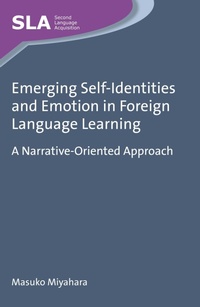
Emerging Self-Identities and Emotion in Foreign Language Learning
A Narrative-Oriented Approach
Published on 16. July 2015
210 pages
978-1-78309-383-0 (ISBN)
Description

This book uses a narrative-oriented approach to shed light on the processes of identity construction and development among Japanese university students of English. The research highlights the instrumental agency of individuals in responding to and acting upon the social environment, and in developing, maintaining and/or reconstructing their identities as L2 users. The study offers unique insights into the role of experience, emotions, social and environmental affordances in shaping their personal orientations to English and self-perceptions as English learner-users. It also examines individuals' responses to these factors and discusses fluctuations in their motivations. The additional value of this book lies in its detailed account of methodological procedures, challenges and ways to overcome obstacles encountered when undertaking qualitative longitudinal studies.
Reviews / Votes
Miyahara's detailed and illuminating narrative study of university students in Japan offers new insights into the role of experience and emotion in language learning in an EFL context. This book brings to life both current theories surrounding identity and motivation in language learning and complex methodological issues that arise in the research of these important concepts. -- Alison Stewart, Gakushuin University, Tokyo, Japan This book uniquely incorporates Dewey's work on experience to the development of an understanding of situated learning, imagined communities and the L2 ideal self. Miyahara links social and psychological factors in an effective and innovative way, making for a complex model of L2 identity which she applies masterfully to the English language learning narratives of Japanese university students. The book is a must-read for anyone interested in L2 identities, either from a theoretical or practical perspective.-- David Block, ICREA/Universitat de Lleida, Spain This is a bold study that brings together psychological and sociological perspectives on the motivation to learn English of six young Japanese. Informed both by wide reading and an intimate knowledge of context, Miyahara uses a narrative approach to demonstrate convincingly how the learners' experiences with English in childhood and adolescence colour their attitudes and motivation to learn during their first year at college. -- Martin Lamb, University of Leeds, UK Miyahara's monograph contributes to identity research by constructing a theoretical framework combining both post-structuralist and psychological theories of identity (...) The explored EFL learners' identities strengthen the field by shedding more light on the diverse ways in which English learners in EFL (as opposed to ESL) contexts construct their identities as English users in the globalized world. Furthermore, the detailed discussion of narrative analysis provides methodological insights for interested researchers to further develop the approach. -- Hui-Jung Tang, University of Rochester, USA * Journal of Language, Identity & Education, 16:4 * I thoroughly enjoyed reading this book and I found it a thought-provoking and stimulating read for those interested in identities, the self, and emotions, and their interplay with foreign language learning. Additionally, anyone with an interest in
conducting research using learner narratives may use it as an informative guide to the process and be alert to challenges that this type of research might pose. -- Christina Gkonou, University of Essex, UK * ELT Journal, Volume 71, Issue 3 *
More details
Series
Language
English
Place of publication
Bristol
United Kingdom
Publishing group
Channel View Publications Ltd
Target group
Professional and scholarly
Product notice
Reflowable
ISBN-13
978-1-78309-383-0 (9781783093830)
Copyright in bibliographic data and cover images is held by Nielsen Book Services Limited or by the publishers or by their respective licensors: all rights reserved.
Schweitzer Classification
Other editions
Additional editions
Masuko Miyahara
Emerging Self-Identities and Emotion in Foreign Language Learning
A Narrative-Oriented Approach
Book
07/2015
Multilingual Matters
€137.10
Shipment within 10-20 days
Person
Masuko Miyahara is Lecturer at the International Christian University, Tokyo, Japan. She has been working in the field for over 20 years and her areas of interest include identity studies and language learning, autonomy, emotions in language learning and methodological issues related to language learning research.
Content
Overview of the Research
Acknowledgments
Researcher's Background
Chapter 1. Introduction
Chapter 2. Theoretical Frameworks
Chapter 3. Narrative Approach: Identities Studies and Emotions
Chapter 4. The Research Design, the Site, Participants, Data Collection and Analysis
Chapter 5. Sayaka and Megumi 's Stories: Authenticate and Strengthen the L2 Possible Selves
Chapter 6. Megumi and Yui's Stories: Desires to Create and Develop the L2 Possible Selves
Chapter 7. Hinako and Takehiro's Stories: Ambivalent Desires to Create the L2 Possible Selves
Chapter 8. An Attempt to Weave the Threads Together:
Chapter 9. Conclusion and Afterword
Figures and Tables?
Appendices
Acknowledgments
Researcher's Background
Chapter 1. Introduction
Chapter 2. Theoretical Frameworks
Chapter 3. Narrative Approach: Identities Studies and Emotions
Chapter 4. The Research Design, the Site, Participants, Data Collection and Analysis
Chapter 5. Sayaka and Megumi 's Stories: Authenticate and Strengthen the L2 Possible Selves
Chapter 6. Megumi and Yui's Stories: Desires to Create and Develop the L2 Possible Selves
Chapter 7. Hinako and Takehiro's Stories: Ambivalent Desires to Create the L2 Possible Selves
Chapter 8. An Attempt to Weave the Threads Together:
Chapter 9. Conclusion and Afterword
Figures and Tables?
Appendices
