

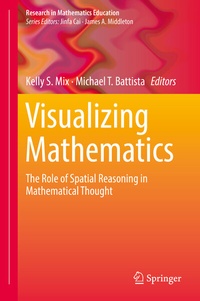
Visualizing Mathematics
Description

This unique volume surveys recent research on spatial visualization in mathematics in the fields of cognitive psychology and mathematics education. The general topic of spatial skill and mathematics has a long research tradition, but has been gaining attention in recent years, although much of this research happens in disconnected subfields. This volume aims to promote interaction between researchers, not only to provide a more comprehensive view of spatial visualization and mathematics, but also to stimulate innovative new directions in research based on a more coordinated effort. It features ten chapters authored by leading researchers in cognitive psychology and mathematics education, as well as includes dynamic commentaries by mathematics education researchers on cognitive psychology chapters, and by cognitive psychologists on mathematics education chapters.
Among the topics included:
- From intuitive spatialmeasurement to understanding of units.
- Spatial reasoning: a critical problem-solving tool in children's mathematics strategy tool-kit.
- What processes underlie the relation between spatial skill and mathematics?
- Learning with and from drawing in early years geometry.
- Communication of visual information and complexity of reasoning by mathematically talented students.
Visualizing Mathematics makes substantial progress in understanding the role of spatial reasoning in mathematical thought and in connecting various subfields of research. It promises to make an impact among psychologists, education scholars, and mathematics educators in the convergence of psychology and education.
More details
Other editions
Additional editions
Persons
Kelly S. Mix, Ph.D., is Professor and Chair of the Department of Human Development and Quantitative Methods at the University of Maryland. A former elementary school teacher with a specialization in mathematics teaching and learning, she received her Ph.D. in Developmental Psychology from the University of Chicago in 1995.
Michael T. Battista is EHE Distinguished Professor of Mathematics Education at The Ohio State University. He earned a B.S. degree in mathematics from Kent State University in 1971, an M.S. degree in mathematics from Purdue University in 1973, and a Ph.D. degree in mathematics education from Purdue University in 1977.
