

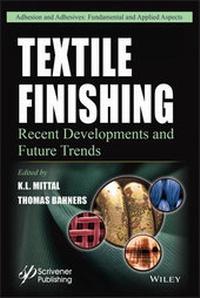
Textile Finishing
Description

More details
Other editions
Additional editions
Persons
Kashmiri Lal Mittal was employed by the IBM Corporation from 1972 through 1993 Currently, he is teaching and consulting worldwide in the broad areas of adhesion as well as surface cleaning. He has received numerous awards and honors including the title of doctor honoris causa from Maria Curie-Sklodowska University, Lublin, Poland. He is the editor of more than 130 books dealing with adhesion measurement, adhesion of polymeric coatings, polymer surfaces, adhesive joints, adhesion promoters, thin films, polyimides, surface modification surface cleaning, and surfactants. Dr. Mittal is also the Founding Editor of the journal Reviews of Adhesion and Adhesives.
Thomas Bahners studied physics at the universities of Münster and RWTH Aachen from 1974 to 1981. He has been a research scientist at the Deutsches Textil-orschungszentrum Nord-West (DTNW), Krefeld from November 1982. In 1987 he obtained his PhD in physical chemistry at the University of Duisburg where he is now the Head of Department of Physical Technologies whose research focuses on soft matter material science, polymer physics, and surface design by means of physical technologies. He has supervised about 50 research projects funded by companies or national/European research programs, and published about 200 journal articles and book chapters.
Content
Preface xv
Part 1 Recent Developments and Current Challenges in Textile Finishing
1 Recent Concepts of Antimicrobial Textile Finishes 3
Barbara Simoncic and Brigita TomSic
1.1 Introduction 3
1.2 Antimicrobial Agents 5
1.2.1 Mechanisms of Antimicrobial Activity 6
1.2.2 Structures of Antimicrobial Agents 7
1.2.2.1 Leaching Antimicrobial Agents 7
1.2.2.2 Bound Antimicrobial Agents 17
1.3 Low Adhesion Agents 21
1.4 Dual-Action Antimicrobial Agents 24
1.5 Evaluation of Antimicrobial Activity of Functionalized Textiles 29
1.5.1 Standardized Methods for the Determination of Antibacterial Activity 31
1.5.2 Standardized Methods for the Determination of Antifungal Activity 35
1.6 Health and Environmental Issues 39
1.6.1 Health and Environmental Impacts of Antimicrobial Compounds 41
1.7 Future Trends 46
1.8 Summary 46
Acknowledgement 48
References 48
2 Flame Retardant Textile Finishes 69
A Richard Horrocks
2.1 Introduction 70
2.2 Current Commercial, Durable Flame Retardants: Advantages and Disadvantages 71
2.3 Current Challenges 78
2.3.1 Minimisation of Effluents 78
2.3.2 Replacing Formaldehyde Chemistry, Particularly with Respect to Cotton and Blended Fabrics 82
2.3.2.1 Oligomeric Phosphate-Phosphonate 83
2.3.2.2 Multifunctional Carboxylic Acids 83
2.3.2.3 Alkyl Phosphoramidate Adduct 86
2.3.2.4 Phosphonyl Cyanurates 87
2.3.2.5 Cellulose-Phosphoramidate Ester Interchange 88
2.3.2.6 Cellulose-Chloro Triazinyl Derivative Condensation 89
2.3.2.7 Phosphorus Acid Derivatives of Cellulose 90
2.3.2.8 Phosphorus-Nitrogen-Silicon Developments 91
2.3.2.9 Polymer Networks 92
2.3.2.10 Other Finishing Treatments 93
2.3.3 Replacing Bromine, Notably in Coating and Back-Coating Formulations 94
2.3.3.1 Reducing the BrFR Concentrations 95
2.3.3.2 Possible Bromine-Chlorine and Phosphorus-Bromine Synergies 96
2.3.3.3 Effectiveness of Phosphorus 97
2.3.3.4 The Sensitisation of Decomposition or Flame Retarding Efficiency of Phosphorus-Based Systems 99
2.3.3.5 The Introduction of a Volatile and Possible Vapour-Phase Active, Phosphorus-Based Flame Retardant Component 99
2.4 Novel Surface Chemistries 101
2.4.1 Sol-Gel Surface Treatments 103
2.4.2 Layer-by-Layer Treatments 107
2.4.3 Polymer Coating and UV and Plasma Grafting Treatments 111
2.4.3.1 Plasma Treatments 112
2.4.3.2 UV and Other Grafting Treatments 116
2.5 Summary 117
References 117
Bibliography 127
3 Striving for Self-Cleaning Textiles - Critical Thoughts on Current Literature 129
Thomas Bahners and Kash Mittal
3.1 Introduction 130
3.2 Fundamental Principles 133
3.2.1 Self-Cleaning - The Super-Hydrophobic Approach 133
3.2.2 Self-Cleaning - The Super-Hydrophilic Approach 136
3.2.3 Expected Merits of the Concepts 138
3.3 Attempts to Attain Super-Hydrophobic Behavior 140
3.3.1 Minimized Surface Free Energy 140
3.3.1.1 Novel Chemical Finishes of Non-Polar Character 141
3.3.1.2 Deposition of Non-Polar Thin Layers by Plasma and Dielectric Barrier Discharge (DBD) 142
3.3.1.3 Deposition of Non-Polar Thin Layers by Photo-Chemical Surface Modification 145
3.3.2 Enhancing Liquid Repellence by Adding Surface Roughness 147
3.3.2.1 Application of Micro- and Nano-Rough (Hybrid) Coatings 147
3.3.2.2 Incorporation of Micro- and Nanoparticles 149
3.3.2.3 Laser-Based Surface Roughening 151
3.4 Attempts to Attain Super-Hydrophilic Properties 153
3.4.1 Use of Photo-Catalytic TiO2 153
3.4.2 Making Use of Micro-Roughness According to the Wenzel Model 155
3.5 Relevance for Dirt Take-Up, Cleanability, and Self-Cleaning 156
3.6 Summary 160
References 162
4 Metallization of Polymers and Textiles 171
Piotr Rytlewski, Krzysztof Moraczewski and Bartlomiej Jagodzinski
4.1 Introduction 171
4.2 Main Methods of Metallization 173
4.2.1 Methods Based on Physical Vapor Deposition 173
4.2.2 Chemical Vapor Deposition Methods 178
4.3 Electroless Metallization 184
4.4 Summary 198
References 199
5 Wettability Characterization in Textiles - Use and Abuse of Measuring Procedures 207
Thomas Bahners, Helga Thomas and Jochen S. Gutmann
5.1 Introduction 208
5.2 Peculiarities of Textile Substrates 209
5.3 Wettability Measurements on Fabrics 213
5.3.1 Contact Angle Measurements 213
5.3.2 Drop Penetration Tests 217
5.3.3 Soaking or Rising Height Test 222
5.3.4 The Wilhelmy Method 224
5.4 Contact Angle Measurements on Fibers 226
5.4.1 Adapting the Wilhelmy Plate Method to Single Fibers 226
5.4.2 The Washburn Approach - Wilhelmy Wicking Method 226
5.5 Summary and Concluding Remarks 228
Acknowledgements 231
References 231
Part 2 Surface Modification Techniques for Textiles
6 Surface Functionalization of Synthetic Textiles by Atmospheric Pressure Plasma 237
Keiko Gotoh
6.1 Introduction 237
6.2 Processing Parameters of Atmospheric Pressure Plasma (APP) Jet 239
6.3 Change in Single Fiber Wettability Due to APP Jet Treatment 241
6.4 Hydrophobic Recovery after APP Jet Treatment 244
6.5 Chemical and Topographical Changes on Fiber Surface Due to APP Jet Treatment 245
6.6 Fabric Damage Due to APP Jet Treatment 247
6.7 Improvement of Textile Serviceability Properties by APP Jet Treatment 250
6.7.1 Water Wicking Property 250
6.7.2 Detergency 251
6.7.3 Dyeability 252
6.8 Summary and Prospects 254
Acknowledgements 254
References 255
7 UV-Based Photo-Chemical Surface Modification of Textile Fabrics 261
Thomas Bahners and Jochen S. Gutmann
7.1 Introduction 261
7.2 Fundamentals of the Process 263
7.2.1 Photo-Addition, Irradiation in Air 263
7.2.2 Layer Formation by Homo-Polymerization and Graft-co-Polymerization 265
7.2.3 Experimental Concept 268
7.3 Fiber Properties Defined by the Surface Chemistry of Deposited Layers 269
7.3.1 Wetting and Adhesion 269
7.3.2 Wetting and Protein Adhesion - Antifouling Surfaces 271
7.3.3 Highly Liquid Repellent Technical Textiles 276
7.3.4 Patterned Wettablitity 280
7.4 Fiber Modification by Bulk Properties of Deposited Layers 281
7.4.1 Mechanical and Thermal Stability 282
7.4.2 Barrier Function 284
7.4.3 Charge Storage 285
7.4.4 Permanent Flame Retardant Finish 287
7.5 Summary and Outlook 289
References 291
Part 3 Innovative Functionalities of Textiles
8 Glimpses into Tunable Wettability of Textiles 299
Pelagia Glampedaki
8.1 Introduction 300
8.2 Paths to Tunable Wettability 302
8.2.1 Fibre and Textile Surface Functionalisation 305
8.2.2 Stimuli-Responsive Hydrogel Functionalising Systems 306
8.2.3 Modes of Functionalisation and Additional Parameters to be Considered 308
8.3 Practical Aspects and Applications 314
8.4 Prospects 316
8.5 Summary 318
References 318
9 3D Textile Structures for Harvesting Water from Fog: Overview and Perspectives 325
Jamal Sarsour, Thomas Stegmaier and Goetz Gresser
9.1 Introduction 326
9.2 Biological Models 327
9.2.1 Namib Desert Grass 327
9.2.2 Black Beetle in the Namib Desert 328
9.2.3 Epiphytic bromeliads 328
9.2.4 Pinus canariensis 330
9.3 Textile Development and Engineering 331
9.3.1 Fog Harvesting Efficiency in the Laboratory 333
9.3.2 Model of Drop Formation on the Yarn System of 3D Textiles 324
9.3.3 Scale Up to an Industrial Process 326
9.4 Technical Realization 340
9.5 Summary and Prospects 342
References 342
10 Textile-Fixed Catalysts and their Use in Heterogeneous Catalysis 345
Klaus Opwis, Katharina Kiehl, Thomas Straube, Thomas Mayer-Gall and Jochen S. Gutmann
10.1 Introduction 346
10.2 Immobilization of Catalysts on Textile Carrier Materials 348
10.2.1 Inorganic Catalysts 348
10.2.2 Organo-Metallic Catalysts 350
10.2.3 Enzymes 352
10.2.4 Organic Catalysts 355
10.3 Summary and Outlook 357
Acknowledgements 358
References 359
11 Medical Textiles as Substrates for Tissue Engineering 363
Sahar Salehi, Mahshid Kharaziha, Nafiseh Masoumi, Afsoon Fallahi, and Ali Tamayol
11.1 Introduction 364
11.1.1 Concept of TE 364
11.1.2 Background of Medical Textiles in TE 365
11.2 Fiber Formation Approaches 368
11.2.1 Wet Spinning 368
11.2.2 Melt Spinning 369
11.2.3 Microfluidic Spinning 369
11.2.4 Self-Assembly 371
11.3 Fiber-Based Architectures for the TE Scaffold 371
11.3.1 Woven Fabrics 371
11.3.2 Knitted Fabrics 373
11.3.3 Braided Fabrics 375
11.3.4 Non-Woven Fabrics 375
11.3.5 Bioprinting 377
11.4 Applications of Medical Textiles in TE 380
11.4.1 Musculoskeletal Tissues 380
11.4.2 Muscular Tissues 387
11.4.3 Ocular Tissues 391
11.4.4 Nerve Tissue 394
11.4.5 Skin 397
11.5 Summary and Prospects 399
Note 400
References 400
Part 4 Fiber-Reinforced Composites
12 Thermoset Resin Based Fiber Reinforced Biocomposites 425
D. Kalita and A. N. Netravali
12.1 Introduction 426
12.1.1 Reinforcements and Fillers 427
12.1.2 Resins 429
12.1.3 Composites 430
12.1.4 Nanocomposites 430
12.1.5 Interfaces 431
12.1.6 Petroleum Based and Biobased Resins and Fibers 432
12.2 Characteristics of Biocomposites 433
12.3 Composite Classification 434
12.3.1 Hybrid Composites 434
12.3.2 'Greener' Composites 435
12.3.3 'Green' Composites 435
12.4 Natural Fiber Processing 436
12.4.1 Fiber Extraction 437
12.4.2 Fiber Treatments 437
12.4.3 Fiber Forms (Nonwoven, Woven, Knitted) 438
12.5 Polymeric Resins 439
12.5.1 Green Resins 440
12.5.2 Thermoset Green Resins 441
12.5.2.1 Protein Based Resins 441
12.5.2.2 Starch Based Resins 444
12.5.2.3 Fats/Lipids/Oils Based Resins 447
12.6 Biobased Thermoset Composites 448
12.6.1 Plant Based Cellulose Fiber Biocomposites 449
12.6.2 Starch Based Biocomposites 450
12.6.3 Protein Based Biocomposites 452
12.6.4 Chitosan Based Biocomposites 453
12.6.5 Lipid Based Biocomposites 453
12.7 Bionanocomposites 456
12.7.1 Starch Based Nanocomposites 457
12.7.2 Cellulose Based Nanocomposites 458
12.7.3 Protein Based Nanocomposites 460
12.7.4 Chitosan Based Nanocomposites 462
12.8 Applications and Advantages of Biocomposites 463
12.9 Opportunity and Challenges 466
12.10 Summary 468
References 469
13 Characterisation of Fibre/Matrix Adhesion in Biobased Fibre-Reinforced Thermoplastic Composites 485
J. Müssig and N. Graupner
13.1 Introduction 485
13.1.1 Terms and Definitions 487
13.1.1.1 Fibre 487
13.1.1.2 Fibre Bundle 487
13.1.1.3 Equivalent Diameter 488
13.1.1.4 Critical Length 488
13.1.1.5 Aspect Ratio and Critical Aspect Ratio 489
13.1.1.6 Single Element versus Collective 489
13.1.1.7 Collective Test to Measure Pull-Out 490
13.1.1.8 Interface and Interphase 490
13.1.1.9 Adhesion and Adherence 492
13.1.1.10 Practical & Theoretical Fibre/Matrix Adhesion 492
13.1.2 Terminology and Properties of Fibres and Matrices 492
13.1.2.1 Polymer Matrices 492
13.1.2.2 Natural Fibres 496
13.1.2.3 Regenerated Cellulose Fibres 497
13.2 Methods 503
13.2.1 Overview 503
13.2.2 Single Fibre/Single Fibre Bundle Tests 504
13.2.2.1 Pull-Out and Microbond Tests 504
13.2.2.2 Fragmentation Test 529
13.2.3 Composite Tests 534
13.2.3.1 Double-Notched Tensile Test 534
13.2.3.2 Iosipescu Shear Test 536
13.2.3.3 90° (Off-Axis) Tensile Test and 90° (Off-Axis) Bending Test 537
13.2.3.4 Short Beam Shear Test 538
13.3 Comparison of Data 539
13.4 Summary 543
Acknowledgements 545
References 545
Index 557
Chapter 1
Recent Concepts of Antimicrobial Textile Finishes
Barbara Simoncic* and Brigita Tomsic
University of Ljubljana, Faculty of Natural Sciences and Engineering, Department of Textiles, Graphic Arts and Design, Ljubljana, Slovenia
*Corresponding author: Barbara.simoncic@ntf.uni-lj.si
Abstract
The chapter reviews the most important antimicrobial agents for textiles and the mechanisms of their antimicrobial activity. Structures of the leaching and the bound compounds are presented and their modes of antimicrobial functions are discussed. In addition to active antimicrobial agents, the structures of low adhesion compounds and their "passive antimicrobial activity" are also presented. The importance of dual-action antimicrobial coatings consisting of combined controlled release and biobarrier forming active antimicrobial compounds as well as the active antimicrobial and low adhesion agents is highlighted. Standard microbiological test methods for the determination of the efficiency of antibacterial and antifungal activity of the agents on textiles are described and their pros and cons are discussed. Health and environmental impacts of the antimicrobial compounds are discussed as well as the future trends of their use are indicated.
Keywords: Antimicrobial activity, textiles, finishing, mechanisms of action, chemical structures, low-adhesion compounds
1.1 Introduction
The development of effective antimicrobial protection of textile substrates has enabled the expansion of the use of textile products in various industrial sectors, including protective and technical textiles, pharmacy, medicine, transport, tourism, agriculture, and food [1]. It includes protection against all types of microorganisms, i.e., bacteria (antibacterial), viruses (antiviral), fungi (antifungal) and protozoa (antiprotozoal). It may be intended for the protection of the users or the textile fibers. The former protects people against pathogenic and odor-causing microorganisms, which can lead to health and hygiene problems. The latter protects textile substrates against adverse textile aesthetic changes, such as colored stains and discoloration of textiles and biodegradation due to molding and rotting, which results in the reduction of breakage strength, elongation and elasticity and can lead to reduced use value of textiles [1-3].
Microorganisms can be adsorbed onto the textile substrate from the surroundings or colonize on the fibers that are in direct contact with the skin. Natural and synthetic fibers are of organic origin and, as such, represent a culture medium for the growth and development of microorganisms, which reproduce uncontrollably under favorable conditions including moisture, oxygen, heat and dirt. Whereas bacteria are primarily present on synthetic fibers, fungi are present only to a minor extent; natural cellulose, wool and silk fibers can provide excellent conditions for the growth of bacteria, fungi and algae [4-7].
As for the microorganisms present on textile fibers, those that cause various diseases and infections and those that are involved in the process of biodegradation of textile fibers are the most important. The bacterial species Staphylococcus epidermidis and Corynebacterium are the main causes of body and clothing odor [8]. The bacterial species Proteus mirabilis, the fungi Candida albicans and Epidermophyton floccosum, and fungi of the genus Trichophyton may cause skin irritation and infections [8]. On the textile fibers, the pathogenic Gram-positive bacterium Staphylococcus aureus, which is one of the major causes of community-acquired and hospital-acquired infections, can also be found [9]. The most active microorganisms in the process of biodegradation of textile fibers are fungi from the genera Aspergillus Chaetomium, Microsporum, Myrothecium and Penicillium, which cause enzymatic decomposition of both natural and synthetic fibers [6]. The most important bacteria that cause biodegradation of textile fibers are from Bacillus, Pseudomonas and Cellulomonas species [6].
Protection against microorganisms can be achieved by chemical modification of textiles with antimicrobial agents, which prevents or inhibits the growth of microorganisms and subsequent biodegradation of the fibers. There is a variety of classical and modern antimicrobials on the market, which differ in chemical structure, mode of application, antimicrobial action, effectiveness, durability to washing, impact on people and the environment, and price [1-3, 7, 9]. The effectiveness of antimicrobial agents is directly influenced by various factors; of these factors, the chemical structure and concentration of the agent, its antimicrobial mechanism, the type of microorganisms present, the chemical and morphological properties of the textile substrate, and environmental conditions including temperature, pH, the presence of moisture are the most important [3]. An effective, ecologically safe antimicrobial agent should have the following characteristics: efficiency against a broad spectrum of microorganisms, effectiveness at low concentrations and low contact time in the whole lifecycle of the textile product, colorlessness and odorlessness, washing durability, resistance to UV radiation, compatibility with other finishing agents and auxiliaries, preservation of the mechanical and physical properties of textiles, application with the use of standard equipment, economical use, nontoxicity to humans at the concentrations used and environmental friendliness [3]. Although many research works have considered the synthesis of novel antimicrobial agents, none of them fully and simultaneously meets all of the abovementioned characteristics. Accordingly, this research topic still offers many challenges and poses different toxicological and ecological problems and questions for researchers.
1.2 Antimicrobial Agents
Antimicrobial agents for textiles can be classified in several ways, the most frequently used are in terms of chemical structure, origin, concentration, efficiency, mechanism and spectrum of activity, and purpose of the antimicrobial textiles [1-3, 7, 10].
The concentration of the active substance in the antimicrobial agent is of prime importance for its antimicrobial activity [10]. It is found that a minimum inhibitory concentration (MIC) is required for biostatic activity and that the biocidal activity is achieved only if the minimum biocidal concentration (MBC) is exceeded. Whereas the biostats inhibit the growth of microorganisms, the biocides kill the microorganisms. The concentration directly influences the efficiency of the antimicrobial agent and should not be below the MIC, which ensures the resistance of microorganisms to the antimicrobial agent. Biocidal or biostatic activity of the antimicrobial agent is also influenced by the microorganisms because the toxicity of the agent to a particular microorganism can vary [11]. Namely, some antimicrobial agents seem to be more effective against bacteria than fungi or against Gram-positive than Gram-negative bacteria. There are antimicrobial agents that act on a wide range of microorganisms and those with a very limited spectrum of action. Accordingly, the concentration and the mode of action of the antimicrobial agent are directly correlated.
1.2.1 Mechanisms of Antimicrobial Activity
Antimicrobial agents used for textile protection utilize two mechanisms of antimicrobial activity:
- a controlled-release (Figure 1.1a) and
- a barrier formation mechanism (Figure 1.1b).
Figure 1.1 Schematic presentation of the controlled-release of the antimicrobial agent particles (depicted as grey spots) from the textile surface to surrounding where they kill the microorganisms (a) and the formation of polymer film by the antimicrobial agent on textile surface which acts as a barrier for microorganisms (b).
The controlled-release mechanism is characteristic of the leaching antimicrobial agents [1-3, 7, 10]. The majority of these agents are physically incorporated into the textile fibers, and their antimicrobial activity is attributed to the gradual and persistent release of the agents from the textile into their surroundings in the presence of moisture, where they act as a poison to the antimicrobials. There are also antimicrobial agents that are chemically bonded to the textile fibers, but their antimicrobial activity is due to the controlled-release of the active substance. Because these agents can be regenerated in an appropriate medium to restore their antimicrobial activity, their antimicrobial mechanism is also considered as the regeneration model [7]. Related to the antimicrobial mechanism, there are some important disadvantages in the application of the leaching antimicrobials. A release of the agent from the textile surface to the surrounding results in a decrease in the concentration of the active substance, which eventually falls below the limit of effectiveness. In addition to the deactivation of the antimicrobial agent, this can induce microorganisms to become resistant to it. If the textiles are used in contact with skin, the released antimicrobial agent can kill the beneficial bacteria of the skin microbiota, causing skin irritation. Furthermore, physically bonded leaching antimicrobials are not resistant to washing but are gradually removed from the textiles via repetitive laundering. This may cause serious environmental problems. To prolong the...
