

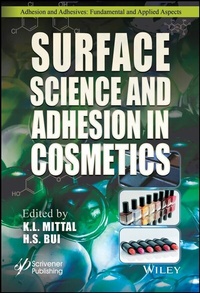
Surface Science and Adhesion in Cosmetics
Description

Activity in the arena of surface chemistry and adhesion aspects in cosmetics is substantial, but the information is scattered in many diverse publications media and no book exists which discusses surface chemistry and adhesion in cosmetics in unified manner.
This book containing 15 chapters written by eminent researchers from academia and industry is divided into three parts: Part 1: General Topics; Part 2: Surface Chemistry Aspects; and Part 3: Wetting and Adhesion Aspects. The topics covered include: Lip biophysical properties and characterization; use of advanced silicone materials in long-lasting cosmetics; non-aqueous dispersions of acrylate copolymers in lipsticks; cosmetic oils in Lipstick structure; chemical structure of the hair surface, surface forces and interactions; AFM for hair surface characterization; application of AFM in characterizing hair, skin and cosmetic deposition; SIMS as a surface analysis method for hair, skin and cosmetics; surface tensiometry approach to characterize cosmetic products; spreading of hairsprays on hair; color transfer from long-wear face foundation products; interaction of polyelectrolytes and surfactants on hair surfaces; cosmetic adhesion to facial skin; and adhesion aspects in semi-permanent mascara; lipstick adhesion measurement.
Kashmiri Lal Mittal was employed by the IBM Corporation from 1972 through 1993. Currently, he is teaching and consulting worldwide in the broad areas of adhesion as well as surface cleaning. He has received numerous awards and honors including the title of doctor honoris causa from Maria Curie-Sk?odowska University, Lublin, Poland. He is the editor of more than 130 books dealing with adhesion measurement, adhesion of polymeric coatings, polymer surfaces, adhesive joints, adhesion promoters, thin films, polyimides, surface modification surface cleaning, and surfactants. Dr. Mittal is also the Founding Editor of the journal Reviews of Adhesion and Adhesives.
Hy Si Bui obtained his BS degrees in Physics, Mathematics and Polymer Science at the University of Southern Mississippi, MS in Colloids, Polymers & Surfaces, and PhD in Chemistry at Carnegie Mellon University. He was a Coating chemist at Bayer Corporation (Covestro) and was a recipient of the Presidential Green Chemistry Challenge Award in 2000 for Two-Component Waterborne Polyurethane Coatings. He has been at L'OREAL USA for 16 years and is currently a Sr. Principal Scientist and Sr. L'OREAL Expert in Cosmetic Application Domain. He has contributed to the launch of more than 45 cosmetic products to the market and obtained 108 granted US patents and 70 pre-granted patents.
More details
Other editions
Additional editions
Persons
Kashmiri Lal Mittal was employed by the IBM Corporation from 1972 through 1993. Currently, he is teaching and consulting worldwide in the broad areas of adhesion as well as surface cleaning. He has received numerous awards and honors including the title of doctor honoris causa from Maria Curie-Sklodowska University, Lublin, Poland. He is the editor of more than 130 books dealing with adhesion measurement, adhesion of polymeric coatings, polymer surfaces, adhesive joints, adhesion promoters, thin films, polyimides, surface modification surface cleaning, and surfactants. Dr. Mittal is also the Founding Editor of the journal Reviews of Adhesion and Adhesives.
Hy Si Bui obtained his BS degrees in Physics, Mathematics and Polymer Science at the University of Southern Mississippi, MS in Colloids, Polymers & Surfaces, and PhD in Chemistry at Carnegie Mellon University. He was a Coating chemist at Bayer Corporation (Covestro) and was a recipient of the Presidential Green Chemistry Challenge Award in 2000 for Two-Component Waterborne Polyurethane Coatings. He has been at L'OREAL USA for 16 years and is currently a Sr. Principal Scientist and Sr. L'OREAL Expert in Cosmetic Application Domain. He has contributed to the launch of more than 45 cosmetic products to the market and obtained 108 granted US patents and 70 pre-granted patents.
Content
Preface xxi
Part 1: General Topics 1
1 Lip Biophysical Properties and Characterization Methods for Long-Wear Lipsticks 3
Rebecca Barresi and I-Chien Liao
1.1 Introduction 4
1.2 Overview of Lip Anatomy & Lip Surface Properties 8
1.3 In Vitro Evaluation Methods for Lipsticks 17
1.4 Relation of In Vitro Analysis with Consumer Sensory Testing 25
1.5 Summary 28
2 Effect of Cosmetic Oils on Lipstick Structure and Its Deposit 35
Momoko Suzumeji Shimizu, Yuta Nomura and Hy Si Bui
2.1 Introduction 35
2.2 Types of Natural Waxes, Their Physical Properties and Potential Applications 38
2.3 Factors Affecting Oil-Wax Structures 41
2.4 Study on Model Oil-Wax System Containing Polyethylene Wax 47
2.5 Results and Discussion 50
2.6 Summary 67
3 UV Curing of Nail Gels by Light Emitting Diode (LED) and Fluorescent (FL) Light Sources 73
Michael J. Dvorchak and Melanie L. Clouser
3.1 Introduction 73
3.2 UV Cure Chemistry 74
3.3 UV Cure Light Sources: Gallium-Doped Low-Wattage Long Wavelength Fluorescent (FL) Bulbs and Light Emitting Diodes (LEDs) 76
3.4 UV Cure Oxygen Inhibition Issues 80
3.5 Special Considerations for the Use of UV Nail Gel Technology Due to Oxygen Inhibition 81
3.6 How to Formulate a UV-A Cure Nail Gel 85
3.7 Formulation of UV Nail Gels with 100% Solids UV Cure Oligomers and Monomers 89
3.8 Human Nail Mechanical and Surface Free Energy Properties 92
3.9 Adhesion of UV Nail Gel to the Human Nail Plate 97
3.10 Removal of the UV Nail Gel From the Human Nail Plate 99
3.11 Alternative Uses of UV Cured Nail Gels as a Solution to Remedy Onychomycosis (Toenail Fungus) 99
3.12 UV Cured Nail Gel Safety 103
3.13 Prospects on UV Nail Gels 104
3.14 Summary 105
4 Rheological Properties Influence Tackiness, Application and Performance of Nail Polish/Lacquer Formulations 109
Leidy Nallely Jimenez, Carina D. V. Martínez Narváez, Chenxian Xu, Samantha Bacchi and Vivek Sharma
4.1 Introduction 110
4.2 Typical Ingredients of a Nail Polish Formulation 113
4.3 Rheological Response of Nail Polishes: Background 116
4.4 Methods for Characterizing Flow Behavior and Applicationto Nail Polishes 120
4.5 Materials: Ingredients of the Twelve Nail Polishes 122
4.6 Results and Discussion 123
4.7 Summary and Conclusions 141
5 Use of Advanced Silicone Materials in Long-Lasting Cosmetics 151
Amar B. Pawar and Benjamin Falk
5.1 Introduction 151
5.2 Adhesion to Skin 152
5.3 Formulation Strategies for Long-Lasting Cosmetics 157
5.4 Advanced Silicone Materials for Long-Wear Cosmetics 160
5.5 Summary and Prospective Film-Formers for Long-Wear
Part 2: Surface Science Aspects 183
6 Advances in the Chemical Structure of the Hair Surface, Surface Forces and Interactions 185
Gustavo S. Luengo and Andrew J. Greaves
6.1 Introduction 185
6.2 Structure of Hair and the Outermost Surface 187
6.3 Chemical and Physical Modifications of the Hair Surface 187
6.4 Local Physico-Chemical Understanding of the Hair Surface 197
6.5 Macroscopic Understanding of the Chemical Nature of the Hair Surface 203
6.6 Impact of the Hair Chemical Nature on Sensorial and Consumer Benefits 207
6.7 Prospects 208
6.8 Summary 208
7 AFM for Hair Surface Characterisation 215
Steven Breakspear, Bernd Noecker and Crisan Popescu
7.1 Hair Structure 215
7.2 Elements of AFM 217
7.3 The Use of AFM to Characterize the Hair Surface/Cuticle 227
7.4 Cosmetic Treatment (e.g. Bleaching) as Shown by AFM 237
7.5 Summary 240
8 Atomic Force Microscopy (AFM) as a Surface Characterization Tool for Hair, Skin, and Cosmetic Deposition 245
Norbert Biderman and Hy Si Bui
8.1 Introduction 245
8.2 Atomic Force Microscopy Compared to Other Microscopy Techniques 246
8.3 The Principles of Atomic Force Microscopy 247
8.4 A Brief History of Hair Surface Investigation via Atomic Force Microscopy 249
8.5 Lateral Force Microscopy (LFM) of the Hair Surface 249
8.6 Adhesion at the Nanoscale via AFM 251
8.7 Elastic Modulus Measurement via AFM 254
8.8 Hair Studies via AFM 256
8.8.1 Nanomechanical Properties of the Hair Surface 256
8.9 Skin Studies via AFM 265
8.10 Summary and Prospects 274
9 Secondary Ion Mass Spectrometry as a Surface Analysis Method for Hair, Skin, and Cosmetics 279
Norbert Biderman
9.1 Introduction 279
9.2 Secondary Ion Mass Spectrometry (SIMS) 280
9.3 Studying the Skin via TOF-SIMS 290
9.4 Studying the Hair Via TOF-SIMS 295
9.5 Future Prospects 305
Part 3: Wetting and Adhesion Aspects 309
10 Surface Tensiometry Approach to Characterize Cosmetic Products in the Beauty Sector 311
Davide Rossi and Nicola Realdon
10.1 Introduction 312
10.2 Peels 313
10.3 Face Masks 316
10.4 Serums 325
10.5 Eye Contour Creams 327
10.6 Mascara 329
10.7 Eyeshadows 334
10.8 Lipsticks 336
10.9 Foundation 339
10.10 Anti-Aging Formulations 340
10.11 Summary 348
11 Spreading of Hairsprays on Hair 353
Yashavanth Kamath and Xuemin Chen
11.1 Introduction 353
11.2 Background on Interaction of Liquid Droplets with Fibers 354
11.3 Materials and Experimental Methods 359
11.4 Results and Discussion 361
11.5 General Observations on the Behavior of Holding Spray on Hair 370
11.6 Shine Spray on One Bleached Hair Fiber 373
11.7 Summary 375
12 Quantification of the Color Transfer from Long-Wear Face Foundation Products: The Relevance of Wettability 379
Joseph V. Badami and Hy Si Bui
12.1 Introduction 380
12.2 Experiments 381
12.3 Results and Discussion 384
12.4 Summary and Perspectives 396
13 Interaction of Polyelectrolytes and Surfactants on Hair Surfaces. Deposits and their Characterization 401
Gustavo S. Luengo, Eduardo Guzman, Laura Fernández-Peña, Fabien Leonforte, Francisco Ortega and Ramon G. Rubio
13.1 Introduction 402
13.2 Hair Structure and Its External Surface 403
13.3 Experimental Approaches for the Evaluation of the Deposition of Polyelectrolyte-Surfactant Systems onto Model Surfaces 413
13.4 Theoretical Modelling of Polyelectrolyte-Surfactant Mixtures 430
13.5 Prospects 441
13.6 Summary 441
14 Adhesion Aspect and Film-Forming Properties of Hydrocarbon Polymers-Based Lipsticks 451
Julien Portal, Xavier Schultze, Simon Taupin, Mireille Arnaud-Roux, Jerome Bonnard, Gregoire Naudin, Marc Hely, Hy Bui and Norbert Biderman
14.1 Introduction 452
14.2 Synthesis and Characterization of the Model Oil Compatible Polymers Dispersions 456
14.3 NADs as Film-Formers for Long-Wear, Non-Transfer Lipstick 476
14.4 Summary and Prospects 480
15 Factors Enhancing Adhesion of Color Cosmetic Products to Skin: The Role of Pigments and Fillers 487
Hubert Lam
15.1 Introduction 488
15.2 Overview of Pigments: Basic Physicochemical Considerations in Long-Wear Color Cosmetics 488
15.3 Factors Affecting Adhesion of Long-Wear Color Cosmetics 510
15.4 Summary and Prospects 534
16 Factors Affecting Cosmetics Adhesion to Facial Skin 543
Zhi Li and Hy Si Bui
16.1 Introduction 543
16.2 Factors Affecting Adhesion to Skin: Skin Substrate Properties 544
16.3 Factors Affecting Adhesion to Skin: Formulation Components 549
16.4 Factors Affecting Adhesion to Skin: Combination of Film-Formers and Emulsifiers 573
16.5 Summary and Prospects 580
17 Adhesion Aspect in Semi-Permanent Mascara 585
Christopher Pang and Hy Si Bui
17.1 Introduction 585
17.2 Structure of Eyelash and Eye Lid: An Overview 587
17.3 Types of Mascaras 589
17.4 Components in Mascara Formulations 593
17.5 Long-Wear Mascaras 596
17.6 Evaluation Methods for Long-Wear Mascara 598
17.7 Factors Affecting Adhesion of Mascara on an Eyelash 604
17.8 Removability of Mascara 624
17.9 Summary and Prospects 628
18 Lipstick Adhesion Measurement 635
Caroline Richard
18.1 Introduction 635
18.2 Definition of Adhesion 641
18.3 Sensory Metrology: Subjective Methods 643
18.4 Mechanical Tests: Objective Methods 649
18.5 Correlation Between Sensory and Instrumental Tests 656
18.6 Summary 659
Acknowledgments 659
References 659
Index 663
1
Lip Biophysical Properties and Characterization Methods for Long-Wear Lipsticks
Rebecca Barresi and I-Chien Liao*
L'Oreal Research and Innovation Clark, NJ, USA
Abstract
The lips are two pliable and mobile muscular folds that surround the oral cavity and assist in a variety of functions which enable both human survival and communication. In addition to their functional purpose, the lips are frequently cosmetically enhanced, in terms of color and gloss, through the application of lipsticks. Understanding both the biophysical and surface properties of lips is crucial for the successful formulation and development of lipsticks, particularly those with long-wear or transfer-resistant claims. Various in vitro methods provide a clear insight as to the stability, physical properties, and visual characteristics of a lipstick formulation, but a correlation between such results and consumer use experience is still lacking.
This book chapter provides an overview of the lip anatomy and lip surface properties, which can be used to provide a general knowledge for lipstick formulation. While much is known in regards to the structure and functionality of the lip tissue, obtaining further knowledge can assist in the development of superior performing lipstick formulations. Classic in vitro test methods for long-wear lipsticks, in addition to such test results correlations with consumer sensory testing, are also discussed. It is important to note that although there is an abundance of in vitro methods available in order to characterize long-wear and transfer-resistant lipsticks, there is still a definite need to develop new methods that better correlate with consumer experience. Existing methods have the potential to be further improved with new knowledge of lip properties and use of better test substrates to illustrate the benefits of new product innovations.
Keywords: Lip anatomy, lip biophysical properties, lip surface properties, long-wear lipstick, in vitro evaluation, consumer sensory testing
1.1 Introduction
Lipsticks have been an integral part of cosmetics since the dawn of civilization. The first man-made lipstick, which consisted of black kohl, was made famous during the ancient Egyptian period as part of Cleopatra's makeup routine. Lipsticks went through a period of low popularity during the European Middle Ages, but returned to glory during the reign of Queen Elizabeth I. During the Second World War, the use of lipsticks had not only made women feel more feminine, but rather red lipstick was seen as a symbol of patriotism and defiance of difficult times during the war. The basis of modern lipstick was invented by chemist Abu al-Qasim al-Zahrawi during the Islamic Golden Age and became a product of commercialization in late 19th century, thanks to industrial advancements. Given the long history of lipstick, consumers have developed clear expectations in regards to performance, appearance, and use experience [1]. The obvious immediate requirement is that the lipsticks should contain no toxic components and irritants. Exposure to potential irritants from lipstick is mainly by swallowing, such as after a consumer licks their lips. Currently, color additives must have FDA approval for its intended use, as many can contain traces of lead as an impurity. Following an investigation effort in 2007, the FDA determined that up to 10 parts per million (ppm) of lead in lipsticks would not pose a health risk.
The long-wear lipstick market can be classified into four key categories, each of which has its own benefits and appeals to consumers: long-wear, gloss, lasting lip gloss, and lip care. Long-wear lipstick, which was also advertised as transfer-resistant, was introduced in the cosmetics market by Shiseido in 1986 as a solution to problems associated with wear and movement experienced by a majority of lipstick users [2]. Functionally, lipsticks are expected to bring instant gratification in regards to the user's appearance, regardless of style and color. To accomplish this, an ideal lipstick is expected to be non-drying, provide sun protection, and have great wear, color, and shine. Wear of lipsticks shall be mentioned further throughout the chapter and can hereby be formally defined as the user's experience as a whole, consumer perception of performance and comfort, and formulation lastingness. Lipsticks should also be easy to apply on the lips and leave a thin film deposit. Early iterations of lipstick technology did not withstand the challenges associated with consumer use and wear, which, in turn, left the consumers desiring a formulation that was able to weather their lifestyle without reduced performance or need for re-application. As a result, long-wear lipstick, substantiating claims of non-transfer, lasting color, and no smearing/smudging, was introduced to the public in the form of a two-part kit. In this kit, the first layer, a pigmented lipstick, was intended to deposit color on the lips and was to be covered by a secondary overcoat containing film-forming polymers [3]. It is important to note the key difference between lipsticks described as long-wear versus transfer-resistant. Long-wear lipstick refers to the coloring remaining the same or visually consistent from the time of application over a period of time [4]. Transfer-resistance relates to the ability of the product not to be transferred onto a secondary surface upon contact. This would relate to the formulation being removed from the consumer's lips after touching another surface, such as a glass. However, most of the time these terms are used interchangeably with consumers.
A key challenge in lipstick development is attaining an acceptable adhesion to the skin and semi-mucous areas around the lip region. After application, products can tend to migrate into cracks in the lip due to poor adhesion, creating an uneven coating and coloring over time [5]. Efforts to alleviate this problem resulted in the use of a pressure-sensitive silicone resin with MQ units (trimethyl endcap and four-way branch point units). This MQ resin, as seen in Figure 1.1, is commonly used to boost lip adherence, but the material itself is brittle, thus requiring a plasticizer in order to allow for film formation [2, 3]. This plasticizer contributes to the formation of a pliable film. Interactions with other components of the formulation, such as pigments, solvents, and fillers, also enhance product adhesion to the skin [2]. Most long-wear cosmetics utilize MQ resin technology because its surface free energy is similar to that of the human skin [2]. Skin surface free energy is a key factor for a cosmetic's wettability, adsorption, and adhesion [6]. This key characteristic is also what permits the technology to allow for better wear and adhesion to the consumer's lips. In formulations of products like Revlon ColorStay and CoverGirl, the MQ resin is used in conjunction with poly(dimethylsiloxane) (PDMS) gum to enhance the tack of the final product [2]. Additionally, initial versions of these non-transfer technologies utilized a volatile solvent with low viscosity PDMS or high viscosity gum in order to deposit a non-transferrable film upon solvent evaporation [2]. L'Oreal further developed the non-transfer MQ resin technology by introducing the use of a thermoplastic elastomer as a replacement for the PDMS gum and oil, in turn enhancing the product durability and adhesion to the lip [2]. This was incorporated into Maybelline Superstay 24 and L'Oreal Infallible lipsticks, permitting a wider range of motion of the lips and longer contact with a secondary surface, such as a drinking glass, without sacrificing the durability and appearance of the formulation [2].
Figure 1.1 Structure of the MQ resin used to enhance formulation adhesion [2].
The use of the MQ resin created quite a tradeoff for formulators: while the MQ resin improves long-wear qualities, it also created issues in terms of application, feel, and shine/gloss capability [4]. The MQ resin also contributes to dryness experienced by consumers post application; this is because the silicone derivative in combination with other lipstick ingredients would result in a dry and tightening effect on the lips [7]. The enhanced adhesion to the skin is beneficial in terms of product appearance, durability and consumer experience, but time and time again consumers have criticized the long-wear formulations due to their drying tendency and discomfort. With no hydrating property, application of the formulation to the lips stratum corneum, which is also relatively low in water content, reduces consumer comfort [2]. This effect is also caused by the film itself: a continuous film applies stress on the skin's keratinous layer which, in turn, translates to the discomfort experienced by the user [8]. A secondary top layer was introduced to the two-step kit in order to help address consumer complaints in regards to durability and performance [2]. A second benefit to the two-step application was the freedom for the consumer to decide what appearance they would like. Rather than solely having a matte option, a shiny topcoat could be used to achieve a satin or sheer effect. Although beneficial, there are limitations to this technology; in order to provide an acceptable level of shine and appearance, the topcoat may need to be re-applied throughout the course of the day and, therefore, cannot truly be classified as...
