

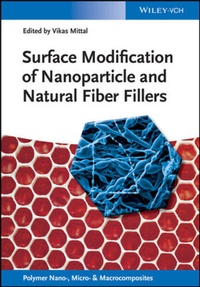
Surface Modification of Nanoparticle and Natural Fiber Fillers
Description

More details
Other editions
Additional editions

Person
Content
SURFACE MODIFICATION OF NANOMATERIALS FOR APPLICATION IN POLYMER NANOCOMPOSITES: AN OVERVIEW
Introduction
Types of Nanomaterials
Synthetic Methodologies of Nanomaterials
Surface Modification of Nanomaterials and Their Advantages in Polymer Composites
Method for the Incorporation of Nanomaterials in a Polymer Matrix
Influence of Surface-Modified Nanomaterials on the Properties of Polymer Nanocomposites
Conclusion
SURFACE MODIFICATION OF BORON CARBIDE FOR IMPROVED ADHESION TO AN EPOXY MATRIX
Introduction
Powder Synthesis
Ceramic Components
Composites
Native Surface Chemistry
Silane Surface Modification
Silane-Treated Boron Carbide
Proposed Mechanism for the Silane Treatment of BC Surface
Summary
SURFACE MODIFICATION OF HYDROXYAPATITE FOR BONE TISSUE ENGINEERING
Introduction
Surface Modification of HA
Applications for Bone Tissue Engineering
Conclusion and Perspective
INFLUENCE OF FILLER SURFACE MODIFICATION ON THE PROPERTIES OF PP COMPOSITES
Introduction
Silica Modification
Glass
Silicates
Mg(OH)2 and Eggshell Modification
Cellulose
Carbon
Conclusion
ScCO2 TECHNIQUES FOR SURFACE MODIFICATION MICRO- AND NANOPARTICLES
Introduction
Compressed CO2 and {CO2 + Solvent} Properties
Modification of Particles Using CO2 as Solvent (Route 1)
Modification of Particles Using CO2 as Non-Solvent (Route 2)
Modification of Particles Using CO2 as Expanding Medium (Route 3)
SURFACE TREATMENT OF SEPIOLITE PARTICLES WITH POLYMERS
Introduction
Surface Properties of Sepiolite
Interactions of Sepiolite with Polymers
The Changes in Colloidal Properties of Sepiolite with Polymers
Thermal Properties
Structural Changes
Adsorption Isotherms
SURFACE MODIFICATION OF ALUMINUM NITRIDE AND SILICON OXYCARBIDE FOR SILICONE RUBBER COMPOSITES
Introduction
Experimental
Results and Discussion
Conclusions
SURFACE MODIFICATION OF NATURAL AND SYNTHETIC POLYMERIC FIBERS FOR TiO2-BASED NANOCOMPOSITES
Introduction
Structure of Titanium Dioxide
Natural Fibers
Synthetic Fibers
Index
1
Surface Modification of Nanomaterials for Application in Polymer Nanocomposites: An Overview
Muthukumaraswamy Rangaraj Vengatesan and Vikas Mittal
1.1 Introduction
In recent years, advanced nanocomposite materials have been widely used in a large number of commercially valuable industrial applications such as in automobile, marine coatings, aerospace, and construction industries. The nanocomposites are made up of organic polymers and inorganic nanomaterials using different processing techniques. For example, metal, metal oxide, and carbon-based nanomaterials have been widely used in the preparation of hybrid polymer nanocomposites. The nanocomposites are a new class of advanced materials exhibiting excellent properties compared to those of virgin polymers [1]. Nanomaterials have the ability to improve the properties of polymeric materials. In order to avoid agglomeration and insufficient dispersion of nanomaterials in polymer matrices, the surfaces of the nanomaterials are modified with some organic functionalities. Without surface modification, the unmodified nanomaterials reduce the properties of polymer nanocomposites [2, 3].
Owing to the excellent interfacial interaction between the surface of the nanomaterials and polymers, Surface-modified nanomaterials (SMNs) have attracted a great deal of attention compared to unmodified nanomaterials [4]. The surface functionalization of nanomaterials is carried out with a variety of organic functional groups such as alcohols, thiols, sulfonic, carboxylic acids, and amines. Numerous methods have been employed in the process of surface modification of nanomaterials, which is based on (i) copolymerization of functional organosilanes, macromonomers, and metal alkoxides, (ii) functionalization of organic components within sol-gel-derived silica or metallic oxides, (iii) organic functionalization of nanotubes, nanoclays, or other compounds with lamellar structures, and so on [5].
SMNs that have been reinforced into polymer matrices result superior hybrid nanocomposites, which possess light weight and high strength. The SMNs enhance the mechanical, rheological, optical, electrical, thermal, and flame retardancy properties of the polymer matrices [6, 7]. SMN-reinforced polymeric nanocomposites are widely used in the form of photonic crystals, coatings, adhesives, pharmaceutical, biomedical, and cosmetic formulations [8-14].
This review is focused on SMNs for the application of polymer nanocomposites. The synthesis, classification, and surface modification of nanomaterials have been summarized and the effects of SMNs on the properties of the polymer matrices are also discussed.
1.2 Types of Nanomaterials
Nanomaterials can be classified on the basis of the number of dimensions, but this is not confined to the nanoscale range. The nanomaterial can be classified into following types:
- Zero-dimensional (0D) nanomaterial
- One-dimensional (1D) nanomaterial
- Two-dimensional (2D) nanomaterial
- Three-dimensional (3D) nanomaterial.
1.2.1 Zero-Dimensional (0D) Nanomaterial
The dimension of the material is measured within a nanoscale range, that is, less than 100 nm, which has no dimension. The 0D nanomaterials are commonly represented as nanoparticles. Recently, numerous physical and chemical methods have been adopted for the fabrication of 0D nanomaterials. A lot of research work has been focused on the synthesis of well-controlled dimension of 0D nanomaterials such as quantum dots [15, 16], hollow spheres [17], core-shell nanospheres [18, 19], and nanocluster [20, 21]. The 0D nanomaterials have been synthesized from metal, metal oxides, and carbon-based materials, and are widely used in applications of nanomedicine [20, 21], display [22], energy [23], and so on.
1.2.2 One-Dimensional (1D) Nanomaterials
The 1D nanomaterials have two physical dimensions in the range of 1-100 nm and lead to a needle-like structure. These materials have been focus of intense interest in both academic research and industrial applications because of their potential as building blocks for other structures [24]. Researchers have classified 1D nanomaterials into four types: nanotubes [25], nanowires [26], nanorods [27], and nanobelts [28], all of which are widely used for the fabrication of electronic and optoelectronic devices in nanoscale dimensions. 1D nanomaterials have a significant impact on applications in electronics, display and devices, composite materials, catalysis, and energy [29-35].
1.2.3 Two-Dimensional (2D) Nanomaterials
The 2D nanomaterials have two dimensions beyond the nanometric size in range and are not confined to the nanoscale [36]. They exhibit plate-like shapes such as nanodisks [37], nanoplatelets [38], nanowalls [39], nanoprisms [40], and nanosheets [41]. These nanomaterials are widely used in applications in the fields of energy [39], sensors [40], and catalysis [41].
1.2.4 Three-Dimensional (3D) Nanomaterials
The 3D materials are the bulk nanomaterials which are not confined to be nanoscale in any dimension. These materials thus possess three arbitrary dimensions above 100 nm and have nanocrystalline structures. The bulk nanomaterials have a multiple arrangement of nanosize crystals with different orientations. The 3D nanomaterials can contain dispersions of nanoparticles, bundles of nanowires, and nanotubes as well as multiple nanolayers. It is well known that the application of 3D nanomaterials mainly depends on sizes, shapes, dimensionality, and morphologies [36]. The 3D nanomaterials are mainly used in applications in the fields of catalysis [42], biomedicine [43], and energy [44].
1.3 Synthetic Methodologies of Nanomaterials
Nanomaterials are prepared via physical or chemical methods. A variety of physical and chemical methods are available for synthesis and fabrication of 0D, 1D, 2D, and 3D nanomaterials. The synthetic methodologies for the preparation of nanomaterials are presented in Tables 1.1 and 1.2.
Table 1.1 Synthetic methodologies of nanomaterials through physical methods.
S. No. Types of nanomaterials Method Examples with reference 1. Nanoparticle (0D) Sputter deposition (i) Ag nanoparticles in TiO2 matrix [45] (ii) Sintered TiO2 [46] 2. Quantum dots (0D) Evaporation Self-assembled ZnO nanodots are grown by electron beam evaporation [47] 3. Nanoclusters (0D) Ultra-high vacuum ion beam evaporation Ge nanoclusters embedded in Al2O3 and ZrO2/Al2O3 matrix [48] 4. Nanowires (1D) Thermal evaporation Silver nanowires [49] 5. Nanorods (1D) Radiofrequency magnetron sputtering ZnS nanorods [50] 6. Nanotubes (1D) Thermal chemical vapor deposition Carbon nanotubes [51] 7. Nanoplatelets (2D) Spray pyrolysis ZnO nanoplatelets [52] 8. Nanodiscs (2D) Thermal evaporation ZnO nanodiscs [53] 9. Nanowalls (2D) Chemical vapor deposition Carbon nanowall [54] 10. Nanoflower (3D) Thermal evaporation ZnO nanoflowers [55] 11. Aligned nanocluster (3D) Thermal evaporation Aligned Cu nanocluster on Si substrate [56]Table 1.2 Synthetic methodologies of nanomaterials through chemical methods.
S. No. Types of nano materials Method Examples with reference 1. Nanoparticle (0D) (i) Chemical reduction (i) Ag nanoparticle [57] (ii) Sol-gel (ii) ZnO nanoparticle [58] 2. Quantum dots (0D) Wet chemical synthesis CdS quantum dots [59] 3. Nanoclusters (0D) Hydrothermal Silver nanocluster [60] 4. Nanowires (1D) Wet chemical synthesis Silver nanowires [61] 5. Nanorods (1D) Solvothermal TiO2 nanorods [62] 6. Nanotubes (1D) Electrochemical TiO2 nanotubes [63] 7. Nanoplatelets (2D) Wet chemical synthesis Amphiphilic graphene platelets [64] 8. Nanosheets (2D) Solvothermal ZnO nanosheets [65] 9. Nanodiscs (2D) Hydrothermal Fe3O4 nanodiscs [66] 10. Nanoflower (3D) Solvothermal CuS flower-like nanostructure [67] 11. Hierarchical (3D) Hydrothermal Anatase TiO2 hierarchical [68]1.4 Surface Modification of Nanomaterials and Their Advantages in Polymer Composites
Numerous methods have been employed for the surface...
