

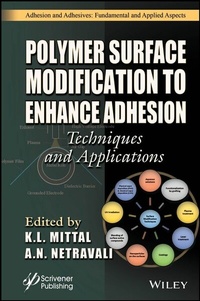
Polymer Surface Modification to Enhance Adhesion
Description

This unique, comprehensive and groundbreaking book is the first on this important subject.
Polymer Surface Modification to Enhance Adhesion comprises 13 chapters and is divided into two parts: Part 1: Energetic Treatments; and Part 2: Chemical Treatments. Topics covered include atmospheric pressure plasma treatment of polymers to enhance adhesion; corona treatment of polymer surfaces to enhance adhesion; flame surface treatment of polymers to enhance adhesion; vacuum UV photo-oxidation of polymer surfaces to enhance adhesion; optimization of adhesion of polymers using photochemical surface modification UV/Ozone surface treatment of polymers to enhance adhesion; adhesion enhancement of polymer surfaces by ion beam treatment; polymer surface modification by charged particles; laser surface modification of polymeric materials; competition in adhesion between polysort and monosort functionalized polyolefinic surfaces; amine-terminated dendritic materials for polymer surface modification; arginine-glycine-aspartic acid (RGD) modification of polymer surfaces; and adhesion promoters for polymer surfaces.
Audience
The book will be of great interest to polymer scientists, surface scientists, adhesionists, materials scientists, plastics engineers, and to those involved in adhesive bonding, packaging, printing, painting, metallization, biological adhesion, biomedical devices, and polymer composites.
More details
Other editions
Additional editions
Persons
Kashmiri Lal Mittal was employed by the IBM Corporation from 1972 through 1993. Currently, he is teaching and consulting worldwide in the broad areas of adhesion as well as surface cleaning. He has received numerous awards and honors including the title of doctor honoris causa from Maria Curie-Sk?odowska University, Lublin, Poland. He is the editor of more than 160 books dealing with adhesion measurement, adhesion of polymeric coatings, polymer surfaces, adhesive joints, adhesion promoters, thin films, polyimides, surface modification surface cleaning, and surfactants.
Anil N. Netravali was the Jean and Douglas McLean Professor of Fiber Science and Apparel Design in the Department of Fiber Science and Apparel Design at Cornell University until his retirement in 2023. Since 1984 he has been working in the field of polymer composites. He has published widely in the area of fiber/resin interface characterization and control through fiber surface modification and resin modification using nanoparticles and nanofibrils. In the past 25 years, he has made significant contributions in the area of 'green' resins, composites and nanocomposites that are fully derived from plants. He was the recipient of the Fiber Society's Founders Award in 2012 and received the Green of the Crop award from the Creative Core (NY) in 2010.
Content
- Cover
- Title Page
- Copyright Page
- Contents
- Preface
- Part I: Energetic Treatments
- Chapter 1 Atmospheric Pressure Plasma Treatment of Polymers to Enhance Adhesion
- 1.1 Introduction
- 1.2 Historical Development of APPTs
- 1.3 Functional Groups Produced by APPTs
- 1.3.1 Nitrogen-Based Surface Modification
- 1.3.2 Oxygen-Based Surface Modification
- 1.4 Adhesion Improvement for Bonding
- 1.4.1 Adhesive Bonding by Functional Groups
- 1.4.2 Adhesive-Free Joining by Functional Coatings
- 1.5 Targeted Adhesion for Biomedical Applications
- 1.6 Relevance of Adhesion in Additive Manufacturing
- 1.6.1 Surface Modification for Adhesion Improvement
- 1.6.2 Enhanced Cell Adhesion and Growth on Additive Manufactured Parts
- 1.7 Summary
- 1.8 Acknowledgements
- References
- Chapter 2 Corona Treatment of Polymer Surfaces to Enhance Adhesion
- 2.1 Introduction
- 2.1.1 Chemical versus Physical Methods in Polymer Surface Modifications
- 2.1.2 Corona Treatment and Impact on Polymers
- 2.1.3 Corona Treatment Applications and Limitations
- 2.2 Mechanism of Corona Treatment
- 2.2.1 Equipment and Operation Details for Corona Treatment
- 2.2.2 Effect of Plasma Source on Efficiency of Corona Treatment
- 2.3 Factors Affecting Performance of Corona Treatment
- 2.3.1 Effect of Material Surface Preparation: 2-D vs. 3-D
- 2.3.2 Mechanistic Discussions of Corona Parameters
- 2.3.3 Influence of Physical Factors and Equipment Design
- 2.3.4 Influence of Plasma Chemistry and Gas Composition
- 2.3.5 Effects of Process Control Methods
- 2.3.6 Hydrophobic Recovery and Mitigation by Additives
- 2.4 Surface Effects of Corona Treatment
- 2.4.1 Surface Polar Functional Groups
- 2.4.2 Modifying Surface Wettability
- 2.5 Adhesion Improvement by Corona Treatment
- 2.5.1 Polypropylene (PP)
- 2.5.2 Polyethylene (PE)
- 2.5.3 Poly(ethylene terephthalate) (PET)
- 2.5.4 Poly(vinyl chloride) (PVC)
- 2.5.5 Polystyrene (PS)
- 2.6 Summary
- References
- Chapter 3 Flame Surface Treatment of Polymers to Enhance Their Adhesion
- 3.1 Introduction
- 3.2 Chemistry of Flame Treatment
- 3.3 Flame Treatment Equipment
- 3.4 Factors Controlling Flame Plasma Surface Treatment
- 3.4.1 Flame Chemistry
- 3.4.2 Amount of Plasma Generated
- 3.4.3 Flame Geometry
- 3.4.4 Distance of the Substrate from the Flame
- 3.4.5 Dwell Time
- 3.5 Measurement of Treatment Level
- 3.6 Safety and Other Considerations
- 3.7 Adhesion Improvement
- 3.8 Summary
- References
- Chapter 4 Vacuum UV (VUV) Photo-Oxidation of Polymer Surfaces to Enhance Adhesion
- 4.1 Introduction
- 4.2 Vacuum UV Photo-Oxidation Process
- 4.2.1 VUV Background
- 4.2.2 VUV Radiation
- 4.2.2.1 Emission from Excited Atoms
- 4.2.2.2 Emission from High Pressure Rare Gas Plasmas
- 4.2.2.3 Emission from Rare-Gas Halides and Halogen Dimers
- 4.2.2.4 Other VUV Radiation Sources
- 4.2.3 VUV Optical Filters
- 4.2.4 Penetration Depths of VUV Radiation with Polymers
- 4.2.5 Analytical Methods for Surface Analysis
- 4.2.6 VUV Photochemistry of Oxygen
- 4.2.7 Reactions of O Atoms and Ozone with a Polymer Surface
- 4.3 Adhesion to VUV Surface Photo-Oxidized Polymers
- 4.3.1 Fluorine-Containing Polymers
- 4.3.1.1 Fluoropolymers
- 4.3.1.2 Nafion
- 4.3.2 Polyimides (PIs)
- 4.3.3 Polymers and Metals
- 4.3.4 Polyethylene (PE), -(C2H4)n-
- 4.3.5 Polystyrene (PS)
- 4.3.6 Cyclo-Olefin Polymers
- 4.3.7 Poly(ethylene terephthalate) (PET)
- 4.3.8 Polybenzimidazole (PBI)
- 4.3.9 Poly(etheretherketone) (PEEK)
- 4.3.10 Polypropylene (PP), -(C3H6)n-
- 4.3.11 Poly(ethylene 2,6-naphthalate) (PEN)
- 4.3.12 Polyethersulfone (PES)
- 4.3.13 Polyetherimide (PEI) and Epoxy Resin (RTM6)
- 4.4 Sustainable Polymers
- 4.5 Summary
- References
- Chapter 5 Application-Related Optimization of Adhesion of Polymers Using Photochemical Surface Modification
- 5.1 Introduction
- 5.2 Photochemical Surface Modification
- 5.2.1 Fundamentals of the Process
- 5.2.1.1 Photo-Addition or Photo-Grafting
- 5.2.1.2 Layer Formation by Homo-Polymerization and Graft-Co-Polymerization
- 5.2.2 General Process Design
- 5.3 Using Photo-Addition and Photo-Grafting to Promote the Adhesion Property of Hydrophobic Substrates
- 5.4 Enhancing Adhesion of Hydrophobic Materials on Hydrophilic Substrates - Biobased Composites as Case Study
- 5.5 Biosystems: Cell and Protein Adhesion, Antifouling Surfaces
- 5.6 Summary
- Acknowledgement
- References
- Chapter 6 UV/Ozone Surface Treatment of Polymers to Enhance Their Adhesion
- 6.1 Introduction
- 6.1.1 Adhesive Bonding of Polymers
- 6.1.2 UV-C Sensitivity of Polymers
- 6.1.3 UV/Ozone Treatment: Advantages
- 6.1.4 UV/Ozone Treatment: Disadvantages
- 6.2 Historical Development of UV/Ozone Surface Treatment
- 6.3 Parameters Controlling the UV/Ozone Surface Treatment Process
- 6.3.1 Ultraviolet (UV) Light Spectrum
- 6.3.2 UV-Light Generation
- 6.3.3 UV-Light Sources Used
- 6.3.4 Photochemical Ozone Generation
- 6.3.5 Relation between Ozone Generation and UV-Source Power
- 6.3.6 Temperature during UV/Ozone Treatment on Polyolefin Surfaces
- 6.3.7 Influence of Wavelength(s) and Gas Fill on Polyolefin Surfaces
- 6.3.8 Influence of Ozone Gas and UV-Light Spectrum on Polymer Surface Wetting
- 6.3.9 Main Process Variables: Overview
- 6.4 Surface Changes of Polymeric Materials by UV/Ozone Treatment
- 6.4.1 Polymer Bonds
- 6.4.2 Surface Cleaning by UV/Ozone: Increasing Hydrophilicity and Surface Free Energy
- 6.4.3 Photo-Degradation: Surface Roughness and Morphology Changes
- 6.4.4 UV-Light Treatment Depth in Polymer Surfaces
- 6.4.5 Surface Relaxation of HDPE
- 6.5 Surface Analysis of UV/Ozone Treated Polymeric Surfaces
- 6.5.1 Scanning Electron Microscopy (SEM) on UV/Ozone Treated Carbon Fibre Reinforced Polymer (CFRP)
- 6.5.2 Atomic Force Microscopy (AFM) on UV/Ozone Treated CFRP
- 6.5.3 X-Ray Photoelectron Spectroscopy (XPS) on UV/Ozone Treated CFRP
- 6.5.4 Attenuated Total Reflection Fourier Transform Infrared Spectroscopy (ATR-FTIR) Investigation on UV/Ozone Treated CFRP
- 6.5.5 Optically Stimulated Electron Emission (OSEE) Investigation on UV/Ozone Treated CFRP
- 6.5.6 Contact Angle Measurements on UV/Ozone Treated CFRP
- 6.6 UV/Ozone Treatment of Polymers: Improved Wetting and Adhesion
- 6.6.1 Introduction: UV/Ozone Treatment of Polymers
- 6.6.2 UV/Ozone Treatment of Thermoset Materials
- 6.6.2.1 Introduction: UV/Ozone Treatment of CFRP
- 6.6.2.2 Mechanical Tests on UV/Ozone Treated CFRP
- 6.6.2.3 Mechanical Fatigue Loading of UV/Ozone Treated CFRP
- 6.6.2.4 Adhesive Bonding of UV/Ozone Treated CFRP to Aluminium
- 6.6.2.5 UV/Ozone Treatment and Testing of Aerospace Primers
- 6.6.2.6 Mechanical Tests on UV/Ozone Treated Epoxy Coated Magnets
- 6.6.2.7 UV/Ozone Modification of Poly(dimethylsiloxane)
- 6.6.3 UV/Ozone Treatment of Thermoplastics
- 6.6.3.1 Adhesive Bonding of POM to Aluminium
- 6.6.3.2 Adhesive Bonding of Polyethylene (PE) to Stainless Steel
- 6.6.3.3 Adhesive Bonding and Aging of HDPE
- 6.6.3.4 Adhesive Bonding of Polyethylene (PE) to Acrylonitrile Styrene Acrylate (ASA)
- 6.6.3.5 Adhesive Bonding of Polypropylene (PP)
- 6.6.3.6 Surface Treatment of Nylon (Polyamide 6)
- 6.6.3.7 UV/Ozone Treatment of Poly(phenylene sulphide) (PPS)
- 6.6.3.8 UV/Ozone Treatment of Poly(methyl methacrylate) (PMMA)
- 6.6.3.9 Adhesive Bonding of Flexible Polymeric Solar Cells
- 6.6.3.10 Treatment of ABS for Adhesive Bonding
- 6.6.3.11 Adhesive Bonding of Styrene-Acrylonitrile (SAN) to a Thermoplastic Elastomer (TPE)
- 6.6.4 UV/Ozone Treatment of Rubbers
- 6.6.4.1 UV/Ozone Treatment of SBS Rubber
- 6.6.4.2 Surface Treatment of Ethylene Propylene Diene Monomer (EPDM) Rubber to Optimize the Adhesion of a Coating
- 6.6.4.3 EPDM Rubber Pre-Treated by a Low Pressure UV-Source
- 6.7 Prospects
- 6.8 Summary
- Acknowledgements
- References
- Chapter 7 Adhesion Enhancement of Polymer Surfaces by Ion Beam Treatment
- 7.1 Introduction
- 7.1.1 Ion Beam - Surface Interactions: Background
- 7.1.2 Ion Beam - Surface Interactions: Kinetics
- 7.1.3 Computer Simulations of Ion Beam - Solid Interactions
- 7.2 Ion Beam Treatment of Polymers
- 7.2.1 Principle of Technique
- 7.2.2 Types of Ion Beams and Interactions
- 7.2.3 Impacts and Outcome of Polymer Surface Modification
- 7.3 Analysis Techniques to Analyze Post Ion Beam Treatment
- 7.3.1 X-Ray Diffraction
- 7.3.2 Scanning Electron Microscopy (SEM)
- 7.3.3 Scanning Tunneling Microscopy (STM)
- 7.3.4 Fourier Transform Infrared Spectroscopy
- 7.3.5 Raman Spectroscopy
- 7.3.6 UV Spectroscopy
- 7.3.7 X-Ray Photoelectron Spectroscopy (XPS)
- 7.3.8 Atomic Force Microscopy (AFM)
- 7.3.9 Wettability Measurements
- 7.4 Polymer Surface Modifications for Biomedical Applications
- 7.4.1 Poly(lactic acid) (PLA)
- 7.4.2 Poly(L-lactic acid) (PLLA)
- 7.4.3 Poly(L-lactide) (PLA), Poly(D, L-Lactide-co-glycolide) (PDLG) and Poly(L-lactide-co-caprolactone) (PLC)
- 7.4.4 Poly(dimethylsiloxane) (PDMS)
- 7.4.5 He+ Ion Irradiation of Selected Polymeric Materials
- 7.4.6 Ion Beam Assisted Deposition (IBAD)
- 7.4.7 Ion Beam Texturing (IBT)
- 7.5 Polymer Surface Modification for Microelectronics Applications
- 7.5.1 Bisphenol A Polycarbonate (PC)
- 7.5.2 Aluminum Films on Bisphenol A Polycarbonate (PC)
- 7.5.3 Indium Tin Oxide (ITO) Films on Bisphenol A Polycarbonate (PC)
- 7.5.4 Polyimide Films
- 7.5.5 Cu/Polyimide Films
- 7.5.6 PVA/PANI Polymer Composite Films
- 7.5.7 Multiple Ion Beam Treatment of Polymers
- 7.5.7.1 Kapton H, Teflon PFA, Tefzel and Mylar Polymers
- 7.5.7.2 Polycarbonate (PC, Lexan)
- 7.6 Summary
- References
- Chapter 8 Polymer Surface Modification by Charged Particles from Plasma Using Plasma-Based Ion Implantation Technique
- 8.1 Introduction
- 8.2 Overview of Literature About Polymer Surface Modification by Charged Particles from Plasma Using Plasma-Based Ion Implantation
- 8.3 Principle of PBII: Advantages and Limitations
- 8.4 Equipment Needed
- 8.5 Factors Influencing the Outcome/Results
- 8.5.1 Wettability Studies
- 8.5.2 Surface Free Energy and Wettability
- 8.5.3 Surface Morphology
- 8.5.4 XPS Spectra
- 8.5.5 Raman Spectrometry
- 8.5.6 FT-IR Measurements
- 8.6 Results Showing Adhesion Improvement after PBII Treatment
- 8.7 Prospects
- 8.8 Summary
- References
- Chapter 9 Laser Surface Engineering of Polymeric Materials for the Modification of Wettability and Adhesion Characteristics
- 9.1 Introduction
- 9.2 Methods for Measuring Wettability and Adhesion Characteristics
- 9.2.1 Contact Angle Goniometry
- 9.2.2 Tensiometry
- 9.3 Laser Surface Engineering of Polymeric Materials
- 9.3.1 Common Surface Engineering Techniques
- 9.3.2 CO2 Laser and Ultraviolet (UV) Excimer Laser Surface Engineering of Polymeric Materials
- 9.3.3 Ultrafast Lasers for Surface Engineering of Polymeric Materials
- 9.3.4 Currently Available Literature Related to Laser Surface Engineering of Polymeric Materials
- 9.4 Summary
- Acknowledgements
- References
- Chapter 10 Competition in Adhesion between Polysort and Monosort Functionalized Polyolefin Surfaces Coated with Vacuum-Evaporated Aluminium
- 10.1 Introduction
- 10.2 Differences in Adhesion between Poly- and Monosort Functionalized Polyolefin Surfaces
- 10.2.1 General Comparison of Mono- and Polysort Functional Groups
- 10.2.2 Methods for Modifying Polyolefin Surfaces with Polysort Functional Groups
- 10.2.3 Polysort Functionalization of Polyolefins and the General Problem with Polymer Degradation
- 10.2.4 Polysort Functionalization and Surface Free Energy
- 10.2.5 Methods of Generating Polysort Functionalized Polyolefin Surfaces
- 10.2.6 Monosort OH Groups
- 10.2.7 OH Groups by Wet-Chemical Post-Plasma Transformation of Polysort O Functional Groups into OH Groups
- 10.2.8 Monosort COOH Groups
- 10.2.9 Monosort NH2 Groups
- 10.2.10 Other Methods for Selectively Modifying Polyolefin Surfaces with Monosort Functional Groups
- 10.2.11 Monosort Bromination
- 10.2.12 Advantages of Plasma Monosort Bromination
- 10.2.13 Transformation of C-Br Groups into Adhesion-Promoting OH- or NH2-Groups
- 10.2.14 Monosort Functionalization via Grafting of Flexible Spacer Molecules
- 10.2.15 Advantages of Monosort Functionalized Surfaces Formed by Spacer Molecules
- 10.2.16 Monosort Functional Groups Deposited via Plasma Polymers as Ultra-Thin Film Adhesion Promoters
- 10.2.17 Variation of the Density of Monosort Functional Groups by Copolymerization
- 10.2.18 Plasmaless Coating with Classic Polymers Carrying Monosort Functional Groups
- 10.3 Bonding of Metal Coatings to Polysort and Monosort Functionalized Polyolefins
- 10.3.1 Physical Bonding
- 10.3.2 Covalent Bonding along the Metal-Polymer Interface
- 10.4 Adhesion Results for Evaporated Aluminium Coating on Poly- and Monosort Functionalized Polyolefin Surfaces
- 10.4.1 Competition of Adhesion Efficiency between Strong Covalent Bonds and Polar Groups with Weak Interactions
- 10.4.2 Peel Strength of Metal-Monosort Functionalized Polyolefin Laminates
- 10.4.3 Peel Strength of Monosort Terminal Groups of Flexible Spacers Grafted to the Polyolefin Surface
- 10.4.4 Role of Spacer Length and Associated Flexibility
- 10.4.5 Protection of Al-O-C Bonds against Hydrolysis
- 10.4.6 Redox Reactions and Ion Migration
- 10.5 Realization of Ideal Covalently Bonded Interface
- 10.5.1 Schematic Structure of "Ideal" Interface
- 10.5.2 Results
- 10.5.3 Comparison of Results
- 10.5.4 Limitations of Ideally Designed Interface
- 10.6 Summary
- Acknowledgements
- References
- Part II: Chemical Treatments
- Chapter 11 Amine-Terminated Dendritic Materials for Polymer Surface Modification to Enhance Adhesion
- 11.1 Introduction
- 11.2 Dendritic Materials
- 11.3 Amine-Terminated Dendritic Materials as Adhesion Modifiers
- 11.3.1 Hydrophilicity
- 11.3.2 Zeta Potential and Surface Charge
- 11.3.3 Surface Topography
- 11.3.4 New Interaction
- 11.4 Applications of Amine-Terminated Dendritic Materials in Adhesion
- 11.4.1 Cell Adhesion
- 11.4.2 Bacterial Adhesion
- 11.4.3 Adhesion in Composites
- 11.4.4 Adhesion in Water Treatment
- 11.4.5 Coatings Adhesion
- 11.5 Summary
- References
- Chapter 12 Arginine-Glycine-Aspartic Acid (RGD) Modification of Polymer Surfaces to Enhance Cell Adhesion
- 12.1 Introduction
- 12.2 RGD Peptides
- 12.3 RGD Immobilization Techniques
- 12.3.1 Physical Entrapment
- 12.3.2 Covalent Attachment
- 12.3.2.1 Water-Soluble Carbodiimide (WSC) Chemistry
- 12.3.2.2 Click Chemistry
- 12.3.2.3 Photo-Immobilization
- 12.3.3 Micro/Nano-Patterning
- 12.3.3.1 Photolithography
- 12.3.3.2 Focused Laser Light
- 12.3.3.3 Soft Lithography
- 12.3.3.4 Dip Pen Nanolithography
- 12.3.3.5 Bioprinting
- 12.4 Characterization
- 12.5 Applications
- 12.6 Summary
- References
- Chapter 13 Adhesion Promotors for Polymer Surfaces
- 13.1 To Coat or Not to Coat Polymer Surfaces
- 13.2 Theory of Adhesion: Adhesion Forces
- 13.3 Plastics
- 13.4 Polymer Adhesion Mechanisms
- 13.4.1 Mechanical
- 13.4.2 Electrical
- 13.4.3 Adsorption/Wetting
- 13.4.4 Diffusion
- 13.4.5 Covalent Bonding
- 13.4.6 Summary: Adhesion Mechanisms
- 13.5 Pretreatments
- 13.5.1 Solvent Wipe Treatment
- 13.5.2 Chemical Treatments
- 13.5.3 Chemical Etching
- 13.5.4 Adhesion Promoters
- 13.5.4.1 Chlorinated Polyolefin (CPO)
- 13.5.4.2 CPO Cosolvent
- 13.5.4.3 Other Chlorinated Tie-Coats
- 13.5.4.4 In-Mold Application of CPO
- 13.5.4.5 Non-Chlorinated Adhesion Promoters
- 13.5.4.6 Environmentally-Benign Approaches
- 13.5.4.7 Melt-Blended Polymer Additives
- 13.5.4.8 Silanes
- 13.6 Summary
- References
- Index
- EULA
