

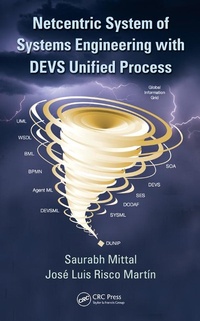
Netcentric System of Systems Engineering with DEVS Unified Process
1st Edition
Published on 3. September 2018
712 pages
978-1-4398-2707-9 (ISBN)
Description

In areas such as military, security, aerospace, and disaster management, the need for performance optimization and interoperability among heterogeneous systems is increasingly important. Model-driven engineering, a paradigm in which the model becomes the actual software, offers a promising approach toward systems of systems (SoS) engineering. However, model-driven engineering has largely been unachieved in complex dynamical systems and netcentric SoS, partly because modeling and simulation (M&S) frameworks are stove-piped and not designed for SoS composability. Addressing this gap, Netcentric System of Systems Engineering with DEVS Unified Process presents a methodology for realizing the model-driven engineering vision and netcentric SoS using DEVS Unified Process (DUNIP).
The authors draw on their experience with Discrete Event Systems Specification (DEVS) formalism, System Entity Structure (SES) theory, and applying model-driven engineering in the context of a netcentric SoS. They describe formal model-driven engineering methods for netcentric M&S using standards-based approaches to develop and test complex dynamic models with DUNIP. The book is organized into five sections:
Section I introduces undergraduate students and novices to the world of DEVS. It covers systems and SoS M&S as well as DEVS formalism, software, modeling language, and DUNIP. It also assesses DUNIP with the requirements of the Department of Defense's (DoD) Open Unified Technical Framework (OpenUTF) for netcentric Test and Evaluation (T&E).
Section II delves into M&S-based systems engineering for graduate students, advanced practitioners, and industry professionals. It provides methodologies to apply M&S principles to SoS design and reviews the development of executable architectures based on a framework such as the Department of Defense Architecture Framework (DoDAF). It also describes an approach for building netcentric knowledge-based contingency-driven systems.
Section III guides graduate students, advanced DEVS users, and industry professionals who are interested in building DEVS virtual machines and netcentric SoS. It discusses modeling standardization, the deployment of models and simulators in a netcentric environment, event-driven architectures, and more.
Section IV explores real-world case studies that realize many of the concepts defined in the previous chapters.
Section V outlines the next steps and looks at how the modeling of netcentric complex adaptive systems can be attempted using DEVS concepts. It touches on the boundaries of DEVS formalism and the future work needed to utilize advanced concepts like weak and strong emergence, self-organization, scale-free systems, run-time modularity, and event interoperability.
This groundbreaking work details how DUNIP offers a well-structured, platform-independent methodology for the modeling and simulation of netcentric system of systems.
The authors draw on their experience with Discrete Event Systems Specification (DEVS) formalism, System Entity Structure (SES) theory, and applying model-driven engineering in the context of a netcentric SoS. They describe formal model-driven engineering methods for netcentric M&S using standards-based approaches to develop and test complex dynamic models with DUNIP. The book is organized into five sections:
Section I introduces undergraduate students and novices to the world of DEVS. It covers systems and SoS M&S as well as DEVS formalism, software, modeling language, and DUNIP. It also assesses DUNIP with the requirements of the Department of Defense's (DoD) Open Unified Technical Framework (OpenUTF) for netcentric Test and Evaluation (T&E).
Section II delves into M&S-based systems engineering for graduate students, advanced practitioners, and industry professionals. It provides methodologies to apply M&S principles to SoS design and reviews the development of executable architectures based on a framework such as the Department of Defense Architecture Framework (DoDAF). It also describes an approach for building netcentric knowledge-based contingency-driven systems.
Section III guides graduate students, advanced DEVS users, and industry professionals who are interested in building DEVS virtual machines and netcentric SoS. It discusses modeling standardization, the deployment of models and simulators in a netcentric environment, event-driven architectures, and more.
Section IV explores real-world case studies that realize many of the concepts defined in the previous chapters.
Section V outlines the next steps and looks at how the modeling of netcentric complex adaptive systems can be attempted using DEVS concepts. It touches on the boundaries of DEVS formalism and the future work needed to utilize advanced concepts like weak and strong emergence, self-organization, scale-free systems, run-time modularity, and event interoperability.
This groundbreaking work details how DUNIP offers a well-structured, platform-independent methodology for the modeling and simulation of netcentric system of systems.
Reviews / Votes
"The book is the first to expose the DEVS Unified Process (DUNIP), a methodology that employs the DEVS formalism to provide a sound modeling and simulation framework for model-driven systems engineering. Software and systems engineers at the cutting edge of intelligent system technologies will be particularly interested in the fact that the book extends DUNIP to apply to systems capable of complex adaptive and emergent behaviors."-Bernard P. Zeigler, the father of DEVS formalism, University of Arizona, USA
"This book is among the first to coherently and concisely address the challenge to integrate modeling and simulation (M&S) as one of the emerging decision support tools of the 21st century into this netcentric environment. ... The task for integrating solutions that are implemented on heterogeneous IT systems and that were developed independently from each other, but that nonetheless shall support homogeneous presentation of required functionality to the user, is supported by netcentric system of systems. The book brings both aspects together successfully and proposes a general solution that merges successful formal approaches with state-of-the-art engineering solutions. Although the case studies are taken from the defense domain, the applicability of the recommended approach to all domains of M&S-such as business, transportation, and medical-is given implicitly, as formalism as well as engineering solutions are accepted in these domains."
-Andreas Tolk, Ph.D., Old Dominion University, USA
"... there is interesting content in this book for systems engineers who are interested in model-based systems engineering and in different kinds of simulation, as well as those interested in how the software for distributed systems of computer systems can be modeled.
-INCOSE INSIGHT, December 2013 "The book is the first to expose the DEVS Unified Process (DUNIP), a methodology that employs the DEVS formalism to provide a sound modeling and simulation framework for model-driven systems engineering. Software and systems engineers at the cutting edge of intelligent system technologies will be particularly interested in the fact that the book extends DUNIP to apply to systems capable of complex adaptive and emergent behaviors."-Bernard P. Zeigler, the father of DEVS formalism, University of Arizona, USA
"This book is among the first to coherently and concisely address the challenge to integrate modeling and simulation (M&S) as one of the emerging decision support tools of the 21st century into this netcentric environment. ... The task for integrating solutions that are implemented on heterogeneous IT systems and that were developed independently from each other, but that nonetheless shall support homogeneous presentation of required functionality to the user, is supported by netcentric system of systems. The book brings both aspects together successfully and proposes a general solution that merges successful formal approaches with state-of-the-art engineering solutions. Although the case studies are taken from the defense domain, the applicability of the recommended approach to all domains of M&S-such as business, transportation, and medical-is given implicitly, as formalism as well as engineering solutions are accepted in these domains."-Andreas Tolk, Ph.D., Old Dominion University, USA
"... there is interesting content in this book for systems engineers who are interested in model-based systems engineering and in different kinds of simulation, as well as those interested in how the software for distributed systems of computer systems can be modeled."-INCOSE INSIGHT, December 2013
More details
Series
Language
English
Place of publication
Baton Rouge
United States
Publishing group
Taylor & Francis Inc
Target group
College/higher education
Systems engineers, software engineers, computer scientists, computer engineers, and control engineers working in communications, robotics, neural networks, simulation, modeling, control, and Discrete Event Systems Specification (DEVS).
Illustrations
284 s/w Abbildungen, 61 s/w Tabellen
61 Tables, black and white; 284 Illustrations, black and white
File size
13,93 MB
ISBN-13
978-1-4398-2707-9 (9781439827079)
Copyright in bibliographic data and cover images is held by Nielsen Book Services Limited or by the publishers or by their respective licensors: all rights reserved.
Schweitzer Classification
Other editions
Additional editions
Saurabh Mittal | Jose L. Risco Martin
Netcentric System of Systems Engineering with DEVS Unified Process
Book
03/2017
1st Edition
CRC Press
€150.50
Shipment within 10-20 days
Saurabh Mittal | Jose L. Risco Martin
Netcentric System of Systems Engineering with DEVS Unified Process
Book
02/2013
1st Edition
CRC Press
€321.88
Shipment within 15-20 days
Persons
Saurabh Mittal is the founder and principal scientist at Dunip Technologies, which he manages in his free time. He is currently a full-time research scientist at L-3 Communications and is a contractor to the U.S. Air Force Research Laboratory, Wright-Patterson Air Force Base, Ohio. In this capacity, he is working on large-scale cognitive M&S, cognitive domain ontologies extending SES theory, and various other cross-directorate M&S integration and interoperability efforts using architecture frameworks such as the Department of Defense Architecture Framework (DoDAF). He is a recipient of the highest civilian contractor recognition, the "Golden Eagle" award, by the Joint Interoperability Test Command, Defense Information Systems Agency, U.S. DoD. He serves on various conference program committees and is a reviewer for many prestigious international journals. He is also interested in open systems research, artificial intelligence, complex adaptive systems, metamodeling, and systems interoperability.
Jose L. Risco Martin is an associate professor in the Computer Architecture and Automation Department of Universidad Complutense de Madrid (UCM), Spain. His research interests focus on the design methodologies for integrated systems and high-performance embedded systems, including new modeling frameworks to explore thermal management techniques for multiprocessor system-on-chip, novel architectures for logic and memories in forthcoming nanoscale electronics, dynamic memory management and memory hierarchy optimizations for embedded systems, networks-on-chip interconnection design, and low-power design of embedded systems. He is also interested in theory of M&S, with an emphasis on DEVS, and the application of bioinspired optimization techniques in computer-aided design problems.
Jose L. Risco Martin is an associate professor in the Computer Architecture and Automation Department of Universidad Complutense de Madrid (UCM), Spain. His research interests focus on the design methodologies for integrated systems and high-performance embedded systems, including new modeling frameworks to explore thermal management techniques for multiprocessor system-on-chip, novel architectures for logic and memories in forthcoming nanoscale electronics, dynamic memory management and memory hierarchy optimizations for embedded systems, networks-on-chip interconnection design, and low-power design of embedded systems. He is also interested in theory of M&S, with an emphasis on DEVS, and the application of bioinspired optimization techniques in computer-aided design problems.
Content
The Basics: Introduction to Systems Modeling and Simulation. System of Systems Modeling and Simulation with DEVS. DEVS Formalism and Variants. DEVS Software: Model and Simulator. DEVS Modeling Language. DEVS Unified Process. Modeling and Simulation-Based Systems Engineering: Reconfigurable DEVS. Real-Time DEVS and Virtual DEVS. Model-Driven Engineering and Its Application in Modeling and Simulation. System Entity Structures and Contingency-Based Systems. Department of Defense Architecture Framework: Version 1.0. Modeling and Simulation-Based Testing and DoDAF Compliance. Netcentric System of Systems: DEVS Standard. Architecture for DEVS/SOA. Model and Simulator Deployment in a Netcentric Environment. Netcentric System of Systems with DEVS-Based Event-Driven Architectures. Metamodeling in Department of Defense Architecture Framework (Version 2.0). Case Studies: Joint Close Air Support: Designing from Informal Scenarios. DEVS Simulation Framework for Multiple Unmanned Aerial Vehicles in Realistic Scenarios. Generic Network Systems Capable of Planned Expansion: From Monolithic to Netcentric Systems. Executable UML. BPMN to DEVS: Application of MDD4MS Framework in Discrete Event Simulation. Next Steps: Netcentric Complex Adaptive Systems. Acronyms. Index.
