

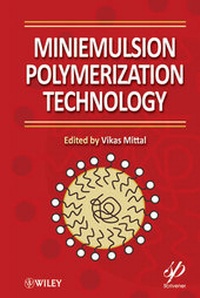
Miniemulsion Polymerization Technology
Description

More details
Other editions
Additional editions
Person
Content
1 Miniemulsion Polymerization: An Overview (V. Mittal).
1.1 Introduction to Polymerization Techniques.
1.2 Emulsion and Miniemulsion Polymerization.
1.3 Properties of Miniemulsion Polymerization.
1.4 Controlled Miniemulsion Polymerization.
2 Multi-Functional Stabilizers in Miniemulsion Polymerization (Alain Durand).
2.1 Introduction.
2.2 Stability of Initial Monomer Droplets.
2.3 Stabilizers and Polymerization Processes.
2.4 Conclusion.
3 Structured Copolymer Particles by Miniemulsion Polymerization (V. Mittal).
3.1 Introduction.
3.2 Styrene-Dodecyl Methacrylate/Stearyl Methacrylate.
3.3 n-Butyl Methacrylate-Crosslinking Monomers.
3.4 Vinyl Acetate-Butyl Acrylate.
3.5 Butyl Acrylate-(2-Methacryloxy)ethyl)trimethyl Ammonium Chloride.
3.6 Butyl Acrylate-Methyl Methacrylate-Vinyl Acetate.
3.7 Styrene-Acrylic Acid or 2-Aminoethyl Methacrylate Hydrochloride (AEMH).
3.8 Styrene-Butyl Acrylate.
3.9 Styrene-Butadiene Rubber.
3.10 Fluoroacrylate-LaurylMethylacrylate-Methyl Methacrylate.
3.11 Polyurethane-Block-Polystyrene.
3.12 Alkyd-Acrylic.
3.13 Oil-Acrylate.
3.14 Urethane-Acrylic.
4 Encapsulation of Inorganic Nanoparticles by Miniemulsion Polymerization (Jacqueline Forcada and Jose Ramos).
4.1 Introduction.
4.2 Miniemulsion Polymerization in the Presence of Inorganic Nanoparticles.
4.3 Encapsulation of Silica Nanoparticles.
4.4 Encapsulation of Magnetite Nanoparticles.
4.5 Conclusions and Future Perspectives.
4.6 Acknowledgements.
5 Polymeric Nanocapsules by Interfacial Miniemulsion Polymerization (Guo-Rong Shan and Zhi-Hai Cao).
5.1 Introduction.
5.2 Organic Nanocapsules by Inter facial Miniemulsion Polymerization.
5.3 Organic-Inorganic Hybrid Nanocapsules by Interfacial Miniemulsion Polymerization.
5.4 Conclusions.
6 Miniemulsion Polymerization of Vegetable Oil Macromonomers (Shelby F. Thames, James W. Razvlins, and Sharathkumar K. Mendon).
6.1 Introduction and Background.
6.2 Emulsion Polymerization of Alkyds and Vegetable Oils.
6.3 (Meth)acrylated Vegetable Oil Derivatives.
6.4 Vegetable Oil Macromonomers.
6.5 The Potential for Emulsion Polymerization of Model Saturated Monomers.
6.6 Nucleation Mechanisms.
6.7 Design of Thermosetting Latex Polymers.
6.8 Classifying Monomer Solubility for Macro and Miniemulsion Polymerization.
6.9 Soybean Acrylated Monomer Synthesis.
6.10 Miniemulsion Polymerization.
6.11 Conclusions.
7 Controlled/Living Radical Polymerization in Aqueous Miniemulsion (Catherine Lefay, and Julien Nicolas).
7.1 Introduction.
7.2 Controlled/Living Radical Polymerization in Bulk/Solution: General Considerations.
7.3 Nitroxide-Mediated Miniemulsion Polymerization.
7.4 Atom Transfer Radical Miniemulsion Polymerization 188
7.5 Reversible Addition-Fragmentation Chain Transfer Miniemulsion Polymerization.
7.6 Iodine Transfer Polymerization in Miniemulsion.
7.7 Conclusion.
8 Inverse Miniemulsion Polymerization of Unsaturated Monomers (Ignác Capek).
8.1 Introduction.
8.2 General.
8.3 Kinetic Studies.
8.4 Traditional and Nonconventional Inverse Latexes.
8.5 Controlled Radical Miniemulsion Polymerization.
8.6 Amphiphilic and Associating Copolymers.
8.7 Conclusion.
8.8 Acknowledgements.
9 Double Miniemulsion Preparation for Hybrid Latexes (R.Y. Hong, G. Liu, B. Feng, and H.Z. Li).
9.1 Introduction.
9.2 Hybrids via Mini-Emulsion Polymerization.
9.3 Double-Miniemulsion Formation.
9.4 Stability.
9.5 Characterization.
9.6 Applications.
9.7 Summary.
9.8 Acknowledgments.
10 Surfactant Effect in Miniemulsion Polymerization for Biodegradable Latexes (V. Soldi, B.G. Zanetti-Ramos, and E. Minatti).
10.1 Introduction.
10.2 Miniemulsion Polymerization of Biodegradable Latexes.
10.3 Mechanisms of Surfactant Protection of Colloidal Dispersions.
10.4 Effect of Surfactants on Miniemulsion Polymerization.
10.5 Final Remarks.
Index.
