

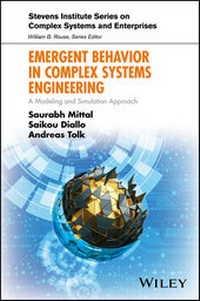
Emergent Behavior in Complex Systems Engineering
Description

In Emergent Behavior in Complex Systems Engineering, the authors present the theoretical considerations and the tools required to enable the study of emergent behaviors in manmade systems. Information Technology is key to today's modern world. Scientific theories introduced in the last five decades can now be realized with the latest computational infrastructure. Modeling and simulation, along with Big Data technologies are at the forefront of such exploration and investigation.
The text offers a number of simulation-based methods, technologies, and approaches that are designed to encourage the reader to incorporate simulation technologies to further their understanding of emergent behavior in complex systems. The authors present a resource for those designing, developing, managing, operating, and maintaining systems, including system of systems. The guide is designed to help better detect, analyse, understand, and manage the emergent behaviour inherent in complex systems engineering in order to reap the benefits of innovations and avoid the dangers of unforeseen consequences. This vital resource:
* Presents coverage of a wide range of simulation technologies
* Explores the subject of emergence through the lens of Modeling and Simulation (M&S)
* Offers contributions from authors at the forefront of various related disciplines such as philosophy, science, engineering, sociology, and economics
* Contains information on the next generation of complex systems engineering
Written for researchers, lecturers, and students, Emergent Behavior in Complex Systems Engineering provides an overview of the current discussions on complexity and emergence, and shows how systems engineering methods in general and simulation methods in particular can help in gaining new insights in complex systems engineering.
More details
Other editions
Additional editions
Persons
SAURABH MITTAL, PhD, is Lead Systems Engineer/Scientist at MITRE Corporation, USA. He is also affiliated with Dunip Technologies, LLC, USA and Society of Modeling Simulation International, USA. He is a recipient of US Department of Defense's highest civilian contractor recognition: Golden Eagle. He has co-authored over eighty articles including two books: Netcentric System of Systems Engineering with DEVS Unified Process (CRC Press 2013) and Guide to Simulation-based Disciplines: Advancing our Computational Future (Springer 2017).
SAIKOU DIALLO, PhD, is a Research Associate Professor at Old Dominion University's Virginia Modeling, Analysis and Simulation Center. Dr. Diallo has studied the concepts of interoperability of simulations and composability of models for over ten years. He is the Vice President in charge of conferences and a member of the Board of Directors for the Society for Modeling and Simulation International (SCS). Dr. Diallo has over one hundred publications in peer-reviewed conferences, journals and books.
ANDREAS TOLK, PhD, is Division Technology Integrator at The MITRE Corporation and Adjunct Professor at the Old Dominion University. He is a Fellow of the Society for Modeling and Simulation. He published several books on systems engineering and modeling and simulation topics, among them: Engineering Principles of Combat Modeling and Distributed Simulation (Wiley 2012), Modeling and Simulation Support for System of Systems Engineering Applications (Wiley 2015), and The Profession of Modeling and Simulation (Wiley 2017).
Content
FOREWORD x
PREFACE xiii
ABOUT THE EDITORS xvi
LIST OF CONTRIBUTORS xviii
SECTION I EMERGENT BEHAVIOR IN COMPLEX SYSTEMS 1
1 Metaphysical and Scientific Accounts of Emergence: Varieties of Fundamentality and Theoretical Completeness 3
John Symons
2 Emergence: What does it mean and How is it Relevant to Computer Engineering? 21
Wesley J. Wildman and F. LeRon Shults
3 System Theoretic Foundations for Emergent Behavior Modeling: The Case of Emergence of Human Language in a Resource-Constrained Complex Intelligent Dynamical System 35
Bernard P. Zeigler and Saurabh Mittal
4 Generative Parallax Simulation: Creative Cognition Models of Emergence for Simulation-Driven Model Discovery 59
Levent Yilmaz
SECTION II EMERGENT BEHAVIOR MODELING IN COMPLEX SYSTEMS ENGINEERING 77
5 Complex Systems Engineering and the Challenge of Emergence 79
Andreas Tolk, Saikou Diallo, and Saurabh Mittal
6 Emergence in Complex Enterprises 99
William B. Rouse
7 Emergence in Information Economies: An Agent-Based Modeling Perspective 129
Erika Frydenlund and David C. Earnest
8 Modeling Emergence in Systems of Systems using Thermodynamic Concepts 149
John J. Johnson IV, Jose J. Padilla, and Andres Sousa-Poza
9 Induced Emergence in Computational Social Systems Engineering: Multimodels and Dynamic Couplings as Methodological Basis 171
Tuncer Ören, Saurabh Mittal, and Umut Durak
10 Applied Complexity Science: Enabling Emergence through Heuristics and Simulations 201
Michael D. Norman, Matthew T.K. Koehler, and Robert Pitsko
SECTION III ENGINEERING EMERGENT BEHAVIOR IN COMPUTATIONAL ENVIRONMENTS 227
11 Toward the Automated Detection of Emergent Behavior 229
Claudia Szabo and Lachlan Birdsey
12 Isolating the Causes of Emergent Failures in Computer Software 263
Ross Gore
13 From Modularity to Complexity: A Cross-Disciplinary Framework for Characterizing Systems 285
Chih-Chun Chen and Nathan Crilly
14 The Emergence of Social Schemas and Lossy Conceptual Information Networks: How Information Transmission can lead to the Apparent "Emergence" of Culture 321
Justin E. Lane
15 Modeling and Simulation of Emergent Behavior in Transportation Infrastructure Restoration 349
Akhilesh Ojha, Steven Corns, Tom Shoberg, Ruwen Qin, and Suzanna Long
SECTION IV RESEARCH AGENDA 369
16 Research Agenda for Next-Generation Complex Systems Engineering 371
Saikou Diallo, Saurabh Mittal, and Andreas Tolk
INDEX 391
