

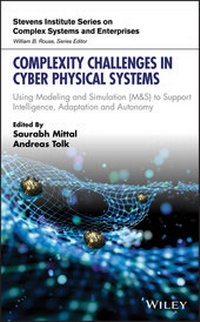
Complexity Challenges in Cyber Physical Systems
Description

This book provides the state-of-the-art in methods and technologies that aim to elaborate on the modeling and simulation support to cyber physical systems (CPS) engineering across many sectors such as healthcare, smart grid, or smart home. It presents a compilation of simulation-based methods, technologies, and approaches that encourage the reader to incorporate simulation technologies in their CPS engineering endeavors, supporting management of complexity challenges in such endeavors.
Complexity Challenges in Cyber Physical Systems: Using Modeling and Simulation (M&S) to Support Intelligence, Adaptation and Autonomy is laid out in four sections. The first section provides an overview of complexities associated with the application of M&S to CPS Engineering. It discusses M&S in the context of autonomous systems involvement within the North Atlantic Treaty Organization (NATO). The second section provides a more detailed description of the challenges in applying modeling to the operation, risk and design of holistic CPS. The third section delves in details of simulation support to CPS engineering followed by the engineering practices to incorporate the cyber element to build resilient CPS sociotechnical systems. Finally, the fourth section presents a research agenda for handling complexity in application of M&S for CPS engineering. In addition, this text:
* Introduces a unifying framework for hierarchical co-simulations of cyber physical systems (CPS)
* Provides understanding of the cycle of macro-level behavior dynamically arising from spaciotemporal interactions between parts at the micro-level
* Describes a simulation platform for characterizing resilience of CPS
Complexity Challenges in Cyber Physical Systems has been written for researchers, practitioners, lecturers, and graduate students in computer engineering who want to learn all about M&S support to addressing complexity in CPS and its applications in today's and tomorrow's world.
More details
Other editions
Additional editions
Persons
SAURABH MITTAL, PhD, is Chief Scientist for Simulation, Experimentation and Gaming at The MITRE Corporation. He is the President-Elect and member of the Board of Directors for the Society for Modeling and Simulation International. He is a recipient of US DoD's highest civilian contractor recognition: Golden Eagle award (2006). He has published over hundred articles in various venues including the books: Netcentric System of Systems Engineering with DEVS Unified Process (2013), Guide to Simulation-based Disciplines: Advancing Our Computational Future (2017) and Emergent Behavior in Complex Systems Engineering: A Modeling and Simulation Approach (2018).
ANDREAS TOLK, PhD, is Senior Principal Computer Scientist at The MITRE Corporation and Adjunct Professor at Old Dominion University. He is a Fellow of the Society for Modeling and Simulation International. His numerous publications comprise twelve books on systems engineering and modeling and simulation, including the Engineering Principles of Combat Modeling and Distributed Simulation (2012), Modeling and Simulation Support for System of Systems Engineering Applications (2015), and Emergent Behavior in Complex Systems Engineering: A Modeling and Simulation Approach (2018).
Content
Preface xi
Foreword xv
Barry Martin Horowitz
About the Editors xvii
List of Contributors xix
Author Biography xxiii
Part I Introduction 1
1 The Complexity in Application of Modeling and Simulation for Cyber Physical Systems Engineering 3
Saurabh Mittal and Andreas Tolk
2 Challenges in the Operation and Design of Intelligent Cyber-Physical Systems 27
Sebastian Castro, Pieter J. Mosterman, Akshay H. Rajhans, and Roberto G. Valenti
3 NATO Use of Modeling and Simulation to Evolve Autonomous Systems 53
Jan Mazal, Agostino Bruzzone, Michele Turi, Marco Biagini, Fabio Corona, and Jason Jones
Part II Modeling Support to CPS Engineering 81
4 Multi-Perspective Modeling and Holistic Simulation: A System-Thinking Approach to Very Complex Systems Analysis 83
Mamadou K. Traoré
5 A Unifying Framework for the Hierarchical Co-Simulation of Cyber-Physical Systems 111
Fernando J. Barros
6 Model-Based Systems of Systems Engineering Trade-off Analytics 131
Aleksandra Markina-Khusid, Ryan Jacobs, and Judith Dahmann
7 Taming Complexity and Risk in Internet of Things (IoT) Ecosystem Using System Entity Structure (SES) Modeling 163
Saurabh Mittal, Sheila A. Cane, Charles Schmidt, Richard B. Harris, and John Tufarolo
Part III Simulation-Based CPS Engineering 191
8 Simulation Model Continuity for Efficient Development of Embedded Controllers in Cyber-Physical Systems 193
Rodrigo Castro, Ezequiel Pecker Marcosig, and Juan I. Giribet
9 Cyber-Physical Systems Design Methodology for the Prediction of Symptomatic Events in Chronic Diseases 223
Kevin Henares, Josué Pagán, José L. Ayala, Marina Zapater, and José L. Risco-Martín
10 Model-Based Engineering with Application to Autonomy 255
Rahul Bhadani, Matt Bunting, and Jonathan Sprinkle
Part IV The Cyber Element 287
11 Perspectives on Securing Cyber Physical Systems 289
Zach Furness
12 Cyber-Physical System Resilience: Frameworks, Metrics, Complexities, Challenges, and Future Directions 301
Md Ariful Haque, Sachin Shetty, and Bheshaj Krishnappa
13 The Cyber Creation of Social Structures 339
E. Dante Suarez and Loren Demerath
Part V Way Forward 371
14 A Research Agenda for Complexity in Application of Modeling and Simulation for Cyber Physical Systems Engineering 373
Andreas Tolk and Saurabh Mittal
Cyber Physical Systems - Modeling and Simulation to Balance Enthusiasm and Caution 391
Kris Rosfjord
Index 395
Author Biography
Aleksandra Markina-Khusid is a Principal Systems Engineer in The MITRE Corporation Systems Engineering Technical Center, supporting several SoS modeling efforts for DoD and DHS. She is the MITRE Model Based Engineering Capability Area Team leader. Dr. Markina-Khusid holds a BS degree in Physics, MS and PhD degrees in Electrical Engineering, and an MS in Engineering & Management, all from the Massachusetts Institute of Technology.
Agostino G. Bruzzone is Full Professor at DIME University of Genoa, Director of M&S Net (International Network involving 34 Centers) Director of the MISS McLeod Institute of Simulation Science - Genoa Center (over 28 Centers distributed worldwide) founder member and president of the Liophant Simulation, he served as Vice President and Member of the Board of MIMOS (Movimento Italiano di Simulazione), member of the NATO MSG, Executive VP of the Society for Modeling and Simulation International. He works on innovative modeling, AI techniques, application of Neural Networks, GAs and Fuzzy Logic to industrial plant problems using Simulation and Chaos Theory. He is member of several International Technical and Organization Committees (i.e. AI Application of IASTED, AI Conference, ESS, AMS) and General Coordinator of Scientific Initiatives (i.e. General Chair of SCSC and I3M). He teaches "M&S" for the DIMS PhD Program (Doctorship in Integrated Mathematical M&S). He is Director of the Master Program in Industrial Plants & Technologies for the University of Genoa and founder and chair of STRATEGOS International MSc in Engineering Technologies for Strategy and Security (http://www.itim.unige.it/strategos). He served as Project Leader for the NATO Science & Technology Organization at the Centre for Maritime Research and Experimentation (CMRE) founding the new research track on Modeling and Simulation. He has been the 10th scientist worldwide to enter into the Modeling and Simulation Hall of Fame as top Lifetime Achievement Awards of the Society for Modeling and Simulation International.
Akshay H. Rajhans is Principal Cyber-Physical Systems Research Scientist at MathWorks in the Advanced Research & Technology Office, where his research focuses on technical computing for and model-based design and analysis of cyber-physical systems (CPS). Previously, he worked on research and development and application engineering of electronic control systems for diesel-engine applications at Cummins, and invented a model-based approach to non-intrusive load monitoring at Bosch Research and Technology Center. Dr. Rajhans has been involved in leadership capacities in top research conferences in CPS and modeling and simulation communities, including as the inaugural CPS Track Chair at both the Winter Simulation Conference (2017) and the Spring Simulation Conference (2019), and as a Co-Chair of the International Workshop on Monitoring and Testing of CPS (2019). He is a recipient of the 2011 IEEE/ACM William J. McCalla Best Paper Award and his work has been recognized as a Research Highlight in "Communications of the ACM," ACM's flagship magazine. Dr. Rajhans has a PhD in Electrical and Computer Engineering from Carnegie Mellon University and an MS in Electrical Engineering from the University of Pennsylvania. He is a member of IEEE and ACM.
Bheshaj Krishnappa is currently working as a Principal at ReliabilityFirst Corporation. Mr. Krishnappa is responsible for risk analysis and mitigation of threats to bulk power system reliability and security across a large geographic area in the United States. He has over 22 years of professional experience working for large- and mid-sized companies in senior roles implementing and managing information technology, security, and business solutions to achieve organizational objectives. He is a business graduate knowledgeable in sustainable business practices that contribute to the triple bottom line of social, environmental, and economic performance. He is motivated to apply his vast knowledge to achieve individual and organizational goals in creating a sustainable positive impact.
Charles Schmidt is a Group Lead at The MITRE Corporation. He has over 17 years of experience in cybersecurity, security automation, and standards development. He holds a BS in Mathematics and Computer Science from Carleton College and an MS in Computer Science from the University of Utah.
Ezequiel Pecker Marcosig received a degree in Electronic Engineering from the Faculty of Engineering (FIUBA) of the University of Buenos Aires, Argentina. He is currently a PhD student at FIUBA and ICC-CONICET working on modeling and simulation based design of hybrid controllers for cyber-physical systems. His work is supported with a PhD Fellowship from the Peruilh Foundation. Since 2013, he is a Teaching Assistant in the Department of Electronic Engineering at FIUBA in the area of Automatic Control. His academic interests include automatic control, cyber-physical systems, modeling and simulation, and hybrid systems.
E. Dante Suarez is Associate Professor for Finance and Decision Sciences at Trinity University, USA. He holds PhD and MS in Economics from Arizona State University, USA. Suarez's main research field is international finance, where he studies the integration of international financial markets, such as the relationship between American depositary receipts and their corresponding underlying stocks. This research is aimed at understanding how markets around the world interact with each other in this age of globalization. Other research areas include econometrics, European studies and Latin American business practices.
Fabio Corona is employed in the Concept Development and Experimentation Branch (CD&E) at NATO Modelling & Simulation Centre of Excellence in Rome. His primary interests at the Centre are emerging technologies and concepts regarding Autonomous System and M&S as a Service. He earned a PhD degree in Electrical Engineering from "Politecnico di Torino" and a MSc degree in Electronics Engineering from "Roma Tre" University. After joining the Italian Army, his employment ranged from the internetworking field under the Italian Army Signal Headquarter to the maintenance and procurement of optoelectronic and communication systems under the Italian Army Logistics Headquarter. During his PhD study, the main research field was in efficiency and power quality of photovoltaic systems under mismatching conditions.
Fernando Barros is a Professor in the Department of Informatics Engineering at the University of Coimbra. He holds a PhD in Electrical Engineering from the University of Coimbra. His research interests include theory of modeling and simulation, hybrid systems and dynamic topology models. He has published more than 80 contributions to journals, book chapters, and conference proceedings. Fernando Barros is a member of IEEE.
Jan Mazal is graduate of the Faculty of Military Systems Management of the Military College of Ground Forces in Vyskov. In 2003 he graduated the Academic Course of Military Intelligence in Fort Huachuca, Arizona, USA. Since 2005 he is a doctor in the field of the theory of the defence management and since 2013 he is Associate professor in the problematic of military management and C4ISR systems. He is former deputy chief of the Department of Military Management and Tactics at the University of Defence in Brno, currently he works as Doctrine Education and Training Branch Chief at NATO Modelling & Simulation Centre of Excellence in ROME. He is focused on the issue of military intelligence and reconnaissance, C4ISR systems, and Operational Decision Support. He is the author and co-author of more than 70 professional publications, he solved more than 10 scientific projects, and he is the author of a number of functional samples and application software. In his previous military practice, he held command and staff functions at the tactical level and also he took part in the foreign missions as EUFOR (2006) and ISAF (2010).
Jason M. Jones is the Deputy Director for the NATO Modelling & Simulation Centre of Excellence. He has been a U.S. Army Functional Area 57, Simulations Operations Officer, since 2003 and has worked in all aspects of simulations: training, planning, world-wide simulation distribution, testing, and experimentation. Areas of expertise include: live and constructive training; missile defense and logistics simulation; and knowledge management. He has a Master's Degree in Modeling, Virtual Environments, and Simulations from the Naval Postgraduate School in Monterey, CA, where his thesis examined the use of commercial gaming software for training infantry squads.
John Tufarolo is the Technical Director for Systems Engineering at Research Innovations. He holds a BS in Electrical Engineering from Drexel University, and an MS in Systems Engineering from George Mason University, and has more than 32 years of experience providing systems engineering project work, planning, and leadership in complex distributed systems.
Jonathan Sprinkle is the Litton Industries John M. Leonis Distinguished Associate Professor of Electrical and Computer Engineering at the University of Arizona. In 2013 he received the NSF CAREER award, and in 2009, he received the UA's Ed and Joan Biggers Faculty Support Grant for work in autonomous systems. His work has an emphasis for industry impact, and he was recognized with the UA "Catapult Award" by Tech Launch Arizona in 2014, and in 2012 his...
