

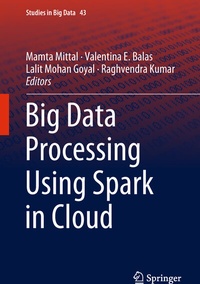
Big Data Processing Using Spark in Cloud
Description

The book describes the emergence of big data technologies and the role of Spark in the entire big data stack. It compares Spark and Hadoop and identifies the shortcomings of Hadoop that have been overcome by Spark. The book mainly focuses on the in-depth architecture of Spark and our understanding of Spark RDDs and how RDD complements big data's immutable nature, and solves it with lazy evaluation, cacheable and type inference. It also addresses advanced topics in Spark, starting with the basics of Scala and the core Spark framework, and exploring Spark data frames, machine learning using Mllib, graph analytics using Graph X and real-time processing with Apache Kafka, AWS Kenisis, and Azure Event Hub. It then goes on to investigate Spark using PySpark and R. Focusing on the current big data stack, the book examines the interaction with current big data tools, with Spark being the core processing layer for all types of data.
The book is intended for data engineers and scientistsworking on massive datasets and big data technologies in the cloud. In addition to industry professionals, it is helpful for aspiring data processing professionals and students working in big data processing and cloud computing environments.More details
Other editions
Additional editions
Persons
Valentina E. Balas, Ph.D. , is currently a Full Professor at the Department of Automatics and Applied Software at the Faculty of Engineering, "Aurel Vlaicu" University of Arad, Romania. She holds a Ph.D. in Applied Electronics and Telecommunications from the Polytechnic University of Timisoara. Dr. Balas is the author of more than 270 research papers in refereed journals and for international conferences. Her research interests are in intelligent systems, fuzzy control, soft computing, smart sensors, information fusion, modeling and simulation. She is the Editor-in-Chief of the International Journal of Advanced Intelligence Paradigms (IJAIP) and International Journal of Computational Systems Engineering (IJCSysE), serves on the Editorial Board of several national and international journals, and as an evaluator expert for national and international projects. She was General Chair of the International Workshop on Soft Computing and Applications held in Romania and Hungary (2005-2016).
Lalit Mohan Goyal, Ph.D. , received his B.Tech (Honors) in Computer Science & Engineering from Kurukshetra University, his M.Tech (Honors) in Information Technology from Guru Gobind Singh Indraprastha University, New Delhi, and his Ph.D. in Computer Engineering from Jamia Millia Islamia, New Delhi. He has 14 years of teaching experience in the areas of parallel and random algorithms and theory of computation. Presently, he is working at Bharati Vidyapeeth's College of Engineering, New Delhi.
Raghvendra Kumar, Ph.D. , is currently an Assistant Professor at the Department of Computer Science and Engineering, LNCT College, Jabalpur, and at Jodhpur National University, Rajasthan, India. He completed his Bachelor of Technology at SRM University, Chennai and his Master of Technology at KIIT University, Odisha. His research interests include graph theory, discrete mathematics, robotics, cloud computing and algorithms. He also works as a reviewer, and an editorial and technical board member for various journals.
