

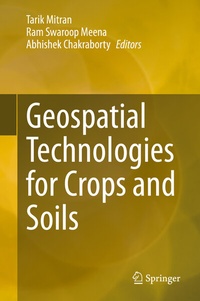
Geospatial Technologies for Crops and Soils
Description

The sustainable development of the agriculture sector is the only option to meet the demands of increased and economically viable production in a changing climate. This means there is a need to introduce the latest technologies to enhance production, and also help policymakers make decisions for the future. Geospatial technologies & tools, such as remote sensing, geographical information systems (GIS), global positioning systems (GPS), and mobile & web applications, provide unique capabilities to analyze multi-scale, multi-temporal datasets, and support decision-making in sustainable agriculture development and natural resources management. Further, the availability of reliable and timely geospatial information on natural resources and environmental conditions is essential for sustainable agricultural development and food security. Since remote sensing solutions are fast, non-destructive and have large spatial coverage, they can play a significant role in the identification, inventory, and mapping of land resources. Over the past four decades, remote sensing has proved to be a cost-effective and powerful tool to assess crop and soil properties in varying spatial and temporal scales using both visual and digital techniques. Satellite remote sensing coupled with GIS & mobile-app based positional information has emerged as an efficient tool for optimizing input resources, and minimizing cost of production and risk of biotic/ abiotic factors nature to promote sustainable agriculture. This book comprehensively documents the applications of space-based technologies for crop and soil assessments for the sustainable development of agriculture.
More details
Other editions
Additional editions
Persons
Dr. Ram Swaroop Meena is an agronomist and Assistant Professor at the Department of Agronomy, I.Ag. Scs. BHU, Varanasi (UP). Dr. Meena was awarded a Raman Research Fellowship by the MHRD, GOI. He completed his postdoctoral research on soil carbon sequestration under Prof. Rattan Lal, Director of C-MASC, Columbus, USA. He has 10 years of research and teaching experience, and is currently working on the three externally funded projects (DST, MHRD, ICAR). Dr. Meena has published more than 110 research and review papers, 4 books at the national level, 13 books at the international level, and contributed to 50 book chapters. He has worked as an expert for the NCERT, MHRD, GOI, and has been involved in various agricultural extension activities, farmer's trainings, meetings and workshops.
Dr. Abhishek Chakraborty is a senior scientist and Head of the Agroecosystem & Modelling Division at the National Remote Sensing Centre, ISRO,Hyderabad, India. He has 15 years' experience in the application of geospatial technologies in agriculture, and has been involved in several national projects funded by DST, ISRO, and central ministries. He has developed a geo-portal (BHUVAN-JAIVOORJA) to assess spatial distribution of biomass potential from crop residues over India to analyze site suitability of biofuel/biomass power plants. He has played a significant role in India's National Agricultural Drought Monitoring and Assessment System. He is recipient of an ISSS gold medal for best doctoral thesis and four best paper awards at conferences. He has published more than 35 research papers in respected peer-reviewed journals and conferences, as well as over 50 scientific reports. He is life member of two national scientific societies.
