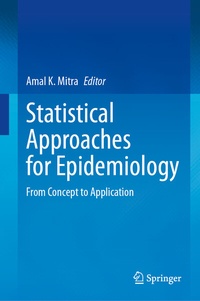
Statistical Approaches for Epidemiology
Description

This textbook provides the basic concepts of epidemiology while preparing readers with the skills of applying statistical tools in real-life situations.
Students, in general, struggle with statistical theories and their practical applications. This book makes statistical concepts easy to understand by focusing on real-life examples, case studies, and exercises. It also provides step-by-step guides for data analysis and interpretation using standard statistical software such as SPSS, SAS, R, Python, and GIS as appropriate, illustrating the concepts.
Through the book's 23 chapters, readers primarily learn how to apply statistical methods in epidemiological studies and problem-solving. Among the topics covered:
- Clinical Trials
-
Epidemic Investigation and Control
-
Geospatial Applications in Epidemiology
-
Survival Analysis and Applications Using SAS and SPSS
-
Systematic Review and Meta-Analysis: Evidence-based Decision-Making in Public Health
-
Missing Data Imputation: A Practical Guide
- Artificial Intelligence and Machine Learning
-
Multivariate Linear Regression and Logistics Regression Analysis Using SAS
Each chapter is written by eminent scientists and experts worldwide, including contributors from institutions in the United States, Canada, Bangladesh, India, Hong Kong, Malaysia, and the Middle East.
Statistical Approaches for Epidemiology: From Concept to Application is an all-in-one book that serves as an essential text for graduate students, faculty, instructors, and researchers in public health and other branches of health sciences, as well as a useful resource for health researchers in industry, public health and health department professionals, health practitioners, and health research organizations and non-governmental organizations. The book also will be helpful for graduate students and faculty in related disciplines such as data science, nursing, social work, environmental health, occupational health, computer science, statistics, and biology.
More details
Other editions
Additional editions