

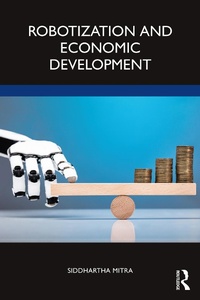
Robotization and Economic Development
1st Edition
Published on 9. September 2022
158 pages
978-1-000-64816-4 (ISBN)
Description

This book critically examines the sweeping impacts of robotization and the use of artificial intelligence on employment, per capita income, quality of life, poverty, and inequality in developing and developed economies.
It analyzes the direct and indirect effects they have had and are projected to have on the labour markets and production processes in the manufacturing, healthcare and agricultural industries among others. The author explores comparisons of human labour with robotic labour emphasizing the changes that new technologies will bring to traditionally labour-intensive industries. Offering various insights into the effectiveness, benefits and negative implications of robotization on the economy, the book provides a comprehensive picture for policymakers to implement changes that embrace new technologies while meeting employment needs and development goals.
Topical and lucid, this book will be an essential read for scholars and researchers of science and technology studies, digital humanities, economics, labour studies, public policy, development studies, political studies and sociology as well as policymakers and others who are interested in these areas.
It analyzes the direct and indirect effects they have had and are projected to have on the labour markets and production processes in the manufacturing, healthcare and agricultural industries among others. The author explores comparisons of human labour with robotic labour emphasizing the changes that new technologies will bring to traditionally labour-intensive industries. Offering various insights into the effectiveness, benefits and negative implications of robotization on the economy, the book provides a comprehensive picture for policymakers to implement changes that embrace new technologies while meeting employment needs and development goals.
Topical and lucid, this book will be an essential read for scholars and researchers of science and technology studies, digital humanities, economics, labour studies, public policy, development studies, political studies and sociology as well as policymakers and others who are interested in these areas.
Reviews / Votes
'Such a fascinating look at the large, even humongous shifts that are all around us through the lens of history, technology and economics. Whether you are a student or a professional who wishes to understand how robotization and AI are going to impact our world-this book is for you. Mitra takes a complex subject and connects the dots in ways that are unexpected, surprising, and ultimately very satisfying.'-Dr. Shalini Lal, Future of Work Specialist, UCLA PhD, and Fellow, Wharton, USA
'The robot revolution is already underway, with profound implications for developing country and developed economies. In this wide-ranging examination, Siddhartha Mitra explains how and when new technologies will replace human labour in manufacturing, agriculture, and service provision. Employing basic economic tools and a clear depiction of how robots, AI, and machine learning will substitute for human effort, Mitra identifies which workers are most at risk of displacement and income loss. With Covid-19 accelerating the adoption of labour-replacing technology, it is urgent that we struggle with Mitra's recommendations for policies designed to harness the benefits of robotization while ensuring a just transition to the brave, new world on our doorstep.'
-Mary E. Lovely, Professor, Maxwell School of Citizenship and Public Affairs and Senior Fellow, Peterson Institute
'Robotization, like other forms of technical progress, expands opportunities for the human race. But in a market economy, it also poses a threat by displacing human labour by robots. These aspects of robotization have been debated in recent times. This book by Professor Siddhartha Mitra provides an eminently readable discussion of the issues involved. He provides a historical background, and an analytical apparatus to make sense of the trade-offs involved. The book does not shy away from discussing difficult questions but does so in a lucid manner. I have no doubt, given the contents of the book, that it will be widely read. And the reader will appreciate, as I have, the hard work that went into making these seemingly obscure topics accessible'.
-Partha Sen, Professor and Former Director, Delhi School of Economics 'Such a fascinating look at the large, even humongous shifts that are all around us through the lens of history, technology, and economics. Whether you are a student or a professional who wishes to understand how robotization and AI are going to impact our world-this book is for you. Mitra takes a complex subject and connects the dots in ways that are unexpected, surprising, and ultimately very satisfying.'
-Dr. Shalini Lal, Future of Work Specialist, UCLA PhD, and Fellow, Wharton, USA
'The robot revolution is already underway, with profound implications for developing country and developed economies. In this wide-ranging examination, Siddhartha Mitra explains how and when new technologies will replace human labour in manufacturing, agriculture, and service provision. Employing basic economic tools and a clear depiction of how robots, AI, and machine learning will substitute for human effort, Mitra identifies which workers are most at risk of displacement and income loss. With Covid-19 accelerating the adoption of labour-replacing technology, it is urgent that we struggle with Mitra's recommendations for policies designed to harness the benefits of robotization while ensuring a just transition to the brave, new world on our doorstep.'
-Mary E. Lovely, Professor, Maxwell School of Citizenship and Public Affairs and Senior Fellow, Peterson Institute, USA
'Robotization, like other forms of technical progress, expands opportunities for the human race. But in a market economy, it also poses a threat by displacing human labour by robots. These aspects of robotization have been debated in recent times. This book by Professor Siddhartha Mitra provides an eminently readable discussion of the issues involved. He provides a historical background, and an analytical apparatus to make sense of the trade-offs involved. The book does not shy away from discussing difficult questions but does so in a lucid manner. I have no doubt, given the contents of the book, that it will be widely read. And the reader will appreciate, as I have, the hard work that went into making these seemingly obscure topics accessible'.
-Partha Sen, Professor and Former Director, Delhi School of Economics, India
More details
Edition
1. Auflage
Language
English
Place of publication
London
United Kingdom
Publishing group
Taylor & Francis Ltd
Target group
College/higher education
Product notice
Reflowable
Illustrations
5 Tables, black and white; 2 Line drawings, black and white; 2 Illustrations, black and white
ISBN-13
978-1-000-64816-4 (9781000648164)
Copyright in bibliographic data and cover images is held by Nielsen Book Services Limited or by the publishers or by their respective licensors: all rights reserved.
Schweitzer Classification
Other editions
Additional editions
Siddhartha Mitra
Robotization and Economic Development
Book
09/2022
1st Edition
Routledge India
€205.80
Shipment within 15-20 days
Siddhartha Mitra
Robotization and Economic Development
Book
09/2022
1st Edition
Routledge India
€66.50
Shipment within 15-20 days
Person
Siddhartha Mitra is Professor of Economics, Jadavpur University, Kolkata, West Bengal, India.
Content
Preface and Acknowledgements
1 An Overview
2 Robots and their Economic Significance
3 The impact of Robotization on Production Processes and its Rudimentary Economic Implications
4 Machine Learning and the Economy
5 Robotization, the Economy and the Labour Market: A Look at Theoretical and Empirical Studies
6 Managing the AI Revolution through Policy: A Nuts-and-Bolts Approach
7 The Immediate Future in the Light of Covid and the Bottom Line
Index
1 An Overview
2 Robots and their Economic Significance
3 The impact of Robotization on Production Processes and its Rudimentary Economic Implications
4 Machine Learning and the Economy
5 Robotization, the Economy and the Labour Market: A Look at Theoretical and Empirical Studies
6 Managing the AI Revolution through Policy: A Nuts-and-Bolts Approach
7 The Immediate Future in the Light of Covid and the Bottom Line
Index
