

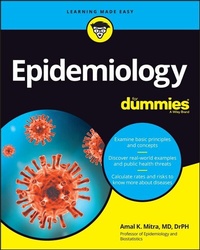
Epidemiology For Dummies
Description

Epidemiology For Dummies is packed with key concepts, practical applications, and real-life examples in the study of disease transmission and control. It's a must-have for students in all public-health-related fields, and for curious learners, too. This Dummies guide will help you conquer even the trickiest epidemiological concepts. In this introduction to the fascinating, complex science, you'll learn--in terms anyone can understand--all the basic principles of epidemiology, plus how those concepts translate to public health outcomes and policy decisions.
* Learn the basic principles and concepts of epidemiology
* Discover real-world examples and public health threats
* Understand the complex social factors that influence health
* Embark on a public health career or just pass your epidemiology course
Anyone who wants or needs to understand the fundamentals of epidemiology and the science behind public health will love Epidemiology For Dummies.
More details
Other editions
Additional editions
Person
Content
Part 1: Getting Started with Epidemiology 5
Chapter 1: Entering the World of Epidemiology 7
Chapter 2: Epidemiology 101 -- Understanding the Basics 17
Chapter 3: Exploring the Development of Epidemiological Thinking 41
Chapter 4: Eyeing the Milestones in Public Health 59
Chapter 5: Recognizing Diseases and Controlling Them 77
Part 2: Understanding Disease Causation 103
Chapter 6: Tackling the Epidemiologic Triangle 105
Chapter 7: Inspecting Descriptive Epidemiology: Person, Place, and Time 117
Chapter 8: Viewing Disease Patterns 135
Chapter 9: Linking Demography and Disease 149
Chapter 10: Digging into Math: Calculating Rates and Risks 163
Part 3: Prevention Is Better Than a Cure 187
Chapter 11: Focusing on the Levels of Prevention 189
Chapter 12: Preventing Disease with Vaccine 199
Chapter 13: Recognizing Methods of Disease Surveillance 223
Chapter 14: Investigating an Outbreak 231
Chapter 15: Identifying Disease by Screening 247
Part 4: Examining a Study Finding 265
Chapter 16: Figuring Out Whether an Association Is Causal 267
Chapter 17: Investigating the Types of Epidemiologic Studies 287
Chapter 18: Encountering Bias and Confounding 313
Chapter 19: Focusing On Ethics in Health Research 329
Part 5: The Part of Tens 343
Chapter 20: Ten Careers with a Degree in Epidemiology 345
Chapter 21: Ten Tips for Acing Your Epidemiology Classes 351
Glossary 357
Index 363
Chapter 1
Entering the World of Epidemiology
IN THIS CHAPTER
Introducing the concepts of epidemiology
Finding out about uses of numbers
Focusing on prevention
You're about to enter the wonderful world of epidemiology - an adventure of hunting for five million trillion trillion (that's a five with 30 zeroes after it) bacteria, about six million parasites, and nearly 7,000 virus species that are prevailing in the world. Thank goodness not all of them are harmful to you. The vast majority of them either live on the planet or inside you harmlessly or keep at bay like microscopic superheroes. Fewer than 100 species of bacteria, 300 species of parasitic worms, about 70 species of protozoa, and more than 200 viruses are known to cause disease in humans.
Most of the disease agents, which are infectious in nature, are controllable, either by antibiotics, vaccines, or by other public health preventive measures, such as personal hygiene, safe water supply, proper sanitation, healthy food habits, and by improving your resistance to infecting agents.
This chapter gives you an overview of this world of epidemiology and serves as a jumping-off point into this book. This chapter previews the concepts of epidemiology, mentions the importance of crunching numbers, addresses disease prevention, and discusses disease prevention, and more.
Introducing Epidemiology
Epidemiology is the study of human diseases and events. Epidemiologists are disease detectives whose jobs include the following:
- Searching for the cause of diseases in humans: All associations aren't causal. Chapter 16 provides concepts on knowing if an association between an exposure and a disease is causal or not.
- Identifying people who are at risk: Certain host factors are associated with diseases. Descriptive epidemiology (see Chapter 7) deals with person, place, and time factors that are associated with diseases. Chapter 5 addresses the risk of people in getting different types of diseases.
- Determining how to control or stop the spread: Knowing the chain of disease transmission helps you prevent or control the spread of a disease. Refer to Chapter 5 for more information about chain of disease transmission.
- Preventing the disease from happening again: Chapter 11 explains the different levels of disease prevention with practical examples.
Recognizing How Numbers Can Help Study Disease
Epidemiology and biostatistics are like cousin sisters. However, epidemiology isn't learning about math. I often ask my students whether they like math, and most of the time, they respond no and sometimes emphatically that they hate math. That's okay. Epidemiology doesn't deal with hard-core math problems. These sections explain that epidemiologists use a basic knowledge of algebra to calculate numbers.
Grappling with the epidemiologic triangle
The concept of the epidemiologic triangle includes these three factors of a disease:
- Agent: The causative factor (such as a bacteria, virus, or parasite). In other words, the what that causes the disease.
- Host: Humans and non-human animals can harbor a disease. They're called disease hosts.
- Environment: Factors in the environment such as temperature (hot or cold), noise, moisture, dusts, and others cause diseases. Also, agents and hosts both live in the environment, which makes a balance between disease and health.
When germs enter and grow in the human body, it's called an infection. The germs may be bacteria, viruses, parasites, yeasts, fungi, or other microorganisms. They're agents for an infectious disease. These agents live and multiply in the environment that humans live. But an infection doesn't necessarily lead to a disease. The favorable conditions in the environment help agents grow.
On the other hand, when a person's immune system is strong enough, it can fight the germs and cure an infection without causing a disease. If immunity is low, the germ gets the upper hand, and the person fails to resist the infection, which in turn leads to a disease. In a chronic disease model, as I describe in Chapter 6, you can find that the causes are multifactorial - they are called risk factors, instead of agents. Chapter 16 explains the concept of multiple risk factors for a noncommunicable disease.
Classifying epidemiology
Two broad classifications of epidemiology that you need to know are as follows:
- Descriptive:Descriptive epidemiology provides you answers for what, when, where, and who questions. Most health surveys, censuses, and case reports are descriptive in nature. In descriptive studies, you can identify risk groups or hot spots (or areas where diseases and agents cluster). Descriptive information can be highly valuable in generating a hypothesis and conducting a future study to evaluate the hypothesis through experimental studies, interventional studies, or a randomized controlled clinical trial (RCT) (you can find details in Chapter 17).
- Analytical:Analytical epidemiology deals with the why and how questions. Some statistical tests (called inferential statistics) are used for answering these questions. Analytical epidemiology is used to prove the hypothesis.
Understanding epidemiologic transition
The changing nature of diseases is a continuous process, and it depends on several factors including the ecology, public health measures, vaccine development, antibiotic use, genetics, and other host factors. The transition of disease occurrence from acute and infectious diseases to chronic and noncommunicable diseases (NCDs) is called the epidemiologic transition.Chapter 8 describes in greater detail this changing pattern of diseases.
Consider the following: The worldwide pandemic of Covid-19 has evolved as one of the most fatal diseases in human history. Similarly, a few other pandemics including plague, influenza (flu), smallpox, and HIV/AIDS have caused devastations and killed a large number of people. Some other infectious diseases such as pneumonia, diarrhea, malaria, and tuberculosis are still common causes of morbidity and mortality in many developing countries.
On the other hand, noncommunicable diseases such as heart disease, cancer, stroke, unintentional injuries, chronic obstructive pulmonary disease (COPD), Alzheimer's disease, and diabetes are the leading causes of death in the United States. Developed countries have curtailed mortality rates from infectious diseases. Some of the infectious disease has been eliminated (such as smallpox) in the world or reduced to a minimum level (such as polio, tetanus, measles) in developed countries. Polio is expected to be eliminated soon.
Connecting demography and disease
Changes in demography are certainly affecting the disease pattern and the healthcare costs. Health consequences of aging are many, including pain and arthritis, osteoporosis, falls and accidents, hearing defects, eye problems, heart disease, diabetes, depression, Alzheimer's, and senile dementia.
The burden of healthcare costs is also escalating. For example, in recent years, one-fifth of older Americans spent more than $2,000 out of pocket on healthcare. Chapter 9 looks at different demographics, including a comparative picture of the population structure of several countries, a list of the ten most populous states in the United States, and the top ten countries with the largest proportion of senior citizens. In addition, you can discover how to project step by step the future population of several countries.
Figuring out rates and risks
One of the focuses of descriptive epidemiology is to calculate rates and risks. Epidemiologists summarize health reports and describe the risks based on numbers. Chapter 10 explains how to calculate important rates such as crude birth rate, crude death rate, age-specific rates such as infant mortality rate, neonatal mortality rate, post-neonatal mortality rate, and perinatal mortality rate, cause-specific rates such as cancer- and heart-diseases mortality rate, and gender-specific rates such as breast cancer rates and prostate cancer rates.
Some of the rates, such as mortality rates, often need to be standardized to compare with similar rates of an entire country or another nation - this process is called standardization. This same chapter shows you how to standardize mortality rates by using direct and indirect methods.
Focusing on Prevention Rather Than a Cure
The three levels of disease prevention include
- Averting a disease before it attacks you
- Detecting a disease early enough so that you can reduce the disease severity
- Preventing disabilities and promoting quality of life
The following sections discuss the specifics.
Identifying prevention levels
Three levels of prevention include primary, secondary, and tertiary prevention. By a simple method of hand washing you can prevent a number of diseases, such as waterborne diseases and Covid-19. Chapter 11 discusses what diseases can be prevented and what the levels of prevention are.
Using vaccines
Vaccines give you a...
