

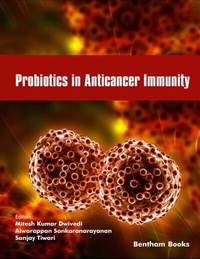
Probiotics in Anticancer Immunity Volume 3
1st Edition
Published on 13. January 2025
305 pages
978-981-5124-78-1 (ISBN)
Description

No detailed description available for "Probiotics in Anticancer Immunity Volume 3".
All prices
More details
Other editions
Additional editions
Mitesh Kumar Dwivedi | Alwarappan Sankaranarayanan | Sanjay Tiwari
Probiotics in Anticancer Immunity
Book
05/2023
Bentham Science Publishers
€101.39
Shipment within 3-4 weeks
Content
- Cover
- Title
- Copyright
- End User License Agreement
- Contents
- Foreword
- Preface
- List of Contributors
- Gut Microbiota and Host Immune System in Cancer
- Shakti Prasad Pattanayak1,*, Gaurav Ranjan1, Priyashree Sunita2 and Pritha Bose3
- 1. INTRODUCTION
- 2. HUMAN HEALTH AND DISEASE: ROLE OF GUT MICROBIOTA
- 2.1. The Human Microbiome in Health
- 3. THE ROLE OF THE HUMAN MICROBIOME IN CANCER INDUCTION
- 3.1. Human Microbiome and Gastrointestinal Malignancy
- 3.1.1. Gastric Cancer
- 3.2. Colorectal Cancer
- 3.3. Oesophageal Cancer
- 4. FUNCTION OF GUT MICROBIOTA IN HOST PHYSIOLOGY AND METABOLISM OF NUTRIENTS
- 5. ISOLATION OF INTESTINAL MICROBES IN DIETARY METABOLIZATION
- 5.1. Omics Approaches
- 5.2. Metagenomics
- 5.3. Meta Transcriptomics
- 5.4. Meta-proteomic
- 5.5. Metabolic Summarizing (metabolomics/ Metabonomics)
- 6. THE CROSSTALK BETWEEN IMMUNE SYSTEM AND MICRO- BIOTA
- 7. MECHANISM OF GUT MICROBIOTA IN ANTICANCER IMMUNITY
- 7.1. Improvement of Antitumor Immunity
- 7.2. Inflammation Reduction
- 7.3. Systemic Genotoxicity Reduction
- 7.4. Stimulation Of Anti-tumor Signalling Pathways
- 8. INTERLINK OF CANCER RISK WITH MICROBIOME
- 8.1. Induction of Inflammation
- 8.2. Immunosuppression
- 8.3. Protumorigenic Environment Development and Genotoxin Aggregation
- 9. GUT MICROBIOME AND ALLEVIATION OF IMMUNE CHECK- POINT INHIBITION RESISTANCE IN CARCINOMA IMMUNO- THERAPY
- 9.1. Cancer Immunotherapy
- 9.2. The Gut Microbiota is Linked to ICI Treatment Sensitivity
- 10. CHALLENGES OF MICROBIOME RESEARCH IN CANCER IMMUNOTHERAPY
- 10.1. Preclinical Model
- 11. NEW INSIGHTS ON THE MODULATION OF THE GUT MICROBIOTA AND THE SUPPRESSION OF IMMUNOLOGICAL CHECKPOINTS IN CANCER
- CONCLUSION
- CONSENT OF PUBLICATION
- CONFLICT OF INTEREST
- ACKNOWLEDGEMENT
- REFERENCES
- Mechanism of Probiotic Action in Anticancer Immunity
- Mangala Lakshmi Ragavan1 and Nilanjana Das1,*
- 1. INTRODUCTION
- 1.1. Gut Microbiome
- 1.2. Current Status of Cancer and Treatments
- 2. PROBIOTIC STRAINS USED FOR CANCER TREATMENT
- 3. MECHANISM OF PROBIOTICS ON CANCER IMMUNITY
- 3.1. Modifications of Gut Microbiota
- 3.2. Immunomodulation
- 3.3. Metabolic Activity
- 3.4. Enhancement of Intestinal Barrier Function
- 3.5. Production of Anti-carcinogenic Compounds
- 3.6. Degradation of Carcinogenic Compounds
- 3.7. Influence on Harmful Enzymes
- 4. ANTICANCER ACTIVITY OF PROBIOTICS
- 4.1. Production of Inhibitory Substances By Probiotics
- 4.2. Efficacy of Probiotics During Cancer Treatment
- 5. BIOTHERAPEUTIC DRUGS FOR CANCER
- CONCLUSION
- CONSENT FOR PUBLICATION
- CONFLICT OF INTEREST
- ACKNOWLEDGEMENT
- REFERENCES
- Probiotics Based Anticancer Immunity in Skin Cancer
- Engkarat Kingkaew1 and Somboon Tanasupawat1,*
- 1. INTRODUCTION
- 2. SKIN CANCERS
- 2.1. Classification of Skin Cancer
- 2.2. Pathophysiology of Skin Cancer
- 3. SKIN MICROBIOME AND SKIN CANCER
- 4. GUT MICROBIOME AND ITS IMPLICATIONS IN SKIN CANER
- 5. PROBIOTIC BASED THERAPEUTIC APPROACHES
- 5.1. Probiotics and their Beneficial Roles
- 5.2. Probiotics and Microorganisms of The Skin
- 5.3. Role of Probiotics' Metabolites (Postbiotics) in Cancer Prevention
- 5.3.1. Exopolysaccharides (EPSs)
- 5.3.2. Short-chain Fatty Acids (SCFAs) and Lipids
- 5.3.3. Bacteriocins
- 5.3.4. Cell-wall Compounds
- 5.4. Role of Probiotics in the Prevention of Skin Cancer
- CONCLUSION
- CONSENT FOR PUBLICATION
- CONFLICT OF INTEREST
- ACKNOWLEDGEMENT
- REFERENCES
- Probiotics-based Anticancer Immunity In Colon Cancer
- Sujitra Techo1, Engkarat Kingkaew2 and Somboon Tanasupawat2,*
- 1. INTRODUCTION
- 2. PROBIOTICS AND THEIR SELECTION
- 3. COLON CANCER
- 4. IMMUNOMODULATORY EFFECT OF PROBIOTICS
- 5. MECHANISMS OF PROBIOTICS IN THE PREVENTION AND/OR TREATMENT OF COLON CANCER
- 5.1. Enhancement of The Host's Immune Response
- 5.2. Suppression of the Enzymatic Activity of Pathogenic Bacteria
- 5.3. Regulation of Proliferation and Apoptotic Responses of Colon Cancer Cells
- 5.4. Protection of Intestinal Mucosal Barrier of Host
- 5.5. Inhibition of Carcinogenic Agents
- 6. PROBIOTICS USED FOR COLON CANCER PREVENTION AND/OR TREATMENT
- CONCLUSION
- CONSENT FOR PUBLICATION
- CONFLICT OF INTEREST
- ACKNOWLEDGEMENTS
- REFERENCES
- Probiotics Based Anticancer Immunity in Colorectal Cancer
- Prashant Shankar Giri1 and Mitesh Kumar Dwivedi1,*
- 1. INTRODUCTION
- 2. PATHOGENESIS OF COLORECTAL CANCER
- 3. CORRELATION BETWEEN THE GUT MICROBIOTA AND COLO- RECTAL CANCER
- 3.1. Dysbiosis of Gut Microbiota in Colorectal Cancer
- 4. ROLE OF PROBIOTICS IN COLORECTAL CANCER
- 4.1. Animal Model Studies
- 4.2. Human Clinical Trials
- 5. PROBIOTICS MECHANISMS INVOLVED IN TREATMENT OF COLORECTAL CANCER
- 5.1. Regulation of Apoptosis
- 5.2. Inhibition of Tumor Cell Proliferation
- 5.3. Modulation of Host Immune Response
- 5.4. Short Chain Fatty Acids (SCFAs)
- 5.5. Reduction of Microbial Infection
- 5.6. Inactivation of Carcinogenic Compounds
- 5.7. Regulation of Tyrosine Kinase Pathway
- 6. FUTURE PERSPECTIVES
- CONCLUSIONS
- CONSENT FOR PUBLICATION
- CONFLICT OF INTEREST
- ACKNOWLEDGEMENT
- REFERENCES
- Probiotics-based Anticancer Immunity in Breast Cancer
- Nosheen Masood1,* and Saima Shakil Malik2,*
- 1. INTRODUCTION
- 2. GUT MICROBIOME
- 3. BREAST MICROBIOME
- 4. MILK MICROBIOME
- 5. MECHANISMS OF MICROBIAL MODULATION IN ANTI-TUMOR IMMUNE RESPONSES BY PROBIOTICS
- 6. MICROBIOME EFFECTS AND APPLICATIONS IN BREAST CANCER
- 7. BENEFICIAL MODULATION OF ANTI-TUMOR IMMUNE RESPO- NSES BY PROBIOTIC BACTERIA
- CONCLUSION
- CONSENT FOR PUBLICATION
- CONFLICT OF INTEREST
- ACKNOWLEDGEMENTS
- REFERENCES
- Probiotics Based Anticancer Immunity In Stomach Cancer
- Shilpi Singh1, Bindu Kumari2, Sonal Sinha3, Gireesh Kumar Singh2, Suaib Lqman1,* and Dhananjay Kumar Singh2,*
- 1. INTRODUCTION
- 2. EPIDEMIOLOGY OF STOMACH CANCER DEVELOPMENT, SYMPTOMS AND RISK FACTORS
- 2.1. Incidence and Mortality
- 2.2. Geographical Variability and Trends
- 2.3. Symptoms
- 2.4. Risk Factors
- 2.5. Diagnosis, Prevention and Treatment
- 2.5.1. Eradication of H. Pylori Infection
- 2.5.2. Diet Improvement
- 2.5.3. Early Detection
- 3. HISTOPATHOLOGY OF STOMACH CANCER
- 3.1. Sporadic Type
- 3.2. Early-onset Gastric Cancer
- 3.3. Gastric Stump Cancer
- 3.4. Hereditary Diffuse Gastric Cancer
- 4. TUMOUR-IMMUNE MILIEU IN STOMACH CANCER
- 5. GUT MICROBIOTA DYSBIOSIS IN STOMACH CANCER
- 6. ROLE OF PROBIOTICS IN STOMACH CANCER MANAGEMENT
- 6.1. Anticancer Mechanism of Probiotics
- 7. CURRENT PROBLEMS AND PROSPECTS
- CONCLUSION
- CONSENT FOR PUBLICATION
- CONFLICT OF INTEREST
- ACKNOWLEDGEMENTS
- REFERENCES
- Probiotic-based Anticancer Immunity In Hepato- cellular Carcinoma (liver Cancer)
- Firdosh shah1 and Mitesh Kumar Dwivedi1,*
- 1. INTRODUCTION
- 2. ROLE OF GUT MICROBIOTA IN LIVER DISEASES
- 3. ROLE OF GUT MICROBIOTA IN HEPATOCELLULAR CARCINO- GENESIS
- 3.1. Gut Microbial Dysbiosis and Bacterial Metabolite Production in Hepatocellular Carcinogenesis
- 3.2. Immunomodulation in Hepatocellular Carcinogenesis
- 3.3. Toll-like Receptors (TLRs) in Hepatocellular Carcinogenesis
- 4. BENEFICIAL ROLE OF PREBIOTICS IN TREATMENT OF HEPATOCELLULAR CARCINOMA
- 4.1. Role of Prebiotics Fructans and Butyrate in Hepatocellular Carcinoma
- 5. PROBIOTICS AS A THERAPEUTIC APPROACH FOR TREATING HEPATOCELLULAR CARCINOMA
- 5.1 Probiotics Helps In Improving Intestinal Dysbiosis
- 5.2 Probiotics Mediate Modulation of SCFAs Production
- 5.3 Probiotics Help in The Regulation of Th17 Response in HCC
- 5.4. Role of Probiotics in Binding or Adsorption to Carcinogens
- 6. FUTURE PERSPECTIVES
- CONCLUSION
- CONSENT FOR PUBLICATION
- CONFLICT OF INTEREST
- ACKNOWLEDGMENT
- REFERENCES
- Probiotics-based Anticancer Immunity In Cervical Cancer
- Mehran Mahooti1,2, Elahe Abdolalipour1, Seyed Mohammad Miri1 and Amir Ghaemi1,*
- 1. INTRODUCTION
- 2. PATHOGENESIS OF HPV AND CERVICAL CANCER
- 3. PROBIOTICS
- 4. PROBIOTIC AND CERVICAL CANCER (WITH A FOCUS ON POSSIBLE ANTI-CERVICAL CANCER MECHANISM OF PROBIOTICS)
- 5. PROBIOTIC AND CERVICAL CANCER (IN VITRO STUDIES)
- 6. ANTI-CERVICAL CANCER EFFECT OF PROBIOTICS IN THE CONTEXT OF PRECLINICAL STUDIES
- 7. PROBIOTICS AGAINST CERVICAL CANCER AND SIDE EFFECTS ASSOCIATED WITH CLINICAL CERVICAL CANCER THERAPIES
- CONCLUSION
- CONSENT FOR PUBLICATION
- CONFLICT OF INTEREST
- ACKNOWLEDGEMENT
- REFERENCES
- Probiotics-based Anticancer Immunity In Lung Cancer
- Rabinarayan Parhi1,*, Suryakanta Swain2, Suvendu Kumar Sahoo3, Sandip Prasad Tiwari4 and Rajni Yadav4
- 1. INTRODUCTION
- 2. LUNG CANCER
- 3. DRIVERS OF LUNG CANCERS
- 3.1. Genetic and Mutation Drivers
- 3.2. Microbial Drivers
- 3.2.1. Lung microbiome and its relation with gut microbiome
- 3.2.2. Immunity of Lung
- 3.2.3. Microbial Contribution To Lung Cancer
- 4. PROBIOTICS
- 4.1. Ideal Properties of Probiotics
- 4.2. Mechanisms of Action of Probiotics
- 4.3. Probiotics in Lung Cancer
- 4.3.1. Direct Action of Probiotics in the Treatment of Lung Cancer
- 4.3.2. Indirect Action of Probiotics in Lung Cancer Therapy
- 4.4. Advances in Probiotic Therapy in Lung Cancer
- 4.5. Safety Aspects of Probiotics
- CONCLUDING REMARKS
- CONSENT FOR PUBLICATION
- CONFLICT OF INTEREST
- ACKNOWLEDGEMENT
- REFERENCES
- Probiotics-based Anticancer Immunity in Head and Neck Cancer
- Shanth Kumar Sushma1, Shivaraju Amrutha1 and Alwarappan Sankaranarayanan1,*
- 1. INTRODUCTION
- 2. TYPES OF HEAD AND NECK CANCER
- 3. HISTORICAL PERSPECTIVE OF CANCER TREATMENTS
- 4. GUT MICROBIOTA DYSBIOSIS IN HEAD AND NECK CANCER
- 5. ROLE OF PROBIOTICS IN TREATMENT OF HEAD AND NECK CANCER
- 6. MODE OF DELIVERY OF PROBIOTICS
- 7. FUTURE PERSPECTIVE
- CONCLUSION
- CONSENT FOR PUBLICATION
- CONFLICT OF INTEREST
- ACKNOWLEDGEMENTS
- REFERENCES
- Subject Index
- Back Cover
