

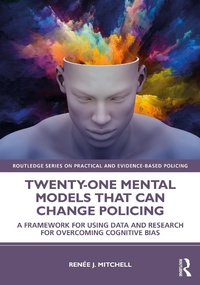
Twenty-one Mental Models That Can Change Policing
A Framework for Using Data and Research for Overcoming Cognitive Bias
1st Edition
Published on 15. September 2021
228 pages
978-1-000-40272-8 (ISBN)
Description

This book goes beyond other police leadership books to teach practitioners how to think about policing in a structured way that synthesizes criminological theory, statistics, research design, applied research, and what works and what doesn't in policing into Mental Models. A Mental Model is a representation of how something works. Using a Mental Model framework to simplify complex concepts, readers will take away an in-depth understanding of how cognitive biases affect our ability to understand and interpret data, what empirical research says about effective police interventions, how statistical data should be structured for management meetings, and how to evaluate interventions for efficiency and effectiveness.
While evidence-based practice is critical to advancing the police profession, it is limited in scope, and is only part of what is necessary to support sustainable change in policing. Policing requires a scientifically based framework to understand and interpret data in a way that minimizes cognitive bias to allow for better responses to complex problems. Data and research have advanced so rapidly in the last several decades that it is difficult for even the most ambitious of police leaders to keep pace. The Twenty-one Mental Models were synthesized to create a framework for any police, public, or community leader to better understand how cognitive bias contributes to misunderstanding data and gives the reader the tools to overcome those biases to better serve their communities.
The book is intended for a wide range of audiences, including law enforcement and community leaders; scholars and policy experts who specialize in policing; students of criminal justice, organizations, and management; reporters and journalists; individuals who aspire to police careers; and citizen consumers of information about policing. Anyone who is going to make decisions about their communities based on data has a responsibility to be numerate and this book Twenty-one Mental Models That Can Change Policing: A Framework For Using Data and Research For Overcoming Cognitive Bias, will help you become just that.
While evidence-based practice is critical to advancing the police profession, it is limited in scope, and is only part of what is necessary to support sustainable change in policing. Policing requires a scientifically based framework to understand and interpret data in a way that minimizes cognitive bias to allow for better responses to complex problems. Data and research have advanced so rapidly in the last several decades that it is difficult for even the most ambitious of police leaders to keep pace. The Twenty-one Mental Models were synthesized to create a framework for any police, public, or community leader to better understand how cognitive bias contributes to misunderstanding data and gives the reader the tools to overcome those biases to better serve their communities.
The book is intended for a wide range of audiences, including law enforcement and community leaders; scholars and policy experts who specialize in policing; students of criminal justice, organizations, and management; reporters and journalists; individuals who aspire to police careers; and citizen consumers of information about policing. Anyone who is going to make decisions about their communities based on data has a responsibility to be numerate and this book Twenty-one Mental Models That Can Change Policing: A Framework For Using Data and Research For Overcoming Cognitive Bias, will help you become just that.
Reviews / Votes
"Complexity, wicked problems, big-data, and a growing body of police research are examples of what chief executives must understand in today's contemporary policing environment to be successful. Mental models can aid in the decomposition of these complexities. Dr. Mitchell's book is the first to amalgamate the concept of mental models and police decision-making by providing a critical thinking framework for police leaders to follow in a pragmatic, easy to follow format. Dr. Mitchell's teachings will challenge the readers' assumptions on how they make decisions. As police leaders, it is time we move the needle forward and examine how we make policy decisions in society's name. This book is a bold step forward."Commander Chris G. Vallejo, Austin (TX) Police Department
"Dr. Renee Mitchell does an outstanding job of discussing her unique approach to utilizing mental modeling to incorporate the use of data and research in the most important areas of the policing realm - making it easily digestible for every reader. As police administrators, we must ensure we are well-educated in the use of data in day-to-day decision-making. Renee outlines this process - utilizing her twenty-one mental models to help strengthen police leadership - in a simple yet progressive way. This is a must-read for every police leader!"
Chief Ken Clary, Bellevue Nebraska Police Department
"If there is one book on policing you should read it is this. It's a well-worn phrase but seriously, all police leaders and commissioners SHOULD read this. Renee has taken the content of hundreds of insightful papers and books and distilled it into a relevant and page turning guide to policing. She highlight pitfalls and opportunities, all with the intention of improving the service we deliver. The problem with the Atlantic difference between the US and Europe means the continued reference to math instead of maths which will drive the European reader mad, but forgive the bad English and instead learn the lessons, some of which you already know and some you won't. There are three things that stand out to me; its relevance, its objectivity and finally its writing style - the perfect fusion of an author that has her feet in the world of policing and academia. I know Renee, and I have to say she is slightly crazy - but nothing great ever comes from mediocrity and it takes someone like Renee to put together something as good as this. The timing is perfect; the erosion of trust meets the opportunity of empirical analysis. Renee quotes Ben Goldacre and I would do the same in motivating people to read this:'anyone who is going to trade in numbers, and use them, and think with them, and persuade with them, let alone lock people up with them, also has a responsibility to understand them'. This book enables us to start doing just that."
Alex Murray, Commander Metropolitan Police Service Founder of the Society of Evidence-based Policing
"Dr. Renee Mitchell expertly blends her academic insights with her wisdom gained through her career as a police officer to create this much-needed, easily accessible book. At a time when there is a historic focus on the role and actions of police in America, Dr. Mitchell distills how best to advance the profession in a simple, compelling framework: if you want to improve the way police act, you first must improve the way they think."
Maureen McGough, Chief of Staff NYU School of Law Policing Project
"This book forces the reader to challenge everything they thought they knew about policing. Have we really been asking the wrong questions? Have we incorrectly defined the problem? Renee offers an insight only gained from experiencing policing as a cop, an academic, and as a champion of evidence-based policing."
Josh Young, Deputy Senior Vice President of Justice Initiatives Center for Policing Equity
"Using robust evidence to enable operational and strategic decision making is a fundamental component of modern policing, this book guides and supports police practitioners through some of the challenges and significant opportunities that various disciplines of science presents for policing, including the Mental Model focusing on Evidence Based Policing which is my favourite. A fantastic read for inquisitive minds".
Superintendent Bruce O' Brien, Director of Evidence Based Policing New Zealand Police
"Overall, Mitchell should be praised for assembling so much important information on data, evidence, and policing in one place. Those who are new to evidence-informed policing will find this book an excellent introduction to the subject, and even a relatively informed reader will come away with new bits of information and new ways of understanding information they may have had already. I certainly did.
We need more pracademics like Mitchell. Evidence is available to guide police leaders, but often it is inaccessible, hidden behind paywalls, spread over thousands of articles, and written in language that is difficult for non-academics to understand. Even with evidence in hand, success in the field also depends on sound implementation, carefully translating lessons learned from rigorous research into practice. Pracademics act as translators, facilitators, even ambassadors, playing key roles in the research-to-practice pipeline. They help ensure that knowledge intended to inform policy does just that.
In today's hyper-partisan political debate over policing, policymakers are often presented with binary choices that are informed mostly by ideology: either #BlackLivesMatter or #BlueLivesMatter, for instance. The need for public decision-making informed by reliable data and rigorous evidence, and not driven by hashtags, is stronger than ever."
Thomas Abt, Senior Fellow at the Council on Criminal Justice, in Cambridge Journal of Evidence-Based Policing 6:1-2 (June 2022)
More details
Series
Edition
1. Auflage
Language
English
Place of publication
London
United Kingdom
Publishing group
Taylor & Francis Ltd
Target group
Professional and scholarly
Illustrations
17 Tables, black and white; 45 Line drawings, black and white; 1 Halftones, black and white; 46 Illustrations, black and white
ISBN-13
978-1-000-40272-8 (9781000402728)
Copyright in bibliographic data and cover images is held by Nielsen Book Services Limited or by the publishers or by their respective licensors: all rights reserved.
Schweitzer Classification
Other editions
Additional editions
Renee J. Mitchell
Twenty-one Mental Models That Can Change Policing
A Framework for Using Data and Research for Overcoming Cognitive Bias
Book
09/2021
1st Edition
Routledge
€184.00
Shipment within 15-20 days
Renee J. Mitchell
Twenty-one Mental Models That Can Change Policing
A Framework for Using Data and Research for Overcoming Cognitive Bias
Book
09/2021
1st Edition
Routledge
€52.30
Shipment within 15-20 days
Person
Renee J. Mitchell served in the Sacramento Police Department for twenty-two years and is currently a Senior Police Researcher with RTI International. She holds a B.S. in Psychology, a M.A. in Counseling Psychology, a M.B.A., a J.D., and a Ph.D. in Criminology from the University of Cambridge. She has taught and lectured internationally on evidence-based policing and is best known for being the first policing pracademic to run a randomized controlled trial. She was a Fulbright Police Research Fellow and is the co-founder and executive committee member of the American Society of Evidence-Based Policing. She has two TEDx talks, "Research Not Protests" and "Policing Needs to Change: Trust me I'm a Cop," where she advocates for evidence-based policing. She has published her research in the Journal of Experimental Criminology, Justice Quarterly, and the Cambridge Journal of Evidence-Based Policing. Her books include Evidence Based Policing: An introduction and Implementing Evidence-Based Research: A How-to Guide for Police Organizations.
Content
Introduction: What is a Mental Model and How Does It Help Policing; PART I: How We Think; Mental Model #1: System 1 and 2; Mental Model #2: Cognitive Bias; Mental Model #3: First Principles Thinking; The Mental Models in Practice I: Mental Models 1-3; Part II: How We Think About Math; Mental Model #4: False Linear Thinking; Mental Model #5: Binary Percent Changes; Mental Model #6: Second Order Thinking; The Mental Models in Practice II: Mental Models 4-6; PART III: How Things Concentrate; Mental Model #7: Pareto Principle; Mental Model #8: The Law of Crime concentration; Mental Model #9: Felonious Few; The Mental Models in Practice III: Mental Models 7-9; PART IV: How Things Vary; Mental Model #10: Distributions; Mental Model #11: Law of Large numbers; Mental Model #12: Regression to the Mean; The Mental Models in Practice IV: Mental Models 10-12; PART V: How to Determine Causality; Mental Model #13: Correlation is not Causation; Mental Model #14: Causal Inference; Mental Model #15: Bayesian (Probabilistic) Reasoning; The Mental Models in Practice V: Mental Models 13-15; Part VI: How to Think Scientifically; Mental Model #16: Peer Review Your Perspectives; Mental Model #17: The Scientific Method; Mental Model #18: Evidence-based Practices; The Mental Models in Practice VI: Mental Models 16-18; PART VII: How to Make Decisions; Mental Model #19: Targeting, Testing, and Tracking; Mental Model #20: Harm Indexes; Mental Model #21: Decision-making Models; The Mental Models in Practice VII: Mental Models 19-21; PART VIII: How to Apply it All; Conclusion: How the Twenty-one Mental Models Can Improve Policing and Reduce Cognitive Bias; Mental Model Method: How it all Fits Together Mental Models 1-21; Notes
