

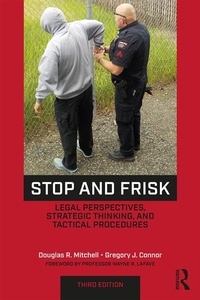
Stop and Frisk
Legal Perspectives, Strategic Thinking, and Tactical Procedures
3rd Edition
Published on 25. October 2017
134 pages
978-1-351-39987-6 (ISBN)
Description

Every law enforcement patrol officer and investigator needs to understand both the tactical considerations of stopping and frisking a suspect, and the legal constraints that should govern that power. Recent years have shown clearly the damage that can be done when police lack an adequate understanding of the legal foundation for their activities. In this new edition of Stop and Frisk, Mitchell and Connor team up to provide active or aspiring police officers with the knowledge of applicable law as well as practical techniques they need to safely and legally carry out their crime suppression and investigative duties. This updated edition includes clear summaries of major cases of the last decade and lessons learned when police and communities failed to fully understand the results of Terry v. Ohio.
Ideal for in-service training at the post-academy level, this book also gives time-tested tools to police officers, supervisors, and legal advisors. Stop and Frisk can be used to teach undergraduate Criminal Justice majors as well as concerned citizens to prevent crime in their communities.
Ideal for in-service training at the post-academy level, this book also gives time-tested tools to police officers, supervisors, and legal advisors. Stop and Frisk can be used to teach undergraduate Criminal Justice majors as well as concerned citizens to prevent crime in their communities.
Reviews / Votes
'While the phrase 'every police professional should have this text in their library' is often overused, I have to attach that mindset to this new manual. Right from the opening pages, this 140-page reference book is loaded with relevant material every police trainer, first- or second-line supervisor, and/or academy instructor needs to know.' - David Grossi, Grossi Consulting, Bonita Springs, FL; Irondequoit (NY) Police Department (Lieutenant, retired)'My experience is that officers who don't understand the concept of investigative detention will do one of two things when confronted by person(s) who are behaving suspiciously: Either they will fail to act, diminishing their ability to prevent crime, or act without the proper legal authority, which causes the criminal prosecutor many problems later. Not to mention, we as peace officers have a duty to protect the Constitutional rights of all citizens or inhabitants of every jurisdiction. I would recommend that veteran officers need this text even more than academy cadets. The authors' experience makes this a real world text that will be invaluable to successfully performing a very difficult job.' - Dale Mann, Georgia Command College; retired director, Georgia Peace Officers Standards and Training Council
'Mitchell and Connor have done law enforcement, the legal profession, and - importantly - interested members of the public a tremendous service. In easy-to-understand language, they have explained what types of encounters the public and police can have, the legal standards for them, and best practices for them.' - Sergeant Erick Gelhaus, Sonoma County, CA, Sheriff's Office
'This should be mandatory reading for anyone teaching Terry stops to all peace officers, jurists, or prosecutors looking to stay current on this important area of law. It nicely blends the arcane world of legal matters with the gritty humor and wisdom of the street cop.' - Lieutenant Colonel David G. Bolgiano, USAF (retired), author of Virtuous Policing
More details
Edition
3rd edition
Language
English
Place of publication
London
United Kingdom
Publishing group
Taylor & Francis Ltd
Target group
Professional and scholarly
Illustrations
7 Line drawings, black and white; 7 Illustrations, black and white
File size
1,30 MB
ISBN-13
978-1-351-39987-6 (9781351399876)
Copyright in bibliographic data and cover images is held by Nielsen Book Services Limited or by the publishers or by their respective licensors: all rights reserved.
Schweitzer Classification
Other editions
Additional editions
Douglas R. Mitchell | Gregory J. Connor
Stop and Frisk
Legal Perspectives, Strategic Thinking, and Tactical Procedures
Book
10/2017
3rd Edition
Routledge
€64.55
Shipment within 10-20 days
Douglas R. Mitchell | Gregory J. Connor
Stop and Frisk
Legal Perspectives, Strategic Thinking, and Tactical Procedures
Book
10/2017
3rd Edition
Routledge
€205.60
Shipment within 10-20 days
Persons
Douglas R. Mitchell, J.D., M.P.A., has been an attorney for 30 years. He is a deputy prosecutor in Washington State, assigned to the Civil Division of his office. His duties include advising several clients in different parts of the Criminal Justice system and serving as public records officer for the office. He has broad experience in both civil and criminal duties, including the prosecution of violent felons.
He is a graduate of the University of Illinois College of Law and Police Training Institute, and he has been a prosecutor and part-time officer in Illinois and Washington. His primary interest is in the legal foundations of law enforcement operations, and he has authored and co-authored several books and articles on related topics.
Gregory J. Connor, M.S., is Professor Emeritus at the University of Illinois Police Training Institute. For more than four decades he provided both practical and tactical education and training to police officers and corrections personnel.
Professor Connor has published numerous texts and articles on associated topics in the criminal justice field and is a recognized expert on such topics as use of force, contact controls, police pursuits, and jail and police procedures and policies.
He is an originator of the Use of Force Model and the recent Police and Jail Control Models designed and developed for peace officers throughout the country and additional graphic illustrations to enhance the training effort in areas including use of force issues, stop and frisk dynamics, vehicle stops, and contemporary operations in both police agencies and jails.
He is a graduate of the University of Illinois College of Law and Police Training Institute, and he has been a prosecutor and part-time officer in Illinois and Washington. His primary interest is in the legal foundations of law enforcement operations, and he has authored and co-authored several books and articles on related topics.
Gregory J. Connor, M.S., is Professor Emeritus at the University of Illinois Police Training Institute. For more than four decades he provided both practical and tactical education and training to police officers and corrections personnel.
Professor Connor has published numerous texts and articles on associated topics in the criminal justice field and is a recognized expert on such topics as use of force, contact controls, police pursuits, and jail and police procedures and policies.
He is an originator of the Use of Force Model and the recent Police and Jail Control Models designed and developed for peace officers throughout the country and additional graphic illustrations to enhance the training effort in areas including use of force issues, stop and frisk dynamics, vehicle stops, and contemporary operations in both police agencies and jails.
Content
Foreword. Preface. Acknowledgements. SECTION I: LEGAL LEGACY AND CONTEMPORARY UPDATE. CHAPTER 1 Foundational Concepts. CHAPTER 2 Terry v. Ohio, 392 U.S. 1 (1968). CHAPTER 3 Understanding Terry v. Ohio. CHAPTER 4 Lessons Learned. CHAPTER 5 Evolving Legal Fundamentals. SECTION II: BLENDING LAW, POLICING, AND THE COMMUNITY. CHAPTER 6 Force and Control. CHAPTER 7 Bases for Interaction. SECTION III: POLICE STRATEGY AND TACTICS. CHAPTER 8 Fundamentals of Policing. CHAPTER 9 Reporting/Recording. CHAPTER 10 Model Policy. Index.
