

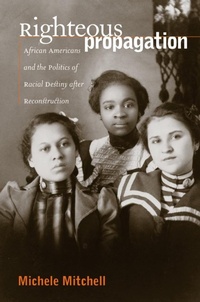
Righteous Propagation
Description

Between 1877 and 1930 — years rife with tensions over citizenship, suffrage, immigration, and “the Negro problem” — African American activists promoted an array of strategies for progress and power built around “racial destiny,” the idea that black Americans formed a collective whose future existence would be determined by the actions of its members. In Righteous Propagation, Michele Mitchell examines the reproductive implications of racial destiny, demonstrating how it forcefully linked particular visions of gender, conduct, and sexuality to collective well-being. Mitchell argues that while African Americans did not agree on specific ways to bolster their collective prospects, ideas about racial destiny and progress generally shifted from outward-looking remedies such as emigration to inward-focused debates about intraracial relationships, thereby politicizing the most private aspects of black life and spurring race activists to calcify gender roles, monitor intraracial sexual practices, and promote moral purity. Examining the ideas of well-known elite reformers such as Mary Church Terrell and W. E. B. DuBois, as well as unknown members of the working and aspiring classes, such as James Dubose and Josie Briggs Hall, Mitchell reinterprets black protest and politics and recasts the way we think about black sexuality and progress after Reconstruction.
More details
Other editions
Additional editions
Person
Michele Mitchell is associate professor of history and Afroamerican and African Studies at the University of Michigan. She is co-editor of Dialogues of Dispersal: Gender, Sexuality, and African Diasporas.
Content
- Intro
- Contents
- Acknowledgments
- Note on Usage and Terminology
- Prologue. To Better Our Condition One Way or Another: African Americans and the Concept of Racial Destiny
- 1. A Great, Grand, & All Important Question: African American Emigration to Liberia
- 2. The Black Man's Burden: Imperialism and Racial Manhood
- 3. The Strongest, Most Intimate Hope of the Race: Sexuality, Reproduction, and Afro-American Vitality
- 4. The Righteous Propagation of the Nation: Conduct, Conflict, and Sexuality
- 5. Making the Home Life Measure Up: Environment, Class, and the Healthy Race Household
- 6. The Colored Doll Is a Live One!: Material Culture, Black Consciousness, and Cultivation of Intraracial Desire
- 7. A Burden of Responsibility: Gender, ''Miscegenation,'' and Race Type
- 8. What a Pure, Healthy, Unified Race Can Accomplish: Collective Reproduction and the Sexual Politics of Black Nationalism
- Epilogue. The Crossroads of Destiny
- Notes
- Bibliography
- Index
- A
- B
- C
- D
- E
- F
- G
- H
- I
- J
- K
- L
- M
- N
- O
- P
- R
- S
- T
- U
- V
- W
- Y
- Z
