

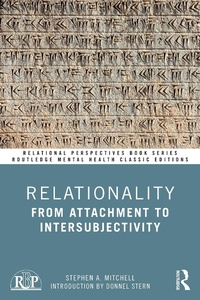
Relationality
From Attachment to Intersubjectivity
1st Edition
Published on 29. September 2022
198 pages
978-1-000-63201-9 (ISBN)
Description

This book, first published in the year of the author's death, expresses Mitchell's vision for the theory of relational psychoanalysis, and provides his most-developed expression of its foundations. Now republished in this Classic Edition, Mitchell's ideas are brought back to the psychoanalytic readership, complete with a new introduction by Donnel Stern.
In his final contribution to the psychoanalytic literature, the late Stephen A. Mitchell provided a brilliant synthesis of the interrelated ideas that describe the relational matrix of human experience. Relationality charts the emergence of the relational perspective in psychoanalysis by reviewing the contributions of Loewald, Fairbairn, Bowlby, and Sullivan, whose voices converge in apprehending the fundamental relationality of the human mind.
Mitchell draws on the multiple dimensions of attachment, intersubjectivity, and systems theory in espousing a clinical approach equally notable for its responsiveness and responsible restraint. This remains a canonical text for all relational psychoanalysts and psychotherapists.
In his final contribution to the psychoanalytic literature, the late Stephen A. Mitchell provided a brilliant synthesis of the interrelated ideas that describe the relational matrix of human experience. Relationality charts the emergence of the relational perspective in psychoanalysis by reviewing the contributions of Loewald, Fairbairn, Bowlby, and Sullivan, whose voices converge in apprehending the fundamental relationality of the human mind.
Mitchell draws on the multiple dimensions of attachment, intersubjectivity, and systems theory in espousing a clinical approach equally notable for its responsiveness and responsible restraint. This remains a canonical text for all relational psychoanalysts and psychotherapists.
Reviews / Votes
'Drawing on the work of Loewald, Fairbairn, and other theorists who deeply inspired him, in Relationality Stephen Mitchell built a compelling vision of human experience that is inextricably embedded in and saturated with the social surround into which we are born and in which we live forever. Mitchell's vivid and compelling clinical vignettes, filled with both his clinical wisdom and his humanity, poignantly illustrate the therapeutic value of his theoretical approach. Written toward the end of Mitchell's life, the book reflects an evolved (and evolving) stage of the integrated relational model that he created. It is essential reading not only for those interested in Mitchell's work, but for anybody who wants to understand how psychoanalysis is developing in the 21st Century.'Jay Greenberg is training and supervising analyst at the William Alanson White Institute; former editor of The Psychoanalytic Quarterly; recipient of the Mary S. Sigourney Award for Outstanding Achievement in Psychoanalysis (2015)
'Stephen Mitchell's outstanding work challenges and enriches our understandings. His capacious theory dynamically links the major developments within contemporary psychoanalysis. In so doing, he rewrites the canon. An absolute must.'
Susie Orbach is a psychotherapist, psychoanalyst, writer and social critic
'Today, when we take for granted relational psychoanalysis and its wide-ranging impact on all of contemporary psychoanalysis, we also know that imagining relational psychoanalysis without Stephen Mitchell is like imagining psychoanalysis without Freud. Relationality expresses on every page the extraordinary brilliance of Mitchell's mind, as he elaborates upon the prehistory of relational psychoanalysis and its current form, in chapters on Sullivan, attachment theory, Fairbairn, and intersubjectivity theory, the complex strands that helped to form Mitchell's thinking and infuse his clinical work. Mitchell begins with a tribute to Loewald, "From Ghosts to Ancestors: The Psychoanalytic Vision of Hans Loewald." At a Loewald conference, Mitchell and I each found ourselves presenting papers with this same title: "The Psychoanalytic Vision of Hans Loewald." Relationality, we could say, brings us the psychoanalytic vision of Stephen Mitchell. And what a vision!
Nancy J Chodorow, Harvard Medical School/Cambridge Health Alliance, University of California, Berkeley, Boston Psychoanalytic Society and Institute. Author, The Psychoanalytic Ear and the Sociological Eye: Toward an American Independent Tradition, The Power of Feelings, The Reproduction of Mothering, and other works
More details
Series
Edition
1. Auflage
Language
English
Place of publication
London
United Kingdom
Publishing group
Taylor & Francis Ltd
Target group
College/higher education
Professional and scholarly
ISBN-13
978-1-000-63201-9 (9781000632019)
Copyright in bibliographic data and cover images is held by Nielsen Book Services Limited or by the publishers or by their respective licensors: all rights reserved.
Schweitzer Classification
Other editions
Additional editions
Book
09/2022
1st Edition
Routledge
€195.90
Shipment within 10-20 days
Book
09/2022
1st Edition
Routledge
€52.80
Shipment within 10-20 days
Person
Stephen A. Mitchell trained as a psychoanalyst at the William Alanson White Institute in New York City and through such influential works as Relational Concepts in Psychoanalysis (1988), Hope and Dread in Psychoanalysis (1993), Influence and Autonomy in Psychoanalysis (1997), and his final volume, Relationality: From Attachment to Intersubjectivity (2000), both developed and championed the theory of relational psychoanalysis.
Content
Introduction to the Classic Edition by Donnel Stern Part I: From Ghosts to Ancestors: The Psychoanalytic Vision of Hans Loewald 1. Language and Reality 2. Drives and Objects Part II: Levels of Organization 3. An Interactional Hierarchy 4. Attachment Theory and Relationality 5. Fairbairn's Object-Seeking: Between Paradigms 6. Intersubjectivity: Between Expressiveness and Restraint in the Analytic Relationship
