


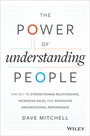
The Power of Understanding People
Description

Developing successful relationships is critical to our success in both our personal and professional lives. The Power of Understanding People shows you how to establish and develop extremely effective relationships by providing you with techniques to better identify and understand the intrinsic needs of others. As a result, you will achieve better team dynamics, increased sales and client satisfaction, higher levels of employee engagement and performance, and even more satisfying marriages and friendships. This book provides the tools to understand others' unique communication style as well as your own. Get detailed advice on how to adjust to diverse communication styles, develop a unifying language for the organization, and better match motivational techniques to team members. Through storytelling and experiential exercises, author Dave Mitchell helps you gain insight into your own unique interaction style and teaches you how to communicate, motivate, sell, and service more successfully no matter the personality types involved.
- Offers insight into the behavior cues and questions to ask to better understand someone's interactive preferences
- Explains how to enhance your sales efforts by better targeting your brand message to the client's style so that your products/services resonate with them more
- Examines strategies for creating a high performing work environment and achieve greater customer service excellence
- Contains conflict resolution strategies, including how to effectively work out differences within a team, between work units, with customers, and even in your personal life
Armed with the ability to interpret the behavior of the people around you, you will achieve greater levels of success at work and at home while also learning how to better handle the difficult situations involving people in your life.
Dave Mitchell (Denver, CO; is an international speaker, trainer, consultant, writer and entrepreneur who has spoken before thousands of audiences who have been delighted with his entertaining style and powerful stories. Since founding the Leadership Difference in 1995, over 250,000 people have attended Dave's seminars on topics that include leadership, customer service, selling skills, and personal performance enhancement. His clients include Allstate Insurance, Bank of America, Universal Studios, Hilton Worldwide, Sub-Zero Wolf Appliances, Electrolux Appliances, Trek Bikes, Walt Disney World, Pitney-Bowes, Novartis Pharmaceuticals and the CIA.
Prior to starting his own organization development consulting firm, Dave was the Vice President of Human Resources and Quality for Buena Vista Hospitality Group, Corporate Director of Training and Development for Marshall Field's and a television reporter and producer for CBS News.
More details
Other editions
Additional editions
Content
1.1 - Contents [Seite 5]
1.2 - Preface [Seite 9]
1.3 - Introduction: We Are All Delusional! [Seite 13]
1.3.1 - Sociocultural Schemas [Seite 15]
1.3.2 - Interactive Styles [Seite 16]
1.3.3 - Hollywood Style! [Seite 22]
1.3.4 - A Disclaimer [Seite 23]
1.3.5 - The Assessment [Seite 24]
1.3.6 - Chapter 1: Understanding Romantics and Warriors: It's Feelings versus Logic for These Styles [Seite 29]
1.3.6.1 - Romantics [Seite 39]
1.3.6.2 - Warriors [Seite 40]
1.3.7 - Chapter 2: Understanding Experts and Masterminds: Tried and True Contrasted with Possibilities [Seite 45]
1.3.7.1 - Experts [Seite 58]
1.3.7.2 - Masterminds [Seite 60]
1.3.8 - Chapter 3: The 12 Interactive Combinations-Hollywood Style! [Seite 63]
1.3.8.1 - The Best Friend [Seite 63]
1.3.8.2 - The Love Interest [Seite 68]
1.3.8.3 - The Crusader [Seite 73]
1.3.8.4 - The Hired Gun [Seite 78]
1.3.8.5 - The Sage [Seite 83]
1.3.8.6 - The Power Broker [Seite 88]
1.3.8.7 - The Voice of Reason [Seite 92]
1.3.8.8 - The Specialist [Seite 97]
1.3.8.9 - The Detective [Seite 102]
1.3.8.10 - The Eccentric [Seite 109]
1.3.8.11 - The Social Reformer [Seite 116]
1.3.8.12 - The Adventurer [Seite 121]
1.3.9 - Chapter 4: Recognizing Each Style: The Behavioral Cues That Might Indicate Another Person's Style [Seite 127]
1.3.9.1 - How Do I Recognize Romantics and Warriors? [Seite 130]
1.3.9.2 - How Do I Recognize Experts and Masterminds [Seite 133]
1.3.10 - Chapter 5: Leading Each Style: Creating a High- Performing Culture by Understanding Interactive Style [Seite 139]
1.3.10.1 - Coaching and Counseling by Style [Seite 144]
1.3.10.2 - Progressive Counseling [Seite 146]
1.3.10.3 - Things to Consider When Counseling Each Style [Seite 149]
1.3.11 - Chapter 6: Selling to Each Style: You Can Expand Your Market Share by Adjusting to Your Consumer's Interactive Style [Seite 153]
1.3.11.1 - Establish Rapport [Seite 157]
1.3.11.2 - Framing Tips [Seite 162]
1.3.11.3 - Common Objections [Seite 171]
1.3.11.4 - Handling Objection Model [Seite 174]
1.3.12 - Chapter 7: Providing Customer Service to Each Style: The Key to High Customer Satisfaction Results Is Adjusting to the Customer's Style [Seite 183]
1.3.12.1 - Behavior Breeds Behavior [Seite 184]
1.3.12.2 - You Can Choose Your Behavior [Seite 185]
1.3.12.3 - Positive Behavior Overcomes Negative Behavior [Seite 185]
1.3.12.4 - Interact with People the Way They Prefer [Seite 186]
1.3.12.5 - Serving the Romantic [Seite 186]
1.3.12.6 - Serving the Warrior [Seite 187]
1.3.12.7 - Serving the Expert [Seite 187]
1.3.12.8 - Serving the Mastermind [Seite 188]
1.3.12.9 - LAST Model of Service Recovery [Seite 189]
1.3.13 - Chapter 8: Personal Relationships and Interactive Style: Better Understand Family and Friends and Enhance Your Marriage [Seite 195]
1.3.13.1 - Conflict Resolution [Seite 198]
1.3.13.2 - A Model for Conflict Resolution [Seite 200]
1.3.14 - Conclusion: The Unusual Goal of an Educator [Seite 205]
1.3.15 - Index [Seite 208]
Introduction
We Are All Delusional!
“Why in the world would you do that?” Haven't we all asked ourselves that question when we witness behavior that makes us scratch our head? And not just about strangers either. Our own spouses, siblings, parents, children, friends, and colleagues have stunned us with their actions as well. Why is this? Why do human beings with the same biophysiological equipment, the same sensory receptors, behave in such diverse ways when in the same settings? I mean, how is it possible that my wife is not completely emotionally immersed in the drama of a University of Illinois basketball game in the same way I am? Why should she be surprised at the expletives I express when my beloved players miss an easy basket in a close game against Michigan State? Oh, the humanity!
The key to understanding the mysteries of human behavior involves a concept called metacognition, which literally means “thinking about thinking.” For the purposes of this book, I will use the term to mean metacognitive self-awareness. There are other slightly different definitions for metacognition and metacognitive self-awareness, so let me clearly articulate mine: Metacognitive self-awareness is an understanding of how our life experiences have shaped our cognitive schemas — which, in turn, determine how we derive meaning from our reality. (I promise that the entire book won't be so painfully clinical.)
Okay, so you're wondering, “What in the world are schemas?” Well, schemas (again, for the purpose of my definition) are mental structures that provide us with a way to organize and derive meaning from our experiences. They are ways we apply our knowledge and assumptions. And they are the core of perception.
Let me give you a couple of examples. Let's say your earliest childhood memories of dogs involved the loyal, fun, and cuddly family pet Kibbles. You played with Kibbles, lay next to him, and often stroked Kibbles's fur for comfort. You create a schema for dogs that organizes your ideas around these positive experiences with Kibbles.
Now, let's say you have a friend who did not grow up around a dog. In fact, he was once bitten by a dog when he was a child. Your friend forms a schema that dogs are unpredictable and potentially mean.
Later, you and your friend are walking down the street when a stray dog suddenly appears. You, with your schema that dogs are positive, probably approach the dog to see if it has a name tag. Your friend freezes, looks around for an owner, and avoids any contact with the dog. Same dog, two distinctly different reactions.
There are actually three realities occurring in this experience. First is what I call absolute or objective reality, the version of reality that represents the actual dog in this scenario. Absolute reality exists only as a concept for people. It is the version of reality that is not influenced by our own experiences, which have created our personal knowledge, preferences, prejudices—our schemas. Because we all have had experiences and have therefore developed schemas, absolute reality is not the reality within which we live.
The other two realities are you and your friend's “delusions.” In your delusion, the stray dog is a cuddly creature in need of assistance. In your friend's delusion, the dog is a dangerous creature that should be avoided. One of you may be closer to the absolute reality than the other, but neither of you are operating completely within it. You are each creating a reality driven by your own schemas.
Sociocultural Schemas
If you consider that no other person on the planet has shared your collection of experiences, then you soon realize that your cognitive schemas are unique to you. And, if you further consider that your schemas determine how you derive meaning, you then realize that your delusion is also unique to you. Finally, because delusion drives behavior and we are all uniquely deluded . . . well, you can see the trouble that ensues when we anticipate that anyone will behave according to our expectations. This is troubling when you consider the 7 billion people on the planet, each living in his or her own Private Idaho, if you will, and acting on a desire to connect with one another. Is it any wonder we are so stressed out?!
Thankfully, civilized society provides us with a number of shared experiences. These are often driven by ideology, things such as religion, government, and education. A simple example from the U.S. educational system is the alphabet. If you were educated in the United States and English is your first language, you likely learned the alphabet using two distinct academic schemas. First, your teacher chunked the 26 symbols into groups of two, three, or four characters. You spent some time on ABCD, then went on to EFG, HIJK, and so on. Second, you learned the melody that kept those individual chunks in order. Now, if a group of individuals learned to recite the alphabet using that approach, they all share a reality. If I ask each member of this group to recite the alphabet, even many years after the experience of learning it, each member will think about it in the same way that the rest of the group would at that moment: Everyone in the group would group the letters and sing the same melody. They have a shared sociocultural schema for the alphabet. However, someone who did not learn the alphabet in this manner does not share this schema.
Sociocultural schemas are vital, because they provide groups of people with a shared way of deriving meaning. Although individuals will still have a unique delusion, the sociocultural schemas provide some common ground that allows them to have a better collective understanding. Unfortunately, although sociocultural schemas may unite some cultures, they will likely divide others. Entire wars are fought over differences in religious, political, and cultural schemas. However, that discussion is for another book. In this book, we look at the one globally unifying set of schemas—species-level schemas, if you will. I call these schemas interactive styles.
Interactive Styles
Have you ever met a total stranger, talked to that person for a few minutes, and said to yourself, “I dig you like a ditch?” You know that feeling; it's an immediate connection that you somehow achieve with certain people. And that feeling increases your self-efficacy, a term that essentially means “situational confidence.” I like to compare it to a baseball player who is feeling comfortable in the batter's box and who possesses a certain surety that he can hit any pitch thrown to him. Someone who has high self-efficacy tends to execute his or her skill set at its highest level. If that individual has a competent skill set, then you can expect to have a successful outcome.
Let's say you are a sales professional. You meet your prospective client for the first time and immediately hit it off. You both get each other, and communication flows comfortably. You experience both relaxation and confidence—that feeling of high self-efficacy. You successfully identify the potential client's needs and frame your products and services in a way that really resonates. And because you have done such a good job of identifying the client's needs—and displaying your products' and service's value—the client buys. You reach a mutually successful outcome.
But what if you meet that new client and your first reaction is, “You . . . might be the anti-Christ!” Come on; we all know it happens on occasion. Some people just rub us the wrong way. And you know what? They probably feel the exact same way about us.
This situation initiates the exact opposite chain reaction to the one described earlier. When you're attempting to make a sale and the initial rapport is poor, self-efficacy drops. You get nervous and uncomfortable, which in turn affects your skills. Now, instead of accurately and efficiently identifying your client's needs and bridging them to your capabilities, you begin to spray and pray or, as sales professionals colorfully say, show up and throw up. That is, you sling all the features and benefits of your products at the client in the hopes that something—anything —excites him or her. And this ineffective approach causes the client to pass on your products.
When you don't consider metacognition—and when you don't have any training on how to recognize behavioral cues and adjust quickly within a given situation—you're leaving your communication success to chance. Obviously, to maximize your effectiveness as a leader, sales professional, or customer service provider, you want to experience far more situations like the first example. To do so, you must understand and apply metacognitive skills and answer questions such as, “What exactly is this phenomenon?” and “How do I improve my skills in communication?” The answers to both of these questions and countless others start by understanding interactive styles.
Some of the greatest minds in history have offered models for explaining human beings' iconic traits. Hippocrates, Galen, Plato, Aristotle, and countless other philosophers noticed that despite our many unique behaviors, patterns could still be observed. These “types” were most comprehensively articulated by Carl Jung in his 1921 book Psychological Types. This book served as the inspiration for the Myers-Briggs Type Indicator, one...

