
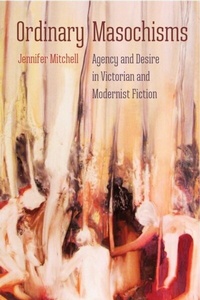
Ordinary Masochisms
Description
Alles über E-Books | Antworten auf Fragen rund um E-Books, Kopierschutz und Dateiformate finden Sie in unserem Info- & Hilfebereich.
Ordinary Masochisms reveals how literary works from the nineteenth and twentieth centuries frequently challenged the prevailing view of masochism as a deviant behavior, an opinion supported by many sexologists and psychoanalysts in the 1800s. In these texts, Jennifer Mitchell highlights everyday examples of characters deriving pleasure from pain in encounters and emotions such as flirtations, courtships, betrothals, lesbian desires, religious zeal, marital relationships, and affairs.
Mitchell begins by examining the archetypal tale of Samson and Delilah together with Venus in Furs by Leopold von Sacher-Masoch, from whom masochism gets its name. Through close readings, Mitchell then argues that Charlotte Brontë's Villette, George Moore's A Drama in Muslin, D. H. Lawrence's The Rainbow, and Jean Rhys's Quartet all experiment with masochistic relationships that are more complex than they seem. Mitchell shows that, far from being victimized, the characters in these works achieve self-definition and empowerment by pursuing and performing pain and that masochism is a generative response rather than a destructive force beyond their control.
Including readings of Octave Mirbeau's The Torture Garden and Ian McEwan's The Comfort of Strangers, Mitchell traces shifts in public consciousness regarding sex and gender and discusses why masochism continues to be categorized as a perversion today. The literary world, she asserts, has repeatedly questioned this notion as well as masochism's associations with passivity and femininity, using the behavior to defy heteronormative and heteropatriarchal gender dynamics.
All prices
More details
Other editions
Additional editions
Person
Content
- Cover
- Ordinary Masochisms
- Title
- Copyright
- Dedication
- Contents
- Acknowledgments
- Introduction: A Tale of Two Terms
- 1. Mythologizing Masochisms
- 2. Villette's Erotic Experimentation
- 3. A Drama in Muslin's Queer Mysticism
- Interlude: Murderous Masochism in The Torture Garden
- 4. The Rainbow's Generational Masochisms
- 5. Quartet's Modernist Muddles
- Conclusion: Murderous Masochism in The Comfort of Strangers
- Afterword: Reading Masochisms
- Notes
- Bibliography
- Index

System requirements
File format: PDF
Copy-Protection: Adobe-DRM (Digital Rights Management)
System requirements:
- Computer (Windows; MacOS X; Linux): Install the free reader Adobe Digital Editions prior to download (see eBook Help).
- Tablet/smartphone (Android; iOS): Install the free app Adobe Digital Editions or the app PocketBook before downloading (see eBook Help).
- E-reader: Bookeen, Kobo, Pocketbook, Sony, Tolino and many more (only limited: Kindle).
The file format PDF always displays a book page identically on any hardware. This makes PDF suitable for complex layouts such as those used in textbooks and reference books (images, tables, columns, footnotes). Unfortunately, on the small screens of e-readers or smartphones, PDFs are rather annoying, requiring too much scrolling.
This eBook uses Adobe-DRM, a „hard” copy protection. If the necessary requirements are not met, unfortunately you will not be able to open the eBook. You will therefore need to prepare your reading hardware before downloading.
Please note: We strongly recommend that you authorise using your personal Adobe ID after installation of any reading software.
For more information, see our eBook Help page.
File format: PDF
Copy protection: Watermark-DRM (Digital Rights Management)
System requirements:
- Computer (Windows; MacOS X; Linux): Use the free software Adobe Reader, Adobe Digital Editions, or any other PDF viewer of your choice (see eBook Help).
- Tablet/Smartphone (Android; iOS): Install the free app Adobe Digital Editions or another reading app for eBooks, e.g., PocketBook (see eBook Help).
- E-reader: Bookeen, Kobo, Pocketbook, Sony, Tolino and many more (only limited: Kindle).
The file format PDF always displays a book page identically on any hardware. This makes PDF suitable for complex layouts such as those used in textbooks and reference books (images, tables, columns, footnotes). Unfortunately, on the small screens of e-readers or smartphones, PDFs are rather annoying, requiring too much scrolling.
This eBook uses Watermark-DRM, a „soft” copy protection. This means that there are no technical restrictions to prevent illegal distribution. However, there is a personalised watermark embedded in the eBook that can be used to identify the purchaser of the eBook in the event of misuse and to provide evidence for legal purposes.
For more information, see our eBook Help page.