

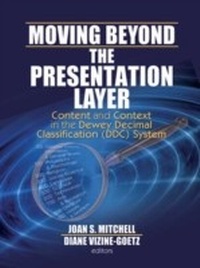
Moving Beyond the Presentation Layer
Content and Context in the Dewey Decimal Classification (DDC) System
1st Edition
Published on 13. May 2013
262 pages
978-1-136-45400-4 (ISBN)
Description

Can the Dewey Decimal System meet the needs of the rapidly changing information environment?
Moving Beyond the Presentation Layer explores the Dewey Decimal System from a variety of perspectives, each of which peels away a bit of the presentation layerthe familiar linear notational sequence-to reveal the content and context offered by the DDS. Library professionals from around the word examine how the content and context offered by the DDS can evolve to meet the needs of the changing information environment, with a special focus on the impact of the Internet on current and future developments.
Moving Beyond the Presentation Layer examines whether the Dewey Decimal System is a rigid structure best suited to a physical information environment or a polymorphic one that can be adapted to meet a variety of physical and virtual needs. This unique book reviews the 40-year history of the online use of classification systems, the development of the Relative Index over 22 editions of the DDC, recommendations to ensure the viability of the DDC in a time of mass digitization, using DDS in an environment where it hasn't been used before, teaching the DDS, special issues related to the use of the DDS in Europe, North America, and Africa, and the future of online classification.
Topics examined in Moving Beyond the Presentation Layer include:
using the DDC as the browsing mechanism for resource discovery
classification as an online cataloging tool
classification as an online end-user tool
browser behavior in a DDC-based Web service
the role of the DDS in the ongoing HILT (High-Level Thesaurus) project
using the DDS to organize Web resources
localization and interoperability in knowledge organization
mapping terminologies to classification systems
the DeweyBrowser
and much more
Moving Beyond the Presentation Layer is an essential professional resource for librarians, information scientists, computer scientists, and metadata and Web services specialists.
Moving Beyond the Presentation Layer explores the Dewey Decimal System from a variety of perspectives, each of which peels away a bit of the presentation layerthe familiar linear notational sequence-to reveal the content and context offered by the DDS. Library professionals from around the word examine how the content and context offered by the DDS can evolve to meet the needs of the changing information environment, with a special focus on the impact of the Internet on current and future developments.
Moving Beyond the Presentation Layer examines whether the Dewey Decimal System is a rigid structure best suited to a physical information environment or a polymorphic one that can be adapted to meet a variety of physical and virtual needs. This unique book reviews the 40-year history of the online use of classification systems, the development of the Relative Index over 22 editions of the DDC, recommendations to ensure the viability of the DDC in a time of mass digitization, using DDS in an environment where it hasn't been used before, teaching the DDS, special issues related to the use of the DDS in Europe, North America, and Africa, and the future of online classification.
Topics examined in Moving Beyond the Presentation Layer include:
using the DDC as the browsing mechanism for resource discovery
classification as an online cataloging tool
classification as an online end-user tool
browser behavior in a DDC-based Web service
the role of the DDS in the ongoing HILT (High-Level Thesaurus) project
using the DDS to organize Web resources
localization and interoperability in knowledge organization
mapping terminologies to classification systems
the DeweyBrowser
and much more
Moving Beyond the Presentation Layer is an essential professional resource for librarians, information scientists, computer scientists, and metadata and Web services specialists.
More details
Language
English
Place of publication
London
United Kingdom
Publishing group
Taylor & Francis Ltd
Target group
College/higher education
File size
4,25 MB
ISBN-13
978-1-136-45400-4 (9781136454004)
Copyright in bibliographic data and cover images is held by Nielsen Book Services Limited or by the publishers or by their respective licensors: all rights reserved.
Schweitzer Classification
Other editions
Additional editions
Joan S. Mitchell | Diane Vizine-Goetz
Moving Beyond the Presentation Layer
Content and Context in the Dewey Decimal Classification (DDC) System
Book
01/2007
Routledge
€133.69
Article not available at the moment
Joan S. Mitchell | Diane Vizine-Goetz
Moving Beyond the Presentation Layer
Content and Context in the Dewey Decimal Classification (DDC) System
Book
01/2007
1st Edition
Routledge
€57.13
Shipment within 10-20 days
Persons
Joan S. Mitchell, Diane Vizine-Goetz
Content
Part 1 CONTENT AND CONTEXT: AN INTRODUCTION; Chapter 1 Forty Years of Classification Online: Final Chapter or Future Unlimited?, Karen Markey; Chapter 2 The DDC Relative Index, Francis Miksa; Chapter 3 Teaching the Dewey Decimal Classification System, Arlene G. Taylor; Part 2 CONTENT AND CONTEXT: AN INTERNATIONAL PERSPECTIVE; Chapter 4 Classifying the Popular Music of Trinidad and Tobago, Lorraine M. Nero; Chapter 5 Dewey Decimal Classification (DDC) at the Swiss National Library, Patrice Landry; Chapter 6 DDC German- The Project, the Aims, the Methods: New Ideas for a Well-Established Traditional Classification System, Magda Heiner-Freiling; Part 3 CONTENT AND CONTEXT: A WEB PERSPECTIVE; Chapter 7 Users Browsing Behaviour in a DDC-Based Web Service: A Log Analysis, Traugott Koch, Koraljka Golub, Anders Ardoe; Chapter 8 HILT: A Pilot Terminology Mapping Service with a DDC Spine, Dennis M. Nicholson, Alan Dawson, Ali Shiri; Chapter 9 Resource Discovery in the Government of Canada Using the Dewey Decimal Classification, Deane Zeeman, Glenyss Turner; Chapter 10 DeweyBrowser, Diane Vizine-Goetz;
