

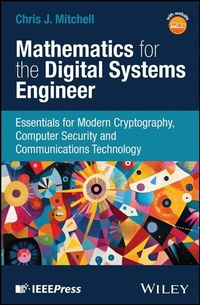
Mathematics for the Digital Systems Engineer
Description

Straightforward resource on the mathematics underpinning the AI/digital world
Mathematics for the Digital Systems Engineer shines a light on the mathematics behind modern cryptography and related areas of communications and security, building from the basics up to more complex mathematical concepts in as simple a way as possible. Every main chapter includes one or more case studies of the discussed mathematics applied to real-world digital technologies.
In Mathematics for the Digital Systems Engineer, readers will learn about:
- Abstract algebra, which looks at what happens when we think about some of the rules underpinning addition and multiplication of numbers, and apply these rules to operations on more general objects
- Number theory, which is concerned with establishing facts about the whole numbers we use every day, and has significant importance in our modern methods for data encryption in financial transactions
- Discrete mathematics, exploring the mathematics of discrete objects (such as the numbers one, two, and three) as opposed to the world of continuous functions, like the trigonometric functions sine or cosine
- Examples of how many "pure" forms of mathematics-those developed without applications in mind-are now, ironically, being used at the foundation of many modern technologies
Mathematics for the Digital Systems Engineer delivers essential mathematical grounding for engineers and computer scientists who find themselves working with and implementing modern information and communications technology, including cryptography and error control codes.
More details
Other editions
Additional editions
Person
Chris J. Mitchell received his PhD in Mathematics from Westfield College, University of London in 1979. He spent over 10 years in industrial research and development, then took up a chair in Computer Science at Royal Holloway in 1990, where he still works today, specializing in cryptography and information security.
Content
List of Figures xi
List of Tables xii
About the Author xiii
Preface: Why This Book? xv
Acknowledgements xix
Table of Abbreviations xxi
About the Companion Site xxiii
1 A Gentle Introduction 1
1.1 What Is This Book About? 1
1.2 Mathematics as Mathematicians See It 2
1.3 Theorems and Proofs 5
1.4 Abstract Algebra 8
1.5 What Do You Need to Know to Make Sense of This Book? 9
1.6 Case Studies of Applications 9
2 Sets, Functions and Relations 11
2.1 Why Are Sets Important? 11
2.2 Sets 12
2.3 Cartesian Products of Sets 17
2.4 Relations 17
2.5 Equivalence Relations and Equivalence Classes 18
2.6 Relations: A Detailed Example 21
2.7 Functions 24
2.8 Operations 26
3 Numbers as We Know and Love Them 29
3.1 Where Does Mathematics Start? 29
3.2 The Natural Numbers and the Integers 30
3.3 Writing Down Numbers 32
3.4 Ordering the Integers 33
3.5 Induction 35
3.6 The Division Theorem 38
3.7 Prime Numbers and Common Factors 40
3.8 Unique Factorisation 43
3.9 The Euclidean Algorithm 44
3.10 The Rationals 46
3.11 The Real and Complex Numbers 49
3.12 Applying Complex Numbers-An Everyday Example 50
4 Modular Arithmetic on the Integers 53
4.1 Working Relative to a Modulus 53
4.2 Congruences: Making It More Mathematical 54
4.3 Parity Checks: Using Modulo 2 Arithmetic 57
4.4 Check Digits: A More Complex Example 58
4.5 Elementary Properties of Zn 61
4.6 The Extended Euclidean Algorithm 64
4.7 Cryptography Ancient and Modern 66
4.8 RSA: How Does It Work? 69
4.9 Using RSA 72
4.10 Implementing RSA 75
4.11 RSA and the Future 78
4.12 Other Applications of Modular Arithmetic 79
5 Groups 81
5.1 What Is a Group? 81
5.2 A First Example: The Integers 83
5.3 A Second Example: Modular Addition 84
5.4 But What About Modular Multiplication? 86
5.5 Subgroups and Lagrange's Theorem 89
5.6 Proving Euler's Theorem 92
5.7 Examples of Non-abelian Groups 95
5.8 When Are Two Groups the Same Group? 100
5.9 Combining Groups 104
5.10 Discrete Logarithms 106
5.11 Diffie-Hellman Key Agreement 108
5.12 Other Applications of Discrete Logarithms 112
5.13 The Threat Posed by Quantum Computing 112
5.14 Other Applications of Groups 114
6 Rings and Fields 117
6.1 Two Operations, Not Just One! 117
6.2 So What Is a Ring? 118
6.3 Types of Rings 120
6.4 Combining Rings 122
6.5 Integral Domains-Some Key Properties 124
6.6 Unique Factorisation Domains-Key Properties 127
6.7 When Are Two Rings the Same Ring? 127
6.8 Fields 130
6.9 Coding Theory 135
7 Polynomials and Polynomial Rings 145
7.1 What Do I Mean by Polynomials? 145
7.2 Doing Arithmetic with Polynomials 149
7.3 Polynomials over a Field 151
7.4 Shift Register Sequences 154
7.5 Polynomial Arithmetic Modulo a Polynomial 168
8 Finite Fields 175
8.1 The Core of the Book 175
8.2 The Prime Fields 176
8.3 How Many Elements Might There Be? 176
8.4 Prime Power Fields 177
8.5 Uniqueness and Representation of Finite Fields 180
8.6 Elliptic Curve Cryptography 181
8.7 Quantum Computing-What Comes Next? 190
8.8 Other Applications of Finite Fields 192
9 Why Stop Now? 199
9.1 Some Edited Highlights 199
9.2 Sizes of Infinity 200
9.3 How Many Prime Numbers Are There? 204
9.4 Difference Sets, Sequences and Finite Geometry 206
9.5 Finite Simple Groups 215
Answers to Questions for the Reader 221
Further Reading 251
Index 257
Preface: Why This Book?
The good Christian should beware of mathematicians.1
Mathematics is what mathematicians do.2
Some are mathematicians; Some are carpenters' wives. Don't know how it all got started; I don't know what they're doin' with their lives.3
There are a vast number of books on mathematics, so why should you read this one? That is, of course, the million dollar question, which I will now try to answer. I should first say that I doubt that anything I say in this book has not been said many times before, and often in much greater detail. Indeed, in sketching historical and philosophical ideas relating to mathematics, I am very much aware that a huge amount could, and indeed has been, said already. If you find yourself interested in these topics, there are many excellent books on the history of mathematics, and also a host of discussions of a more philosophical nature on what mathematics is.
The main aim of this book is to provide a straightforward introduction to topics such as groups and finite fields to engineers and computer scientists who find themselves working with-and possibly implementing-some of the strange types of arithmetic involved. These arithmetics are fundamental to much modern information and communications technology.
Why is this book necessary? After all, there are plenty of excellent books that provide a grounding in mathematics for engineers and computer scientists. However, existing books cover what is commonly known as 'traditional' applied mathematics, that is very different to the topics that I cover in this book. While applied mathematics in the traditional sense is still of huge importance, modern digital systems increasingly build on very different types of mathematics, and these very different types of mathematics form the focus of this book.
I have attempted to make the book accessible to as large an audience as possible. I will provide some proofs (it wouldn't be a mathematics book without proofs) but if you like you can skip them, although I think it would be a shame to avoid them altogether since they are such an integral part of mathematics. More importantly, in all the main chapters after the introductory material I provide case studies of how the mathematics I introduce underlies key modern digital technologies, in particular focussing on those relating to secure and reliable communications.
A somewhat subsidiary aim of the book is to introduce the general reader to some of the fascinating mathematics underlying the modern digital and information-centric world. In doing so, I am hoping to give non-mathematicians a taste of what mathematics is really about, at least as mathematicians see it. I should say that I first wanted to write this book at least ten years ago, but finding the time has been the main obstacle.4 Perhaps the fact that I still wanted to write this book after all this time means that it was a good idea! Anyway, I leave that for you to decide.
It seems rather ironic, to me at least, that much of the mathematics I will attempt to describe in this book was not developed with applications in mind. Instead it was developed, and is still largely taught, very much under the banner of Pure, as opposed to Applied, mathematics where-historically at least-pure mathematics means mathematics done without worrying about applications. The key area I will explore comes under the heading of what might be called 'Abstract Algebra' (or 'Modern Algebra').
So why do I say that this seems ironic? Well, traditionally, and perhaps surprisingly, some pure mathematicians have been a little sniffy about applied mathematics, regarding it as a lower form. Pure mathematics, at least as some see it, is somehow superior precisely because it isn't related to applications but has been developed purely for its own sake. To some extent such a view seems nonsensical, since I suspect that the original roots of all of mathematics lie in applications, although in some cases mathematics has progressed a very long way from its origins. Of course mathematics is not unique; I suspect such views pervade other areas of human activity-for example, perhaps the art world is a little like this, where I get the impression that commercial art is sometimes thought of as being less worthy than fine art, or 'art for art's sake'.
Of course when I mention applied mathematics I mean mathematics applied to the physical sciences or to mechanical or electrical engineering. The term applied mathematics is often taken to mean just this, where other areas of mathematics which find real-world applications are not given the label. Anyway, while I'm sure not everyone would agree with this rather simple discussion of terminology, I hope it gives you a flavour of the rather strange way in which the terms pure and applied are used when referring to mathematics. My emphasis in this book is on mathematics which finds application in real-world systems relating to computing and communications, but is nonetheless often thought of as pure.
Anyway, back to algebra. The word algebra comes from the Arabic word al-jabr meaning 'the reunion of broken parts', used by the Persian mathematician and astronomer Muhammad ibn Musa al-Khwarizmi (in the 9th century CE) for naming a method of transforming equations. Interestingly, al-Khwarizmi also gives his name to the term algorithm, but that's a story for another book.
I suspect most readers will think of algebra as relating to manipulating and solving equations involving symbols which represent numbers. Of course, using symbols in equations to solve problems is a hugely powerful technique that you were very probably taught at school. So we all know what algebra is; but what about 'abstract' algebra? Abstract algebra, as I will discuss in a little more detail in the first chapter, seeks to look at what happens when we think about some of the rules underpinning addition and multiplication of numbers, and look at what happens when we apply these rules to operations on more general objects-which might be thought of as new types of numbers. The implications turn out to be profoundly important for the modern world.
At this point I should also mention another branch of mathematics known as Number theory.5 Number theory is concerned with establishing facts about the whole numbers we use every day. For example, you are probably familiar with the notion of a prime number-a classic concern of number theory is how many prime numbers are there? That is, how densely distributed are they as numbers get larger and larger? By the way, as is always the case when looking at different areas of mathematics, number theory and abstract algebra overlap-indeed, there is a branch of number theory known as algebraic number theory.
Until the second half of the twentieth century, number theory was thought of as the purest of pure mathematics. After all, what possible application could exist for investigating prime numbers, a subject of study by mathematicians for its own sake for at least two thousand years? Well, as I explore in this book, a hugely important method for encrypting data, which has been widely used in securing everyday financial transactions, is built on key results from number theory. So even number theory is not really 'pure' any more.
Another area of mathematics that forms a theme of this book is known as Discrete Mathematics. Discrete mathematics is the mathematics of discrete objects, such as the numbers 1, 2, 3, etc., as opposed to the world of continuous functions (such as the trigonometric functions sine or cosine). Why is discrete mathematics important here? Well, the numbers and objects processed by digital computers, including all the phones, tablets, PCs and servers we use on an everyday basis, are by definition discrete. These devices store and interchange information as zeros and ones, not as continuous values, and so it is inevitable that discrete mathematics is of key importance to the modern information age.
I have tried to give credit throughout this book to some of the great mathematicians of the past two or three thousand years who have developed the ideas I describe. However, I am a little ashamed to have to confess that the vast majority of the mathematicians I mention are men. There are many and varied reasons for this, not least because in many cultures women have been, and continue to be, denied access to mathematical education. More sinisterly, it seems that, as in many other walks of life, efforts have been made to hide contributions made by women, perhaps to try to maintain the fiction that women and mathematics do not go together.6 More happily, women today play a very prominent role in mathematics, including winning many major prizes; while the mathematical community cannot be complacent, my impression is that there is a reasonable balance of women versus men in mathematics undergraduate degree programmes, at least in the ones I am familiar with.
Finally, given my claim about the importance of the mathematical ideas introduced here to the digital world, I will provide examples of how they are used throughout the book. I have to confess I haven't chosen the applications I mention systematically-they simply happen to be the ones I know best. However, rest assured that there are many more that I don't discuss here.
Chris J. Mitchell
Wiltshire
August 2025
Notes
- 1 A widely quoted mistranslation of St Augustine of Hippo,...
