

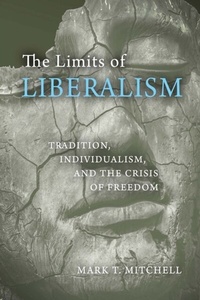
The Limits of Liberalism
Tradition, Individualism, and the Crisis of Freedom
1st Edition
Published on 30. November 2018
277 pages
978-0-268-10431-3 (ISBN)
Description

In The Limits of Liberalism, Mark T. Mitchell argues that a rejection of tradition is both philosophically incoherent and politically harmful.
The Limits of Liberalism identifies why most modern thinkers have denied the essential role of tradition and explains how tradition can be restored to its proper place. Mitchell demonstrates that the rejection of tradition as an epistemic necessity has produced a false conception of the human person-the liberal self-which in turn has produced a false conception of freedom. Together, these false conceptions have facilitated both liberal cosmopolitanism and identity politics.
Mitchell uses the philosophies of Michael Oakeshott, Alasdair MacIntyre, and Michael Polanyi to construct a compelling argument for a reconstructed view of tradition and, as a result, a reconstructed view of freedom. The Limits of Liberalism reveals that only by finding an alternative to the liberal self can we escape the incoherencies and pathologies inherent therein.
The Limits of Liberalism identifies why most modern thinkers have denied the essential role of tradition and explains how tradition can be restored to its proper place. Mitchell demonstrates that the rejection of tradition as an epistemic necessity has produced a false conception of the human person-the liberal self-which in turn has produced a false conception of freedom. Together, these false conceptions have facilitated both liberal cosmopolitanism and identity politics.
Mitchell uses the philosophies of Michael Oakeshott, Alasdair MacIntyre, and Michael Polanyi to construct a compelling argument for a reconstructed view of tradition and, as a result, a reconstructed view of freedom. The Limits of Liberalism reveals that only by finding an alternative to the liberal self can we escape the incoherencies and pathologies inherent therein.
Reviews / Votes
"As it stands,The Limits of Liberalism is a compelling and worthwhile contribution to the ongoing intellectual debate over the future of political life in the West-and it undoubtedly belongs on any philosophical conservative's reading list." -Patheos"Mitchell has written a deep and compelling account of the school of thought that defends tradition. It will long be a resource for conservatives and others who want to understand how tradition can represent an alternative to modern rationality that both recognizes objective truth and our personal rootedness, which paradoxically is what gives us the means to understand that truth." -The American Conservative
"In The Limits of Liberalism, Mitchell laments how liberalism facilitates the abandonment of place and tradition, in which the autonomous individual senses no obligation to her homeland or even her family, but rather is a citizen of the world committed to personal consumption and identity politics. . . . [Mitchell has] offered [a] forceful critique of liberalism." -Law & Liberty
"The book deserves to be read not only for its interesting meditations on the thinkers mentioned above but also because, like Deneen's [Why Liberalism Failed], it provocatively updates an important and perennial challenge to liberalism, thus providing a very liberal reason to read it!" -Choice
"Don't be fooled by the title: This book is a desperately needed defense of reason, science, and liberty against the competing irrationalisms of the Left and Right. Drawing on the rich arguments of neglected or marginalized thinkers like Michael Polanyi and Alasdair MacIntyre, Mitchell persuasively shows why care for tradition cannot be left to sentimentalists, but requires our highest philosophical, political, and human attention." -Nathan Schlueter, Hillsdale College
"Mitchell offers us a way out of the fierce and untenable position between an implausible cosmopolitanism and a dangerous tribalism-namely, humane localism. This is not only a superb work of scholarship, it is living political theory for the problems we face today." -Joshua Mitchell, Georgetown University
"Mark Mitchell traces the intellectual genealogy of the part of modernity that he classifies as 'liberal cosmopolitanism' and focuses on its rejection of tradition. The book's focus is to identify why modernity rejected tradition and how tradition can be restored to its proper place in human understanding. The book deals with a large historical and philosophical topic that will be discussed for generations." -Michael Federici, Middle Tennessee State University
"This is a very good book and a welcome voice in a time when, it seems, both reason and tradition are being relegated to the sidelines. The general argument of the book is presented with a kind of clarity that is rare in political theory. The argument of the book is complicated, but Mitchell makes it seem easy. His prose is clear, his argument always easy to follow. Mitchell's expertise is abundantly evident."-Richard Avramenko, University of Wisconsin-Madison
More details
Language
English
Place of publication
Notre Dame IN
United States
Target group
Professional and scholarly
ISBN-13
978-0-268-10431-3 (9780268104313)
Copyright in bibliographic data and cover images is held by Nielsen Book Services Limited or by the publishers or by their respective licensors: all rights reserved.
Schweitzer Classification
Other editions
Additional editions
Book
11/2018
University of Notre Dame Press
€65.50
Shipment within 10-20 days
Person
Mark T. Mitchell is the dean of academic affairs at Patrick Henry College and co-founder of Front Porch Republic. He is the author and co-editor of a number of books, including Plutocratic Socialism: The Future of Private Property and the Fate of the Middle Class.
Content
Introduction: Surveying the Landscape and Defining Terms
1. The Seventeenth-Century Denigration of Tradition and a Nineteenth-Century Response
2. Michael Oakeshott and the Epistemic Role of Tradition
3. Alasdair MacIntyre's Tradition-Constituted Inquiry
4. Michael Polanyi and Role of Tacit Knowledge
5. The Incoherence of Liberalism and the Response of Tradition
Afterward: A Conservatism Worth Conserving or Conservatism as Stewardship
Bibliography
1. The Seventeenth-Century Denigration of Tradition and a Nineteenth-Century Response
2. Michael Oakeshott and the Epistemic Role of Tradition
3. Alasdair MacIntyre's Tradition-Constituted Inquiry
4. Michael Polanyi and Role of Tacit Knowledge
5. The Incoherence of Liberalism and the Response of Tradition
Afterward: A Conservatism Worth Conserving or Conservatism as Stewardship
Bibliography
