

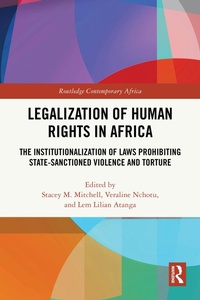
Legalization of Human Rights in Africa
The Institutionalization of Laws Prohibiting State-Sanctioned Violence and Torture
1st Edition
Published on 22. April 2025
280 pages
978-1-040-32770-8 (ISBN)
Description

Most countries on the African continent have ratified or acceded to several human rights treaties, including the Torture Convention and the African Charter on Human and People's Rights. This book assesses the progress African countries have made in institutionalizing human rights laws prohibiting torture, extrajudicial killings, and disappearances domestically.
States ratify human rights treaties for a variety of reasons. Some commentators defend an honest sincerity of purpose, whereas others might point to material incentives. The contributors to this volume go beyond the ratification puzzle to instead reframe legalization according to Lon Fuller's conceptualization of congruence. Congruence is an interactive variable that measures the continuous efforts of government and the public to shape the law and its implementation. By reframing legalization as an ongoing process, the model created by the authors is used to test several hypotheses about what impacts legalization in Africa more broadly, and in countries such as Mali, Cameroon, Botswana, Zimbabwe, and Tunisia, more specifically. The contributors to this volume demonstrate that the legalization of human rights is never a finished product, but is a moving target influenced by exogenous and endogenous phenomena.
This volume is useful for researchers of genocide, human rights, and atrocity prevention, as well as for those interested in legalization and democratization both within Africa and other regions of the world.
States ratify human rights treaties for a variety of reasons. Some commentators defend an honest sincerity of purpose, whereas others might point to material incentives. The contributors to this volume go beyond the ratification puzzle to instead reframe legalization according to Lon Fuller's conceptualization of congruence. Congruence is an interactive variable that measures the continuous efforts of government and the public to shape the law and its implementation. By reframing legalization as an ongoing process, the model created by the authors is used to test several hypotheses about what impacts legalization in Africa more broadly, and in countries such as Mali, Cameroon, Botswana, Zimbabwe, and Tunisia, more specifically. The contributors to this volume demonstrate that the legalization of human rights is never a finished product, but is a moving target influenced by exogenous and endogenous phenomena.
This volume is useful for researchers of genocide, human rights, and atrocity prevention, as well as for those interested in legalization and democratization both within Africa and other regions of the world.
Reviews / Votes
"Using cross country comparisons, this thought-provoking book captures the complexity of domestic legalization processes, offering new insights on the importance of civil society actors to lawmaking and law implementing processes. The book makes important contributions to the literature of human rights development in Africa and the legalization of human rights law in political science."Carrie Booth Walling, Professor of Political Science and Director of the Human Rights Program, University of Minnesota, USA
"This volume is a welcome addition to the growing scholarly literature on the challenges facing efforts to institutionalize human rights laws prohibiting state sanctioned violence in Africa. The editors, Stacey Mitchell, Veraline Nchotu and Lem Lilian Atanga, and the contributors to this analytically insightful and empirically grounded project critically examine the concept of legalization using Lon Fuller's criterion of congruence. Challenging traditional understandings of legalization in the IR literature, they argue that it should be understood as an interactive process which impacts and is impacted by those involved in the processes of domestic lawmaking and accountability. According to them, the real test in assessing the domestic legalization of human rights is "the extent to which lawmaking and accountability processes are fair and inclusive." Providing a more comprehensive understanding of the factors that enable and hinder the domestic legalization of international human rights laws has important implications for the work of scholars and practitioners focusing on violence prevention in a region in which several countries are at risk for mass atrocity crimes."
George Andreopoulos, Professor of Political Science and Criminal Justice, City University of New York, USA
More details
Series
Edition
1. Auflage
Language
English
Place of publication
London
United Kingdom
Publishing group
Taylor & Francis Ltd
Target group
College/higher education
Professional and scholarly
Illustrations
20 Tables, black and white; 13 Line drawings, black and white; 13 Illustrations, black and white
File size
2,51 MB
ISBN-13
978-1-040-32770-8 (9781040327708)
Copyright in bibliographic data and cover images is held by Nielsen Book Services Limited or by the publishers or by their respective licensors: all rights reserved.
Schweitzer Classification
Other editions
Additional editions
Stacey M. Mitchell | Veraline Nchotu | Lem Lilian Atanga
Legalization of Human Rights in Africa
The Institutionalization of Laws Prohibiting State-Sanctioned Violence and Torture
Book
06/2025
1st Edition
Routledge
€206.80
Shipment within 10-20 days
Persons
Stacey M. Mitchell is an Associate Professor at Georgia State University's Perimeter College, USA.
Veraline Nchotu is a Research Fellow at Northeastern Illinois University's Genocide and Human Rights Research in Africa and the Diaspora Center, USA.
Lem Lilian Atanga is Associate Professor, Centre for Gender and African Studies, University of Free State, Bloemfontein, South Africa
Veraline Nchotu is a Research Fellow at Northeastern Illinois University's Genocide and Human Rights Research in Africa and the Diaspora Center, USA.
Lem Lilian Atanga is Associate Professor, Centre for Gender and African Studies, University of Free State, Bloemfontein, South Africa
Content
Introduction to Legalization of Human Rights in Africa Part I: The Theory, The Model, And The International Regimes Regulating State-Sponsored Violence 1 What is legalization? 2 An integrative model for the assessment of legalization as congruence 3 The international legal framework for prohibitions against torture, disappearances, and political killings 4 The African human rights regim 5 The UN Charter-Based Processes and Evaluations of Africa's Conflicts and Human Rights Protections Part II: Continent-Wide Progress In The Legalization Of Prohibitions Against Torture, Disappearances And Killings 6 Taking the broad view 7 Do peace missions in Africa matter? 8 How foreign investment fuels social conflicts in Africa Part III: Case-Studies 9 Cameroon and human rights at a time of national crisis 10 The struggle for human rights in Guinea 11 Civil society and the struggle for human rights in Tunisia 12 Zimbabwe and a reassessment of Institutional Anomie Theory 13 The power of regional peripheries: The making and unmaking of the legalization of human rights in Mali 14 Human rights as a moving target in Botswana 15 Conclusions
